AI Agents For Medicare: Complete 2026 Guide To Intelligent Automation For Enrollment & Member Engagement

The Rise of AI Agents in Medicare Operations
The Medicare ecosystem is undergoing a fundamental transformation as AI agents for Medicare emerge as the cornerstone of operational efficiency, compliance, and member engagement. For managers and directors at Field Marketing Organizations (FMOs), health plan call centers, and marketing agencies, the pressure to deliver exceptional enrollment outcomes while maintaining strict HIPAA and CMS compliance has never been greater. During peak periods like the Annual Enrollment Period (AEP), organizations face unprecedented volume surges that strain traditional staffing models and threaten conversion rates.
AI agents represent a paradigm shift from reactive customer service to proactive, intelligent automation that operates 24/7 without sacrificing quality or compliance. 66% of physicians using health AI with 78% YoY growth, signaling widespread adoption across healthcare verticals. This comprehensive guide explores how AI agents for Medicare are transforming lead qualification, enrollment automation, member retention, and compliance management in 2026.
Understanding AI Agents for Medicare: Core Capabilities
AI agents for Medicare are sophisticated conversational AI systems specifically designed to handle the complex, multi-step interactions required throughout the Medicare enrollment lifecycle. Unlike basic chatbots or Interactive Voice Response (IVR) systems, modern AI agents for Medicare leverage natural language processing, machine learning, and integration capabilities to deliver human-like conversations while maintaining perfect compliance with regulatory frameworks.
Core Functions of Medicare AI Agents
These intelligent systems perform multiple critical functions simultaneously:
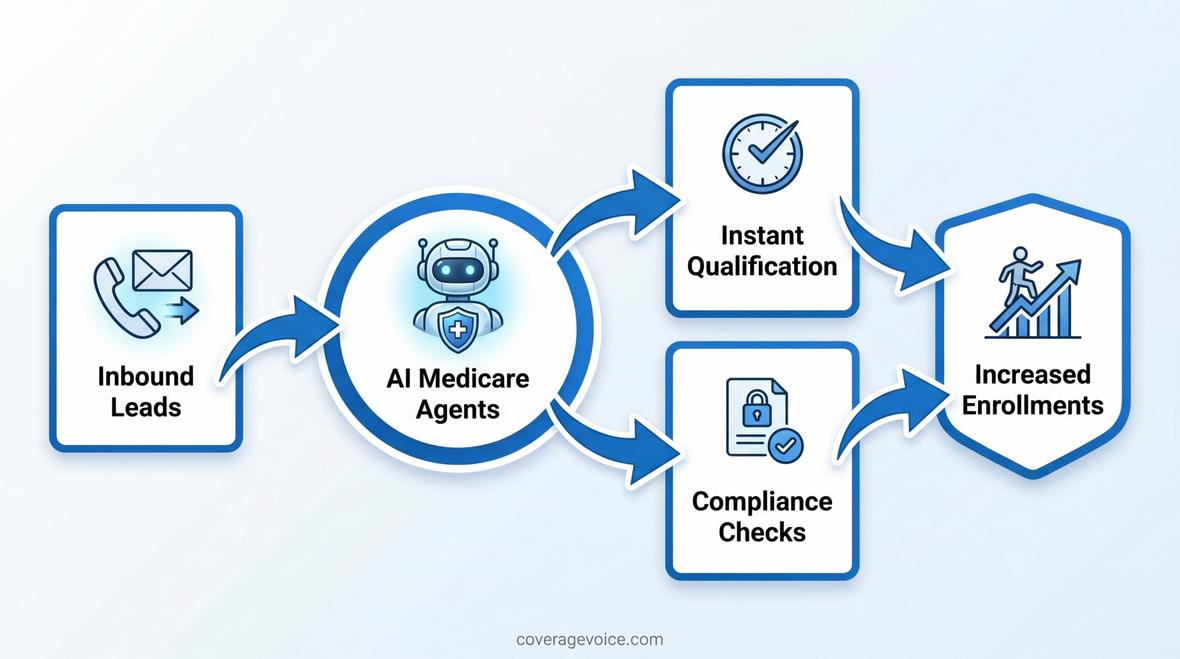
- Instant Lead Qualification: AI agents assess caller eligibility in real-time by gathering age, location, current coverage status, and special enrollment qualifications without human intervention.
- Compliance-First Conversations: Every interaction follows CMS and TCPA guidelines, with built-in consent management, do-not-call list integration, and automatic call recording for audit trails.
- Appointment Scheduling: Seamlessly book qualified prospects with licensed agents based on availability, specialization, and geographic territory.
- Benefit Explanation: Communicate plan details, coverage options, and premium information in plain language while adhering to marketing compliance requirements.
- Enrollment Automation: Guide beneficiaries through application completion, document collection, and submission workflows.
Regulatory Compliance Architecture
CMS vision for agentic AI tools in Medicare emphasizes that these technologies should augment rather than replace licensed agents for complex needs. AI agents for Medicare must incorporate multiple compliance layers including scope of appointment (SOA) management, state-specific regulation adherence, and real-time consent verification. Organizations implementing these systems gain audit-ready documentation that demonstrates compliance at scale.
Operational Benefits: Transforming Medicare Call Centers
The quantifiable impact of AI agents for Medicare on operational metrics demonstrates why adoption has accelerated across the industry. Organizations implementing intelligent automation report dramatic improvements across multiple performance indicators.
Cost Reduction and Efficiency Gains
Traditional Medicare call centers face escalating labor costs, particularly during AEP when temporary staffing requirements can triple operational expenses. AI agents eliminate these variable costs by handling unlimited concurrent conversations without quality degradation. A single AI agent can process qualification calls that would otherwise require 10-15 human agents, reducing per-lead costs by 60-70% while maintaining higher qualification accuracy.
According to Nearly half of US adults use health apps analyzed by AI, demonstrating consumer comfort with AI-driven healthcare interactions. This acceptance enables organizations to confidently deploy AI agents for high-volume, repetitive tasks while human agents focus on complex cases requiring licensed expertise.
Conversion Rate Optimization
Speed-to-lead remains the most critical factor in Medicare lead conversion. AI agents for Medicare eliminate response delays by engaging prospects within seconds of inquiry submission, regardless of time or day. Lead reactivation campaigns benefit particularly from this capability, as AI agents can systematically re-engage aged leads that human teams lack capacity to pursue.
Organizations report conversion rate improvements of 25-40% when implementing AI-powered instant response systems compared to traditional callback models. The combination of immediate engagement, consistent messaging, and perfect CRM integration ensures no opportunity falls through operational cracks.
Enrollment Automation: Streamlining the Member Journey
The enrollment process represents the most compliance-sensitive and operationally complex component of Medicare operations. AI agents for Medicare excel in this domain by providing structured workflows that ensure completeness while reducing administrative burden.
Application Completion and Document Management
Enrollment automation powered by AI agents guides beneficiaries through multi-step application processes with intelligent form completion assistance. These systems validate information in real-time, flag incomplete sections, and request required documentation through omnichannel touchpoints including SMS, email, and voice calls.
For organizations managing dual eligible LIS outreach, AI agents handle the additional complexity of coordinating Medicare and Medicaid enrollment requirements while ensuring proper subsidy application completion. This specialized capability addresses one of the most administratively intensive segments of Medicare enrollment.
AEP and OEP Volume Management
Understanding the distinction between AEP vs OEP Medicare enrollment is critical for resource planning. The Annual Enrollment Period creates predictable volume spikes that strain traditional staffing models. AEP OEP automation through AI agents provides infinite scalability without the recruitment, training, and compliance risks associated with temporary human staff.
Organizations can deploy AI agents to handle initial qualification and information gathering for 100% of inbound volume, then route only pre-qualified, enrollment-ready prospects to licensed agents. This tiered approach maximizes human agent productivity while ensuring comprehensive coverage of all inquiries.
Member Retention and Engagement Strategies
Acquisition costs in Medicare enrollment make retention economics critically important. AI agents for Medicare enable proactive retention programs that were previously cost-prohibitive at scale.
Proactive Retention Outreach
Member retention and renewals benefit from systematic AI-driven touchpoints throughout the policy year. AI agents conduct wellness check-ins, benefit utilization reviews, and renewal reminders that maintain member engagement and identify at-risk enrollees before disenrollment occurs.
Research shows that 39% of Gen Z and Millennials comfortable with genAI for symptoms, indicating generational comfort with AI health interactions extends beyond younger demographics when properly implemented. This acceptance enables organizations to deploy AI retention programs across diverse member populations.
New Member Onboarding
New member welcome calls delivered by AI agents ensure consistent, compliant orientation to plan benefits, provider network navigation, and utilization of preventive services. These structured touchpoints improve early engagement metrics that correlate with long-term retention and Star Ratings performance.
Compliance and Regulatory Frameworks
The regulatory environment surrounding Medicare marketing and enrollment demands technological solutions that embed compliance into every interaction. AI agents for Medicare provide this capability through programmatic enforcement of CMS and TCPA requirements.
CMS Marketing Guidelines
Medicare marketing compliance requires precise adherence to approved messaging, scope of appointment protocols, and documentation standards. AI agents eliminate the variability inherent in human conversations by delivering pre-approved scripts that adapt dynamically to caller circumstances while maintaining compliance boundaries.
Every AI agent interaction automatically generates compliance documentation including call recordings, consent timestamps, and disclosure delivery confirmation. This audit trail provides organizations with defensible evidence of regulatory adherence at scale.
TCPA and Consent Management
Understanding TCPA compliance Medicare voice AI requirements is essential for outbound campaigns. AI agents integrate with do-not-call registries, maintain organization-specific suppression lists, and secure express written consent before initiating outbound calls. This systematic approach eliminates the compliance risks associated with manual list management and agent training variability.
Technology Integration and Implementation
Successful deployment of AI agents for Medicare requires seamless integration with existing technology infrastructure including CRM systems, telephony platforms, and enrollment processing systems.
CRM and Data Management
Modern Medicare CRM systems provide the data foundation for AI agent personalization and workflow automation. Integration enables AI agents to access caller history, previous interactions, and enrollment status in real-time, delivering contextually relevant conversations that improve member experience.
Organizations benefit from unified data models that capture AI agent interactions alongside human agent activities, providing comprehensive analytics on conversion funnels, common objections, and optimization opportunities.
Omnichannel Member Engagement
Omnichannel client intake represents the evolution beyond voice-only AI agents. Modern systems coordinate conversations across phone, SMS, web chat, and email to meet members on their preferred channels. This flexibility particularly benefits diverse Medicare populations with varying technology comfort levels and communication preferences.
Vendor Evaluation and Selection Criteria
The AI agent marketplace includes numerous vendors with varying capabilities, compliance features, and Medicare specialization. Organizations must evaluate solutions against specific criteria relevant to Medicare operations.
Medicare-Specific Functionality
Generic conversational AI platforms lack the specialized knowledge required for Medicare enrollment conversations. Organizations should prioritize vendors offering pre-built Medicare workflows, integrated compliance libraries, and demonstrated CMS audit experience. Comparing solutions like Rivvi vs CoverageVoice or CareCycle vs CoverageVoice reveals significant differences in Medicare-specific capabilities.
Build vs Buy Decision Framework
Organizations face a critical decision between building custom AI solutions or implementing commercial platforms. The Medicare voice AI build buy cost analysis typically favors commercial solutions given the specialized compliance requirements, ongoing maintenance needs, and rapid evolution of AI capabilities. Building custom solutions requires dedicated AI engineering teams, compliance expertise, and continuous model training investments that exceed the total cost of commercial platforms for most organizations.
Implementation Roadmap and Best Practices
Successful deployment of AI agents for Medicare follows a structured implementation approach that minimizes disruption while accelerating time-to-value.
Phased Deployment Strategy
Organizations should begin with clearly defined use cases that deliver immediate value while building organizational confidence in AI capabilities. Common starting points include virtual receptionist functionality for call routing, pre-screening for lead qualification, or after-hour AI agent coverage for extending service availability.
This phased approach allows teams to validate AI performance, refine conversation flows, and establish success metrics before expanding to more complex workflows like full enrollment automation or member retention campaigns.
Training and Change Management
Human agent teams require training on how to collaborate effectively with AI colleagues. This includes understanding when AI agents will transfer conversations, how to access AI-gathered information, and how to provide feedback for continuous improvement. Organizations that invest in change management see faster adoption and better outcomes than those treating AI implementation as purely technical projects.
Performance Metrics and ROI Measurement
Quantifying the business impact of AI agents for Medicare requires comprehensive measurement across operational, financial, and compliance dimensions.
Key Performance Indicators
Organizations should track metrics including:
- Contact Rate: Percentage of leads reached within target timeframes
- Qualification Rate: Proportion of contacts meeting enrollment eligibility criteria
- Conversion Rate: Qualified leads progressing to completed enrollments
- Cost Per Enrollment: Total acquisition cost including AI platform fees and human agent time
- Average Handle Time: Duration of AI agent interactions compared to human baselines
- Member Satisfaction: Post-interaction surveys measuring experience quality
- Compliance Adherence: Audit findings and regulatory violation rates
ROI Calculation Framework
The Medicare voice AI ROI calculator methodology compares total implementation and operational costs against measurable benefits including labor cost reduction, conversion rate improvement, retention rate increases, and compliance risk mitigation. Organizations typically achieve positive ROI within 3-6 months of deployment when targeting high-volume use cases.
Future Trends and Innovation
The trajectory of AI agents for Medicare points toward increasingly sophisticated capabilities that blur the distinction between human and AI interactions.
Agentic AI and Autonomous Decision-Making
According to AI agents proliferating in healthcare for billing and patient queries, systems like Epic's 'Penny' and 'Emmie' demonstrate the evolution toward AI agents capable of independent action within defined parameters. Medicare applications will increasingly include autonomous enrollment completion, proactive plan recommendation, and predictive member retention interventions.
Predictive Analytics Integration
Next-generation AI agents will leverage predictive models to identify high-value prospects, forecast disenrollment risk, and optimize outreach timing. Integration with claims data, utilization patterns, and social determinants of health will enable hyper-personalized member engagement that improves both business outcomes and health equity.
Industry-Specific Applications
Different Medicare ecosystem participants benefit from tailored AI agent deployments aligned with their operational models.
Field Marketing Organizations
Medicare brokers and FMOs leverage AI agents to scale agent recruitment support, provide 24/7 lead distribution, and ensure consistent compliance across distributed agent networks. Medicare FMO automation enables these organizations to support larger agent networks without proportional increases in back-office staff.
Medicare Advantage Plans
Payers MA plans member engagement initiatives utilize AI agents for member services, benefits explanation, provider search assistance, and preventive care outreach. These applications directly impact Star Ratings performance by improving access to care and member satisfaction metrics.
Marketing Agencies
Marketing agencies serving Medicare clients deploy AI agents for PPC ad follow-up, ensuring immediate response to paid search traffic and maximizing return on advertising spend. Integration with campaign tracking enables attribution analysis and continuous optimization of acquisition channels.
Real-World Implementation Results
Organizations across the Medicare ecosystem report transformative outcomes from AI agent deployment.
Call Center Volume Management
A case study detailed in Medicare voice AI replaces 45 agents demonstrates how one organization eliminated seasonal staffing challenges while improving response times from average 8 minutes to under 30 seconds. This transformation reduced abandonment rates by 73% while cutting operational costs by $680,000 annually.
Resolution Time Optimization
Another implementation showcased in Medicare voice AI cuts resolution 30x achieved dramatic efficiency improvements by automating routine inquiries including eligibility verification, benefits explanation, and appointment scheduling. Human agents redirected freed capacity toward complex cases requiring licensed expertise, improving both efficiency and job satisfaction.
Frequently Asked Questions
What is the typical cost of implementing AI agents for Medicare?
Implementation costs vary based on call volume, feature requirements, and integration complexity. Most organizations pay between $0.05-$0.15 per minute of AI agent conversation time, with monthly platform fees ranging from $500-$5,000 depending on scale. This compares favorably to human agent costs of $2-$4 per minute when including fully loaded labor costs.
Are AI agents for Medicare CMS compliant?
Purpose-built Medicare AI agents incorporate CMS compliance requirements including scope of appointment management, approved messaging libraries, and documentation standards. Organizations maintain responsibility for ensuring their specific implementation adheres to current regulations, making vendor selection critical.
Will AI agents replace human Medicare agents?
AI agents augment rather than replace licensed human agents. They handle high-volume, routine interactions like qualification, appointment scheduling, and information delivery, while complex cases requiring licensed expertise transfer to human agents. This division of labor improves efficiency for both AI and human team members.
How long does AI agent implementation take?
Organizations typically complete initial deployment in 4-8 weeks, including workflow configuration, integration development, compliance review, and user acceptance testing. Ongoing optimization continues as teams refine conversation flows based on performance data.
Can AI agents handle multiple languages for Medicare enrollment?
Modern AI agents support multilingual conversations including Spanish, Mandarin, Vietnamese, and other languages common among Medicare beneficiaries. This capability addresses language access requirements while reducing the need for specialized bilingual human agent teams.
Conclusion
AI agents for Medicare represent a fundamental evolution in how organizations approach enrollment, member engagement, and operational efficiency. For managers and directors responsible for lead generation and enrollment outcomes, these intelligent systems deliver measurable improvements in conversion rates, cost efficiency, and compliance adherence. The convergence of AI maturity, regulatory acceptance, and proven implementation models makes 2026 the inflection point for widespread adoption across FMOs, health plans, and marketing agencies. Organizations that strategically deploy AI agents gain competitive advantages in member acquisition and retention while building scalable infrastructure for future growth. Evaluate your current operational challenges, identify high-impact use cases, and begin the implementation journey to transform your Medicare operations with intelligent automation.
Ready to Transform Your Medicare Enrollment Process?
See how Coverage Voice AI can help you automate Medicare enrollment.