AI Auto Dialer: Complete Guide For Medicare Call Centers In 2026

Understanding AI Auto Dialers for Medicare Organizations
An AI auto dialer represents a transformative technology for Medicare insurance organizations, combining artificial intelligence with automated calling systems to streamline outreach, enrollment, and member engagement. Unlike traditional auto dialers that simply connect calls, AI-powered systems analyze conversations in real-time, ensure compliance with CMS regulations, and adapt their approach based on member responses. For Medicare brokers, FMOs, and health plan call centers managing thousands of beneficiary interactions during peak periods, this technology has become essential infrastructure.
The Medicare insurance landscape demands unprecedented efficiency and compliance. With Medicare Advantage payments 14% higher than traditional Medicare in 2026 equating to $76 billion according to MedPAC the financial stakes for successful enrollment and retention have never been greater. Traditional call center operations struggle to meet these demands while maintaining the strict regulatory standards required by CMS, making AI auto dialers not just an operational upgrade but a strategic necessity.
The technology leverages machine learning algorithms to prioritize leads, personalize conversations, and ensure every interaction complies with HIPAA and TCPA requirements. For organizations managing AEP and OEP automation, this means dramatically reducing operational costs while improving conversion rates and member satisfaction simultaneously.
Compliance-First AI Auto Dialing for Medicare Marketing
Regulatory compliance represents the most critical consideration for any Medicare organization implementing an AI auto dialer. CMS maintains strict marketing guidelines that govern how, when, and what can be communicated to Medicare beneficiaries. A single compliance violation can result in significant penalties, suspension of marketing privileges, or damage to Star Ratings that directly impact reimbursement rates.
Modern AI auto dialers address these challenges through built-in compliance features. According to industry analysis, AI enables 100% call monitoring for CMS compliance, automating compliance review by analyzing every call, flagging potential risks, and ensuring alignment with CMS regulations for Medicare Advantage marketing during AEP. This represents a quantum leap beyond traditional quality assurance methods that could only sample a fraction of total call volume.
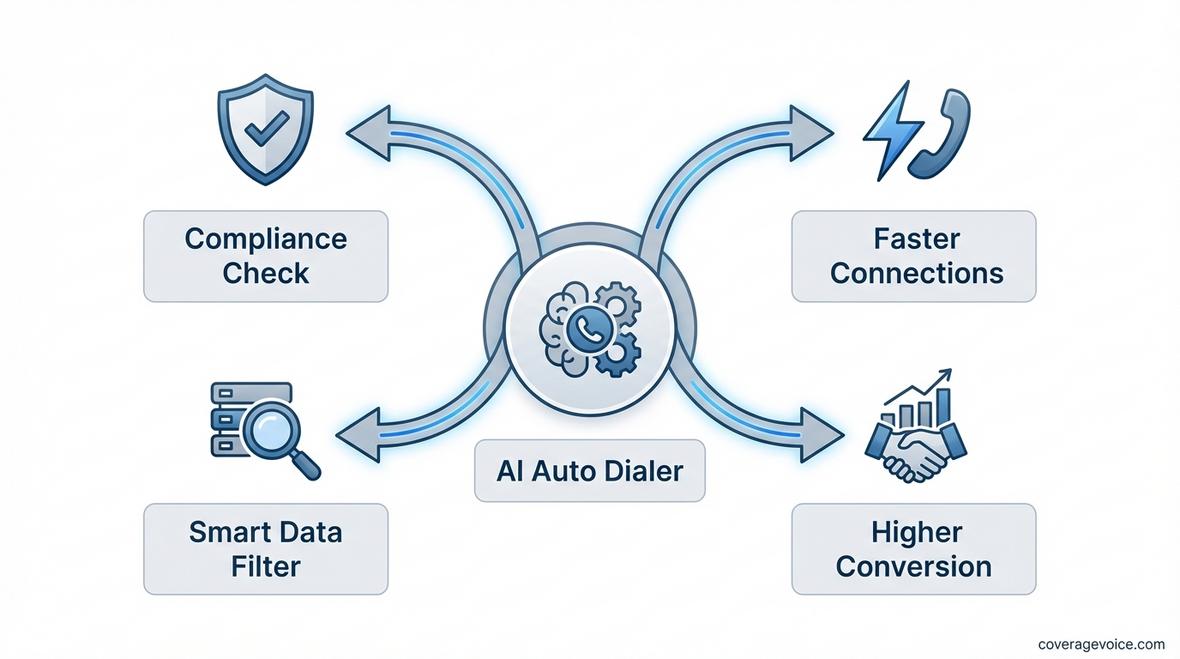
The technology monitors conversations for prohibited language, ensures required disclosures are delivered correctly, and verifies that agents follow approved scripts. For Medicare brokers and FMOs, this comprehensive monitoring eliminates the compliance blind spots that previously represented significant organizational risk. The system can automatically pause campaigns if compliance thresholds are breached and generate detailed audit trails for regulatory review.
Interestingly, research from the Kansas Legislative Research Department indicates that 68% of insurers use AI for prior authorization approvals, with companies selling individual major medical health insurance reporting they are currently using or exploring AI and machine learning for prior authorization processes. This widespread adoption across the healthcare insurance sector demonstrates the industry's confidence in AI's ability to manage complex regulatory requirements.
TCPA Consent Management and Call Time Restrictions
Beyond CMS-specific regulations, Medicare organizations must navigate TCPA requirements governing automated calls and text messages. An effective AI auto dialer integrates comprehensive consent management, tracking express written consent for each beneficiary and automatically suppressing contacts who have withdrawn permission. The system maintains detailed records of consent source, date, and type critical documentation in the event of regulatory inquiry.
Call time restrictions represent another compliance dimension that AI systems handle automatically. The technology respects state-specific quiet hours, time zone differences, and individual beneficiary preferences regarding contact timing. For organizations with Medicare call centers operating across multiple states, this automated compliance management prevents costly violations while maximizing productive calling hours.
Operational Efficiency and Conversion Rate Optimization
The business case for AI auto dialers extends far beyond compliance management. Medicare organizations face intense pressure to reduce cost per enrollment while improving conversion rates in an increasingly competitive marketplace. Traditional call center operations require significant staffing investments, extensive training programs, and ongoing quality management all while struggling with agent turnover rates that often exceed 30% annually.
AI auto dialers address these challenges through multiple efficiency mechanisms. The technology eliminates unproductive dialing time by automatically screening for disconnected numbers, voicemail systems, and unresponsive contacts. Advanced systems can detect answer machine messages within the first second of connection, allowing immediate progression to the next contact without wasting agent time. This 'intelligent call progression' typically increases agent talk time by 200-300% compared to manual dialing operations.
Lead prioritization represents another critical efficiency gain. The AI system analyzes historical data to score leads based on conversion probability, ensuring agents spend their time with the most promising prospects. For marketing agencies managing Medicare campaigns, this intelligent routing can improve conversion rates by 40-60% while simultaneously reducing cost per acquisition.
Personalization at Scale Through AI Analysis
Modern beneficiaries expect personalized interactions that acknowledge their specific circumstances, health conditions, and coverage needs. An AI auto dialer enables this personalization at scale by analyzing CRM data, previous interactions, and behavioral signals before each contact. The system can surface relevant talking points, recommend specific plan options, and even adjust conversation pace based on beneficiary engagement cues.
This personalization extends to multichannel coordination. The AI system tracks beneficiary interactions across phone, email, SMS, and web channels, ensuring consistent messaging and preventing redundant outreach. For organizations focused on member retention and renewals, this unified view of member engagement dramatically improves relationship continuity and satisfaction scores.
AEP Automation and Peak Period Performance
The Annual Enrollment Period represents the most critical and challenging timeframe for Medicare organizations. During this compressed seven-week window, call centers must handle 5-10x normal call volumes while maintaining compliance standards and conversion quality. Traditional staffing models struggle with this volatility, requiring expensive temporary hiring, accelerated training programs, and inevitable quality compromises.
AI auto dialers provide a fundamentally different approach to AEP scaling. The technology enables organizations to handle dramatically increased outreach volumes without proportional staffing increases. A system that would require 50 agents using traditional methods might need only 15-20 agents when supported by intelligent AI automation. This operational leverage transforms AEP economics, allowing organizations to maintain profitability even with aggressive enrollment targets.
The technology also addresses AEP-specific compliance challenges. During peak periods, manual compliance monitoring becomes nearly impossible, creating significant regulatory exposure. AI systems maintain 100% monitoring coverage regardless of call volume, ensuring every interaction meets CMS standards even during the most hectic periods. For FMOs managing multiple carrier relationships, this consistent compliance provides critical protection for the entire distribution network.
After-Hours and Weekend Coverage Without Staffing Costs
Beneficiary preferences increasingly favor evening and weekend contact opportunities when they have time for extended plan discussions. Traditional call centers face prohibitive costs for extended-hours coverage, requiring premium pay rates and supervisory staffing for limited call volumes. AI auto dialers with after-hours capabilities eliminate this constraint entirely.
The technology operates continuously without fatigue, salary costs, or quality degradation. Organizations can extend calling hours from standard 9-5 operations to 8am-9pm seven-day coverage without proportional cost increases. This expanded availability typically increases contact rates by 30-50% while improving beneficiary satisfaction through greater scheduling flexibility.
Integration Ecosystem and Data Management
An effective AI auto dialer functions as part of a broader technology ecosystem rather than as a standalone tool. Modern Medicare operations rely on CRM systems, enrollment platforms, carrier portals, and analytics tools that must work in concert to support efficient operations. The dialer's ability to integrate seamlessly with these existing systems determines its practical value.
Leading AI dialer platforms offer pre-built integrations with major Medicare CRM systems, enabling automatic data synchronization, real-time status updates, and unified reporting. When an agent completes a call, the system automatically logs the interaction, updates lead status, schedules follow-up activities, and triggers appropriate workflow automation. This integration eliminates double data entry, reduces errors, and ensures all systems reflect current beneficiary status.
The technology also supports advanced analytics that inform strategic decision-making. Organizations gain visibility into call outcomes by lead source, agent performance metrics, conversion funnel analytics, and compliance trending. For marketing agencies optimizing Medicare campaigns, these insights enable continuous improvement in targeting, messaging, and resource allocation.
AI Learning and Continuous Improvement
Unlike static auto dialers that operate with fixed rules, AI systems continuously learn from outcomes and optimize their performance over time. The technology analyzes which contact strategies produce the best results, which talking points resonate with different beneficiary segments, and which times yield highest connection rates. This machine learning capability means the system becomes progressively more effective with continued use.
Organizations implementing AI auto dialers typically observe a 'performance curve' where results improve significantly during the first 3-6 months as the system accumulates data and refines its algorithms. This learning extends to compliance as well, with the AI identifying subtle patterns that indicate potential regulatory risk before violations occur.
Cost Analysis and ROI Considerations
Medicare organizations evaluating AI auto dialers must understand both direct costs and comprehensive ROI implications. Platform pricing typically follows a per-agent or per-minute model, with monthly costs ranging from $150-500 per concurrent user depending on feature sophistication and integration requirements. This represents a fraction of traditional agent employment costs when considering salary, benefits, training, and infrastructure expenses.
The ROI calculation extends beyond simple cost replacement. Organizations should evaluate cost per contact, cost per qualified lead, cost per enrollment, and lifetime value per member acquired through AI-supported channels. Many Medicare operations report 40-60% reductions in cost per enrollment when implementing AI dialers, primarily through improved agent productivity and higher conversion rates.
A comprehensive implementation approach for Medicare voice AI enrollment considers both technology costs and change management investments. Successful deployments require agent training, process redesign, and ongoing optimization investments that pay dividends through sustained performance improvements. Organizations should plan for a 3-6 month implementation timeline to realize full benefits.
Vendor Selection and Implementation Strategy
The Medicare-focused AI auto dialer market includes both general-purpose platforms adapted for healthcare and purpose-built solutions designed specifically for insurance operations. Organizations should prioritize vendors demonstrating deep Medicare domain expertise, proven CMS compliance capabilities, and existing customer references within the insurance ecosystem.
Key evaluation criteria include compliance features, integration capabilities, scalability for AEP periods, reporting functionality, and vendor support quality. Medicare-specific requirements like Star Ratings impact, dual-eligible outreach capabilities, and LIS coordination separate specialized vendors from generic dialer platforms.
Implementation strategy should emphasize phased rollout rather than wholesale replacement of existing operations. Leading organizations typically begin with a pilot program focused on a specific use case such as lead reactivation or appointment setting before expanding to full enrollment operations. This approach allows teams to develop expertise, refine processes, and demonstrate value before committing to broader organizational change.
Change Management and Agent Adoption
Technology implementation success depends heavily on agent adoption and effective change management. Many call center agents initially view AI systems with skepticism, concerned about job security or increased monitoring. Forward-thinking organizations position the technology as an agent empowerment tool that eliminates tedious manual dialing and allows focus on high-value beneficiary interactions.
Training programs should emphasize how the AI auto dialer handles compliance monitoring, lead prioritization, and administrative tasks freeing agents to deliver better member experiences. Organizations that successfully navigate this transition typically see improved agent satisfaction alongside operational metrics, as team members appreciate the reduced administrative burden and increased focus on meaningful beneficiary interactions.
Future Trends and Emerging Capabilities
The AI auto dialer landscape continues evolving rapidly as natural language processing, sentiment analysis, and predictive analytics capabilities advance. Emerging features include real-time conversation guidance that coaches agents during calls, emotional intelligence detection that identifies beneficiary concerns requiring empathy, and predictive churn modeling that enables proactive retention outreach.
Regulatory developments will also shape the technology's evolution. CMS has issued requests for information regarding AI and machine learning applications in Medicare operations, with a specific CMS RFI for AI call center automation in Medicare seeking solutions for Medicare modernization, including call center automation, conversational AI support, and predictive analytics for beneficiary engagement. This regulatory interest suggests increasing acceptance of AI tools within the Medicare ecosystem, provided they demonstrate compliance and beneficiary protection.
Organizations should also monitor ongoing discussions about AI transparency and fairness in healthcare. Research from the USC Schaeffer Center indicates that AI-aided prior authorization leads to higher denial rates, with evidence suggesting AI-aided prior authorization results in higher denial rates and larger reductions in healthcare use compared to non-AI decisions in Medicare Advantage. While this research focuses on clinical applications rather than marketing automation, it highlights the importance of algorithmic accountability and bias testing in Medicare AI implementations.
Frequently Asked Questions
How does an AI auto dialer differ from a traditional predictive dialer?
Traditional predictive dialers use statistical algorithms to predict agent availability and dial multiple numbers simultaneously, connecting answered calls to available agents. AI auto dialers incorporate machine learning to analyze conversation content, ensure compliance, personalize interactions, and continuously optimize performance based on outcomes. The AI system understands context rather than simply managing call flow.
Can AI auto dialers maintain CMS compliance during Medicare marketing?
Yes, modern AI auto dialers designed for Medicare operations include comprehensive compliance features that monitor 100% of calls for prohibited language, required disclosures, and adherence to approved scripts. These systems provide superior compliance coverage compared to manual quality assurance methods that can only sample a small percentage of total interactions.
What is the typical implementation timeline for a Medicare AI auto dialer?
Most organizations require 6-12 weeks for initial implementation, including system integration, agent training, and pilot testing. Full optimization typically occurs over 3-6 months as the AI system accumulates data and refines its algorithms. Organizations planning for AEP should begin implementation at least 90 days before the enrollment period begins.
How do AI auto dialers impact agent productivity metrics?
Organizations typically observe 200-300% increases in agent talk time as the AI system eliminates manual dialing, voicemail screening, and unproductive contacts. Conversion rates often improve by 40-60% through intelligent lead prioritization and personalization capabilities. Cost per enrollment frequently decreases by 40-60% when accounting for all efficiency gains.
What integration capabilities should I prioritize when selecting an AI auto dialer?
Prioritize pre-built integrations with your existing CRM system, enrollment platforms, and carrier portals. Real-time data synchronization, automated activity logging, and unified reporting capabilities determine whether the dialer enhances your workflow or creates additional administrative burden. Medicare-specific integrations for Star Ratings impact and compliance reporting provide additional value.
Conclusion
The AI auto dialer represents essential infrastructure for Medicare organizations navigating the complex demands of modern enrollment and member engagement operations. By combining intelligent automation with comprehensive compliance monitoring and continuous learning capabilities, these systems enable dramatic improvements in operational efficiency, conversion rates, and regulatory adherence. Organizations that successfully implement AI dialing technology gain sustainable competitive advantages through reduced costs, improved member experiences, and scalable operations that perform consistently during peak enrollment periods. As the Medicare landscape continues evolving toward value-based care models and increasingly sophisticated beneficiary expectations, AI-powered automation will transition from competitive differentiator to operational necessity for organizations committed to growth and excellence.
Ready to Transform Your Medicare Enrollment Process?
See how Coverage Voice AI can help you automate Medicare enrollment.