AI Call Agent For Medicare: Transform Lead Qualification & Enrollment In 2026

Understanding AI Call Agents in the Medicare Ecosystem
The Medicare insurance landscape is experiencing a technological revolution, with AI call agents emerging as critical infrastructure for organizations handling enrollment, lead qualification, and member engagement. As over 50% of Medicare beneficiaries enrolled in Medicare Advantage, the volume and complexity of member interactions have reached unprecedented levels. An ai call agent represents more than simple automation it's an intelligent, HIPAA-compliant system designed specifically for the Medicare industry's unique regulatory and operational requirements.
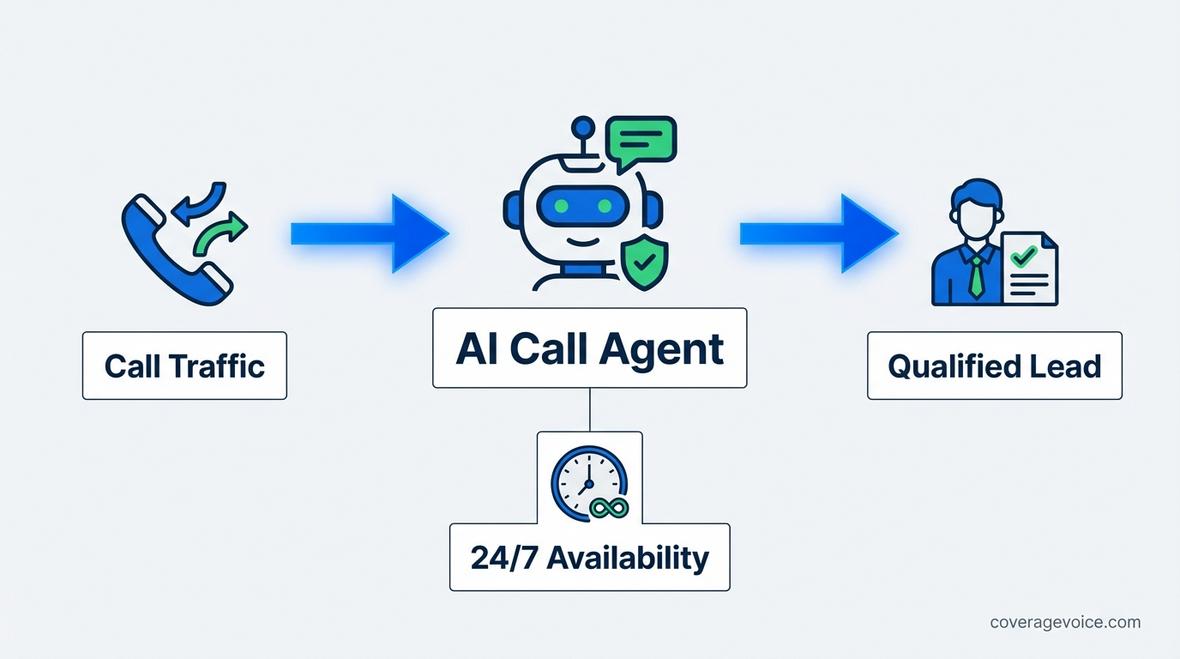
Unlike generic chatbots or basic IVR systems, modern AI call agents leverage natural language processing, contextual understanding, and real-time data integration to conduct meaningful conversations with beneficiaries. For Medicare call centers, FMOs, and marketing agencies, these systems provide 24/7 availability without the scaling challenges of traditional staffing models. The technology addresses the fundamental tension between operational efficiency and compliance adherence that defines the Medicare sector.
Organizations implementing medicare call center solutions powered by AI are discovering that these systems can handle everything from initial lead screening to appointment scheduling, benefits verification, and post-enrollment follow-up. The result is a dramatic reduction in cost-per-enrollment while simultaneously improving conversion rates and member satisfaction scores.
Compliance and Regulatory Framework for Medicare AI Call Agents
The regulatory environment surrounding Medicare communications is exceptionally stringent, and any AI call agent deployed in this space must meet comprehensive compliance standards. The Centers for Medicare & Medicaid Services (CMS) maintains rigorous oversight of all member-facing communications, particularly during the Annual Enrollment Period (AEP) when enrollment activities intensify dramatically.
According to recent regulatory developments, CMS Final Rule allows AI in Medicare Advantage coverage determinations, provided that physician review occurs for medical necessity assessments. This policy shift represents a significant endorsement of AI technology within Medicare operations, while maintaining appropriate clinical oversight.
HIPAA compliance forms the foundation of any Medicare ai call agent implementation. Protected Health Information (PHI) must be encrypted both in transit and at rest, with access controls, audit logs, and breach notification protocols meeting federal standards. Additionally, medicare marketing compliance requirements mandate specific disclosures, recording protocols, and documentation standards for all member interactions.
TCPA (Telephone Consumer Protection Act) compliance represents another critical consideration. AI systems must maintain comprehensive do-not-call lists, respect calling time restrictions, and ensure proper consent mechanisms are in place before initiating outbound communications. Organizations can explore TCPA compliance strategies to ensure their AI implementations meet legal standards.
CMS Marketing Guidelines for AI Systems
The CMS Marketing Guidelines establish specific requirements for Medicare Advantage and Part D plan marketing, and these apply equally to AI-driven communications. Key requirements include:
- Scope of Appointment (SOA): AI systems must verify that proper SOA documentation exists before discussing specific plan details
- Required Disclosures: Certain statements about plan availability, coverage limitations, and enrollment rights must be communicated verbatim
- Recording Requirements: All enrollment-related calls must be recorded and retained for compliance review
- Verification Protocols: Identity verification and beneficiary eligibility must be confirmed through standardized processes
Research indicates that AI enables 100% call monitoring for CMS compliance without staff scaling, providing organizations with comprehensive oversight capabilities that would be cost-prohibitive with manual review processes. This automated compliance monitoring represents one of the most compelling value propositions for AI call agent adoption in the Medicare sector.
Operational Benefits of AI Call Agents for Medicare Organizations
The operational advantages of implementing an ai call agent extend across multiple dimensions of Medicare business operations. Organizations are experiencing transformation in lead management, enrollment efficiency, member retention, and cost structures.
Lead Qualification and Conversion Optimization
Traditional lead qualification processes involve significant manual effort, with agents spending substantial time on unqualified prospects. An AI call agent can instantly assess lead quality by verifying eligibility criteria, confirming age requirements, validating geographic coverage areas, and identifying beneficiary needs. This pre-screening capability ensures that human agents focus exclusively on high-value, qualified prospects.
The impact on conversion rates is substantial. By engaging leads immediately often within seconds of form submission AI systems capitalize on peak interest moments when beneficiaries are actively seeking information. This immediacy, combined with consistent messaging and comprehensive product knowledge, drives conversion improvements that typically range from 30-50% compared to traditional follow-up methods.
Scalability During AEP and OEP
The Annual Enrollment Period presents unique operational challenges, with call volumes often increasing 300-500% compared to baseline periods. Traditional staffing models require extensive seasonal hiring, training investments, and infrastructure expansion all of which introduce quality control challenges and significant costs.
An ai call agent provides elastic scalability, handling unlimited concurrent conversations without degradation in quality or response time. Organizations leveraging AEP and OEP automation can maintain consistent service levels throughout peak periods while avoiding the recruitment, training, and management costs associated with temporary staff augmentation.
Given that the average Medicare beneficiary accesses 40+ Medicare Advantage plans in many metropolitan areas, the complexity of plan comparison and recommendation requires sophisticated decision support. AI systems can navigate this complexity efficiently, presenting personalized plan options based on individual circumstances, medication needs, provider preferences, and budget constraints.
Cost Reduction and ROI Analysis
The financial case for AI call agent implementation is compelling. Traditional call center operations in the Medicare sector typically cost between $85-150 per hour when factoring in agent compensation, benefits, infrastructure, management, and overhead. An AI system can handle equivalent volume at a fraction of this cost, with per-conversation expenses often below $3-5.
Organizations can utilize an AI ROI calculator to model specific cost savings based on their call volumes, conversion rates, and operational parameters. Typical payback periods range from 2-6 months, with ongoing annual savings reaching 60-75% of previous call center expenditures.
Implementation Considerations and Best Practices
Successful deployment of an ai call agent in a Medicare environment requires careful planning, system integration, and change management. Organizations that approach implementation strategically achieve faster time-to-value and higher adoption rates.
System Integration and Data Architecture
Modern AI call agents must integrate seamlessly with existing technology infrastructure, including CRM systems, enrollment platforms, lead management tools, and compliance documentation systems. API connectivity enables real-time data exchange, ensuring the AI has access to current beneficiary information, plan details, agent availability, and compliance status.
Key integration points include:
- CRM Integration: Bidirectional data sync with Salesforce, HubSpot, or proprietary systems
- Calendar Systems: Real-time availability checking and appointment scheduling capabilities
- Telephony Infrastructure: Connection to existing phone systems for seamless call routing
- Compliance Platforms: Automatic documentation of all interactions for audit purposes
Conversation Design and Persona Development
The effectiveness of an AI call agent depends significantly on conversation design quality. Medicare beneficiaries often seniors with varying technology comfort levels require empathetic, patient, and clear communication. Conversation flows should anticipate common questions, handle objections gracefully, and provide appropriate escalation paths when complex situations arise.
Organizations should develop distinct personas for different use cases: initial lead qualification may use a more informational tone, while member retention calls require empathetic acknowledgment of concerns. The AI's communication style should reflect brand values while maintaining professional standards appropriate for healthcare communications.
Training Data and Continuous Improvement
AI systems improve through exposure to real-world interactions. Initial training should leverage historical call recordings, frequently asked questions, and documented objection-handling techniques. Post-deployment, continuous monitoring and refinement ensure the system adapts to emerging patterns, seasonal variations, and regulatory changes.
Quality assurance protocols should include regular review of conversation transcripts, beneficiary satisfaction metrics, compliance verification, and conversion funnel analysis. Many organizations establish feedback loops where human agents review AI interactions and provide corrective guidance that informs system updates.
Advanced Use Cases for Medicare AI Call Agents
Beyond basic lead qualification and appointment setting, sophisticated ai call agent implementations address complex Medicare operational challenges.
Dual Eligible and LIS Outreach
Dual-eligible beneficiaries (those qualifying for both Medicare and Medicaid) and Low-Income Subsidy recipients represent high-value segments requiring specialized outreach. AI systems can identify these populations through eligibility data integration and conduct targeted outreach campaigns that explain available benefits, facilitate enrollment in appropriate programs, and ensure beneficiaries access all entitled coverage.
Member Retention and Disenrollment Prevention
Rapid disenrollment when members leave a plan shortly after enrollment creates significant financial and reputational challenges. AI call agents can implement proactive retention strategies by conducting new member welcome calls, addressing early concerns, verifying understanding of benefits, and identifying dissatisfaction signals before disenrollment occurs. Organizations leveraging member retention strategies powered by AI report disenrollment reductions of 20-40%.
After-Hours Support and Coverage
Medicare beneficiaries often have questions outside traditional business hours, and unanswered calls represent lost enrollment opportunities. An after-hours AI agent provides comprehensive support 24/7, capturing leads, answering common questions, and scheduling callbacks with human agents during business hours. This continuous availability significantly improves lead capture rates and beneficiary satisfaction.
Benefits Verification and Enrollment Automation
The administrative burden of benefits verification and enrollment processing consumes substantial resources. AI systems can automate medicare enrollment processes, verifying eligibility, collecting required information, completing documentation, and submitting enrollment applications all while maintaining compliance with CMS requirements. This automation reduces processing time from days to minutes and eliminates common data entry errors.
Measuring Success: Key Performance Indicators
Organizations implementing AI call agents should establish comprehensive measurement frameworks to assess performance, identify optimization opportunities, and demonstrate ROI. Critical metrics include:
| Metric Category | Key Indicators | Target Benchmarks |
|---|---|---|
| Operational Efficiency | Average handle time, concurrent conversations, resolution rate | 3-5 minutes per call, unlimited concurrency, 85%+ resolution |
| Lead Management | Qualification rate, speed-to-contact, conversion rate | 60%+ qualified, <2 minute contact, 35%+ conversion |
| Compliance | Recording completeness, disclosure accuracy, violation rate | 100% recording, 100% disclosure, <0.1% violations |
| Member Satisfaction | CSAT scores, complaint rate, retention rate | 4.5/5.0+, <2% complaints, 90%+ retention |
| Financial Performance | Cost per lead, cost per enrollment, ROI | $15-25/lead, $200-350/enrollment, 300%+ ROI |
Future Trends in Medicare AI Call Agent Technology
The Medicare AI landscape continues evolving rapidly, with several emerging trends shaping future capabilities. According to industry research, healthcare AI use case projected to grow 320% by 2026, indicating substantial expansion in adoption and sophistication.
Multimodal AI systems that seamlessly integrate voice, text, and video communications will provide beneficiaries with flexible engagement options. Sentiment analysis capabilities will enable real-time emotional intelligence, allowing AI systems to detect frustration, confusion, or satisfaction and adjust communication approaches accordingly.
Predictive analytics integration will transform AI call agents from reactive responders to proactive advisors, identifying beneficiaries likely to disenroll, predicting medication adherence challenges, and recommending preventive interventions. This predictive capability aligns with value-based care models and population health management strategies.
Selecting the Right AI Call Agent Platform
Medicare organizations evaluating AI call agent solutions should assess platforms across multiple dimensions. Key selection criteria include:
- Medicare-Specific Expertise: Generic AI platforms lack the specialized knowledge required for Medicare operations. Solutions purpose-built for the Medicare ecosystem understand regulatory requirements, common beneficiary questions, and industry workflows.
- Compliance Architecture: HIPAA, CMS, and TCPA compliance must be foundational, not afterthoughts. Evaluate audit trails, encryption standards, access controls, and compliance reporting capabilities.
- Integration Capabilities: Assess API quality, pre-built connectors for common Medicare platforms, and data synchronization reliability.
- Scalability and Performance: Verify the platform can handle peak AEP volumes without degradation and provides consistent response times regardless of concurrent load.
- Customization Flexibility: Every Medicare organization has unique processes, branding, and communication preferences. The platform should accommodate customization without requiring extensive development resources.
Frequently Asked Questions About AI Call Agents for Medicare
How do AI call agents maintain HIPAA compliance?
AI call agents maintain HIPAA compliance through end-to-end encryption, secure data storage with access controls, comprehensive audit logging, business associate agreements, and regular security assessments. All PHI is handled according to federal privacy regulations.
Can AI call agents handle complex Medicare plan comparisons?
Yes, advanced AI systems can compare multiple Medicare Advantage plans based on beneficiary-specific criteria including medication coverage, provider networks, premium costs, and benefit structures. They access real-time plan data to provide accurate, personalized recommendations.
What happens when an AI call agent encounters a question it cannot answer?
Quality AI systems recognize their limitations and seamlessly transfer complex situations to human agents. They provide the human agent with complete conversation context, ensuring continuity and preventing beneficiary frustration from repeated explanations.
How quickly can an organization implement an AI call agent?
Implementation timelines vary based on complexity, but many Medicare organizations achieve initial deployment within 4-8 weeks. This includes system integration, conversation design, compliance review, and staff training. Phased rollouts often begin with specific use cases before expanding.
What is the typical cost structure for Medicare AI call agents?
Pricing models vary by vendor but typically include setup fees, monthly platform fees, and per-conversation or per-minute usage charges. Total costs generally range from $2,000-10,000 monthly for small-to-medium implementations, with enterprise deployments scaled accordingly. Most organizations achieve positive ROI within the first enrollment period.
Conclusion
AI call agents represent a transformative technology for Medicare organizations facing the dual challenges of increasing operational demands and stringent regulatory requirements. By providing 24/7 availability, instant lead qualification, and compliant member engagement at scale, these systems address fundamental business challenges while dramatically reducing costs. As Medicare Advantage enrollment continues expanding and beneficiary expectations for responsive service increase, AI call agents transition from competitive advantage to operational necessity. Organizations that implement these solutions strategically with attention to compliance, integration, and continuous improvement position themselves for sustainable growth and enhanced member satisfaction in an increasingly competitive Medicare marketplace.
Ready to Transform Your Medicare Enrollment Process?
See how Coverage Voice AI can help you automate Medicare enrollment.