AI Call Bot: Complete Guide To Intelligent Automation For Medicare Organizations

Introduction
The healthcare industry is experiencing a transformative shift as AI call bot technology reshapes how Medicare organizations handle member interactions, enrollment processes, and operational workflows. For managers and directors at marketing agencies, Field Marketing Organizations (FMOs), and health plan call centers, the pressure to deliver compliant, cost-effective, and high-quality member experiences has never been greater especially during high-volume periods like the Annual Enrollment Period (AEP).
An ai call bot represents more than just automation; it's a strategic solution designed to address the unique challenges facing Medicare professionals. These intelligent systems combine natural language processing, regulatory compliance frameworks, and integration capabilities to handle everything from initial lead qualification to post-enrollment member engagement. According to research from Harvard Business School, AI support tools have enabled human agents to respond approximately 20% faster while cutting overall response times by 22% and improving customer sentiment scores.
This comprehensive guide explores how ai call bot technology is revolutionizing Medicare operations, providing practical insights for professionals responsible for lead generation, member enrollment, and compliance management. We'll examine implementation strategies, regulatory considerations, cost-benefit analyses, and real-world applications that demonstrate the transformative potential of conversational AI in healthcare.
Understanding AI Call Bot Technology in Healthcare Context
An ai call bot is an advanced conversational AI system that can engage in natural, context-aware dialogues with callers through voice channels. Unlike traditional Interactive Voice Response (IVR) systems that rely on rigid menu structures and touch-tone inputs, modern AI call bots leverage machine learning algorithms to understand intent, extract relevant information, and provide personalized responses that adapt to individual caller needs.
Core Components of Medicare-Focused AI Call Bots
The most effective ai call bot solutions for Medicare organizations integrate several critical components. Natural Language Understanding (NLU) engines process spoken language to identify caller intent, whether that's inquiring about plan benefits, scheduling appointments, or completing enrollment steps. Speech recognition technology converts voice input into structured data, while text-to-speech capabilities deliver responses that sound natural and empathetic.
Integration layers connect the ai call bot to existing systems including Customer Relationship Management (CRM) platforms, enrollment databases, and compliance monitoring tools. This connectivity ensures that every interaction is logged, tracked, and available for quality assurance reviews a critical requirement for Medicare marketing compliance initiatives.
According to market analysis from Rev, the global AI chatbot market is projected to grow from $15.6 billion in 2024 to $46.6 billion by 2029, reflecting widespread enterprise adoption across industries. For Medicare organizations specifically, this growth is driven by the need to handle increasing member volumes without proportional increases in staffing costs.
How AI Call Bots Differ from Traditional Systems
Traditional call center technologies operate on predetermined scripts and decision trees. When a caller presents a question outside those parameters, the system fails or transfers to a human agent. An ai call bot, by contrast, uses contextual understanding to handle nuanced conversations, ask clarifying questions, and provide accurate information even when inquiries don't follow expected patterns.
For Medicare professionals managing AEP and OEP automation, this flexibility translates directly to operational capacity. The system can simultaneously handle hundreds of concurrent calls, providing consistent information about plan options, eligibility requirements, and enrollment deadlines all while maintaining HIPAA compliance and CMS regulatory standards.
The Business Case for AI Call Bot Implementation
Medicare organizations face distinct operational challenges that make ai call bot technology particularly valuable. During AEP, call volumes can spike 300-500% compared to off-season periods, requiring organizations to either maintain expensive seasonal staffing or accept degraded service levels and lost enrollment opportunities.
Cost Efficiency and Scalability Benefits
The financial advantages of an ai call bot deployment extend beyond simple labor cost reduction. While human agents typically handle 40-60 calls per day depending on complexity, an AI system can manage thousands of simultaneous conversations without degradation in quality or response time. For organizations processing high volumes during enrollment periods, this scalability eliminates the need for temporary staffing, training overhead, and quality consistency challenges associated with rapid workforce expansion.
According to industry benchmarks compiled by Chatbot.com, Gartner projects that conversational AI will reduce contact center labor costs by $80 billion by 2026. For FMOs and health plans operating on thin margins, these savings represent significant competitive advantages that can be redirected toward member benefits, marketing initiatives, or technology infrastructure.
Organizations implementing Medicare call center solutions report additional cost benefits including reduced real estate requirements, lower telecommunications expenses, and decreased management overhead. The ai call bot operates 24/7 without breaks, sick days, or turnover eliminating recruitment and retention costs that plague traditional call centers.
Lead Qualification and Conversion Optimization
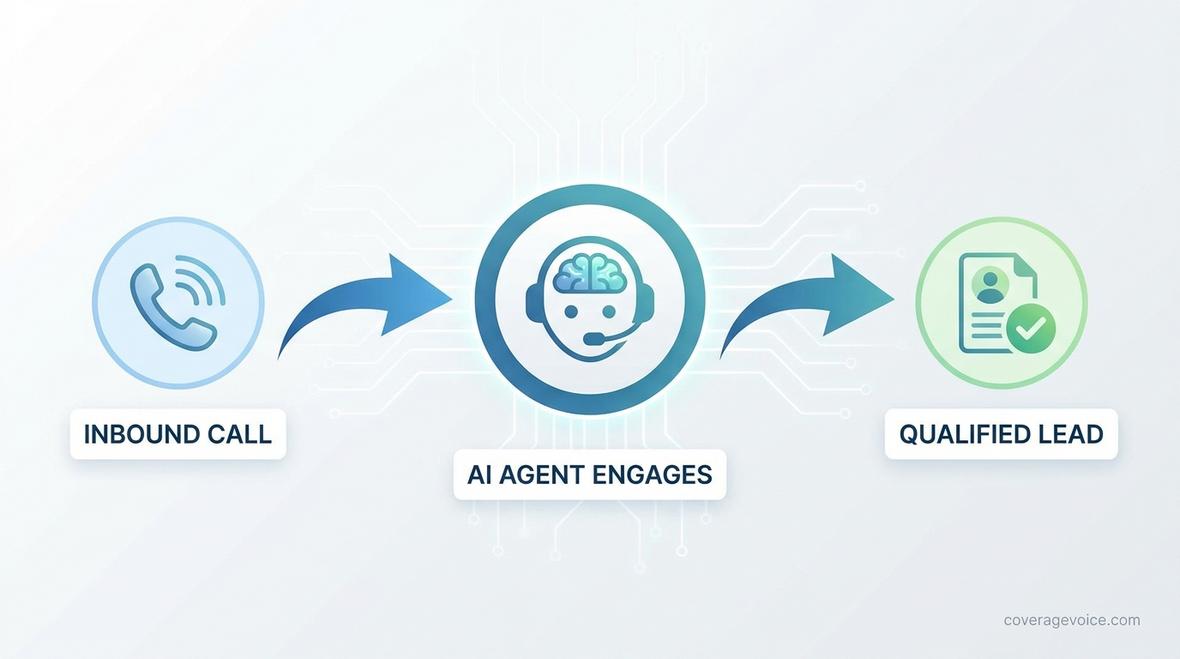
Beyond cost reduction, an effective ai call bot improves revenue generation through superior lead qualification and nurturing. The system can instantly access CRM data to personalize conversations based on lead source, previous interactions, and demographic information. This contextual awareness enables more relevant plan recommendations and increases the likelihood of successful enrollment.
For marketing agencies managing PPC ad follow-up campaigns, AI call bots provide immediate response to inbound inquiries capturing leads when interest peaks rather than losing conversions to response delays. The system can simultaneously validate eligibility, answer benefit questions, and schedule appointments with licensed agents for final enrollment steps, creating a seamless experience that maximizes conversion rates.
Compliance and Regulatory Considerations
For Medicare professionals, regulatory compliance isn't optional it's fundamental to operational legitimacy. An ai call bot deployed in Medicare contexts must adhere to strict HIPAA privacy standards, CMS marketing guidelines, and TCPA telecommunications regulations. Understanding how AI systems maintain compliance while delivering operational benefits is critical for successful implementation.
HIPAA Compliance in Voice AI Systems
Health Insurance Portability and Accountability Act (HIPAA) requirements mandate specific technical and administrative safeguards for Protected Health Information (PHI). An enterprise-grade ai call bot must encrypt all voice data both in transit and at rest, implement role-based access controls, maintain comprehensive audit logs, and execute Business Associate Agreements (BAAs) with all technology vendors in the data chain.
Organizations evaluating HIPAA compliant AI voice automation should verify that providers maintain SOC 2 Type II certifications, conduct regular penetration testing, and demonstrate clear data governance policies. The system should also support data residency requirements, ensuring that PHI remains within approved geographic boundaries.
CMS Marketing and Communication Standards
The Centers for Medicare & Medicaid Services (CMS) impose detailed requirements on how health plans and their representatives communicate with beneficiaries. An ai call bot must deliver accurate benefit information, avoid misleading comparisons, document all member interactions, and respect communication preferences including time-of-day restrictions.
Advanced systems incorporate CMS-approved scripts and talking points directly into conversational flows, ensuring that every interaction meets regulatory standards regardless of call volume or complexity. This programmatic compliance reduces the risk of violations that could result in penalties, enrollment suspensions, or reputational damage.
For organizations managing Medicare broker and FMO operations, the ai call bot can automatically generate required documentation including Scope of Appointment (SOA) forms, enrollment verification records, and member consent acknowledgments streamlining compliance workflows while reducing administrative burden on licensed agents.
Implementation Strategies for Medicare Organizations
Successfully deploying an ai call bot requires careful planning, stakeholder alignment, and phased rollout strategies that minimize disruption while maximizing adoption. Organizations that approach implementation systematically achieve faster time-to-value and higher user acceptance rates.
Assessment and Planning Phase
The implementation journey begins with comprehensive assessment of current call handling processes, pain points, and performance metrics. Organizations should document call volumes by type, average handle times, conversion rates, and common failure points where callers disconnect or demand escalation.
This baseline data informs ai call bot configuration priorities, helping teams identify which use cases deliver the highest return on investment. Common starting points include appointment scheduling, benefit inquiries, and pre-screening qualification functions that are high-volume, relatively standardized, and don't require complex decision-making.
System Integration and Configuration
Technical integration connects the ai call bot to existing infrastructure including phone systems, CRM platforms, and enrollment databases. Organizations should prioritize bidirectional data flow, ensuring that the AI system can both retrieve information (like lead source and previous interactions) and write data back (such as appointment confirmations and qualification results).
Configuration involves training the AI on Medicare-specific terminology, plan details, and conversational patterns common in your member population. This customization ensures that the ai call bot understands regional dialects, correctly interprets benefit inquiries, and provides responses that align with your organization's brand voice and compliance standards.
Pilot Programs and Phased Rollout
Rather than replacing entire call center operations overnight, successful organizations deploy the ai call bot in controlled pilot scenarios. This might involve handling after-hours calls through after-hour AI agent functionality, managing overflow during peak periods, or automating specific interaction types like benefits verification.
Pilot programs provide valuable performance data, identify edge cases requiring additional training, and build organizational confidence in the technology. As teams observe consistent quality and positive member feedback, they can expand deployment to additional use cases and higher call volumes.
Key Use Cases for Medicare AI Call Bots
The versatility of ai call bot technology enables Medicare organizations to address multiple operational challenges through a single platform. Understanding specific use cases helps leaders prioritize deployment strategies and set appropriate performance expectations.
Enrollment Process Automation
Perhaps the most impactful application involves automating portions of the enrollment automation workflow. The ai call bot can guide applicants through eligibility verification, collect necessary demographic information, explain plan options based on individual needs, and initiate the enrollment process all before human agent involvement.
This automation dramatically increases the number of enrollments each licensed agent can complete, as they focus exclusively on final verification and signature collection rather than repetitive information gathering. During AEP when time is the scarcest resource, this efficiency gain translates directly to revenue growth.
Member Retention and Renewal Management
Beyond new member acquisition, the ai call bot plays a critical role in member retention and renewals. The system can proactively reach out to members approaching renewal dates, verify satisfaction with current coverage, answer questions about plan changes, and identify members at risk of disenrollment.
Early identification of dissatisfaction enables retention teams to intervene with targeted solutions before members switch to competitors. The ai call bot can also automate renewal confirmations, reducing passive disenrollment that occurs when members fail to respond to renewal notices.
Lead Qualification and Reactivation
Marketing teams generate thousands of leads through various channels, but not all leads are equally valuable. An ai call bot can immediately contact new leads for lead reactivation and qualification, assessing factors like Medicare eligibility, geographic location, coverage needs, and readiness to enroll.
Qualified leads are immediately routed to licensed agents with complete context, while non-qualified leads receive appropriate information and are entered into nurture campaigns. This intelligent triage ensures that high-value sales resources focus exclusively on prospects most likely to convert.
Performance Metrics and ROI Measurement
Quantifying the impact of an ai call bot deployment requires establishing clear metrics and measurement frameworks. Organizations should track both operational efficiency indicators and business outcome measures to calculate true return on investment.
Operational Efficiency Indicators
Key operational metrics include call containment rate (percentage of interactions resolved without human transfer), average handle time, first-call resolution rate, and system availability. High-performing ai call bot implementations typically achieve 70-85% containment rates for targeted use cases, with average handle times 40-60% lower than human-handled equivalents.
Organizations should also monitor conversation quality through regular transcript reviews, member satisfaction surveys, and compliance audits. These qualitative assessments ensure that efficiency gains don't come at the expense of member experience or regulatory adherence.
Business Outcome Measures
Ultimately, the ai call bot must drive measurable business results. Critical metrics include cost per enrollment, lead-to-enrollment conversion rate, member lifetime value, and churn reduction. Organizations should establish baseline performance before deployment and track improvements over subsequent quarters.
For example, if an FMO previously spent $150 per enrollment including all marketing and operational costs, and the ai call bot reduces that to $95 through improved efficiency and conversion, the ROI calculation becomes straightforward. Multiply the cost savings per enrollment by total annual enrollments to determine total financial impact.
Selecting the Right AI Call Bot Provider
The Medicare AI call bot market includes numerous vendors with varying capabilities, compliance credentials, and pricing models. Selecting the right partner requires careful evaluation across multiple dimensions.
Key Evaluation Criteria
Organizations should assess providers based on Medicare-specific expertise, proven regulatory compliance, integration capabilities, scalability, and support quality. Request detailed information about HIPAA compliance measures, BAA terms, data handling procedures, and audit capabilities.
Technical capabilities matter significantly. Evaluate natural language understanding accuracy, speech recognition performance with diverse accents and speech patterns, and the system's ability to handle complex, multi-turn conversations. Request pilot programs or proof-of-concept deployments to assess real-world performance before committing to long-term contracts.
Total Cost of Ownership Considerations
Pricing models vary widely, from per-minute usage fees to per-conversation charges to flat monthly subscriptions. Calculate total cost of ownership by projecting call volumes across different scenarios, including seasonal peaks. Factor in implementation costs, integration expenses, ongoing training requirements, and support fees.
Organizations exploring pricing options should also consider the opportunity cost of delayed implementation. If current operational inefficiencies are costing $50,000 monthly in excess labor or lost enrollments, a solution that eliminates those costs delivers positive ROI even at premium pricing.
Future Trends in Healthcare AI Call Bot Technology
The ai call bot landscape continues evolving rapidly, with emerging capabilities that will further transform Medicare operations. Understanding these trends helps organizations make future-proof technology investments.
Advanced Personalization and Predictive Analytics
Next-generation systems will leverage predictive analytics to anticipate member needs before they call. By analyzing historical interaction patterns, claims data, and demographic information, the ai call bot could proactively reach out to members who are statistically likely to have questions about recent policy changes or upcoming coverage decisions.
This shift from reactive to proactive engagement represents a fundamental evolution in member experience, positioning health plans as trusted advisors rather than administrative processors.
Multilingual and Cultural Competency
As Medicare populations become increasingly diverse, ai call bot systems are expanding language support beyond basic translation to include cultural competency. These systems understand regional dialects, cultural communication norms, and health literacy variations delivering truly personalized experiences for members regardless of linguistic background.
For organizations serving diverse communities through initiatives like dual eligible and LIS outreach, these capabilities are essential for ensuring equitable access to information and enrollment support.
Frequently Asked Questions
What is an AI call bot and how does it differ from traditional IVR systems?
An ai call bot uses advanced natural language processing and machine learning to engage in natural conversations with callers, understanding intent and context rather than relying on rigid menu structures. Unlike traditional IVR systems that require touch-tone inputs and follow predetermined paths, AI call bots adapt to individual conversations, ask clarifying questions, and provide personalized responses based on the caller's specific needs and circumstances.
How do AI call bots maintain HIPAA compliance when handling Medicare member information?
Enterprise-grade ai call bot platforms designed for Medicare organizations implement comprehensive security measures including end-to-end encryption, role-based access controls, complete audit logging, and Business Associate Agreements with all vendors. These systems undergo regular security audits, maintain SOC 2 Type II certifications, and ensure that all Protected Health Information remains within HIPAA-compliant infrastructure throughout the conversation lifecycle.
Can AI call bots handle the complexity of Medicare benefit explanations?
Modern ai call bot systems are specifically trained on Medicare terminology, benefit structures, and regulatory requirements. They can explain plan differences, coverage details, and eligibility requirements with accuracy that matches or exceeds human agents for standardized inquiries. For complex scenarios requiring judgment or regulatory interpretation, the system seamlessly transfers to licensed agents with complete context, ensuring members receive appropriate guidance.
What is the typical implementation timeline for a Medicare AI call bot?
Implementation timelines vary based on organizational complexity and integration requirements, but most Medicare organizations complete initial deployments within 6-12 weeks. This includes assessment, system configuration, integration with existing platforms, compliance verification, staff training, and pilot testing. Organizations with simpler infrastructure and clearly defined use cases can achieve faster deployment, while those requiring extensive customization may need additional time.
How do members respond to interacting with AI call bots instead of human agents?
Member acceptance of ai call bot technology depends heavily on implementation quality and appropriate use case selection. According to SurveyMonkey research, while 79% of Americans prefer humans over AI agents for complex issues, members appreciate AI assistance for routine tasks like appointment scheduling, benefit verification, and basic inquiries especially when it eliminates hold times and provides immediate responses. The key is ensuring seamless escalation to human agents when conversations exceed the AI's capabilities.
Conclusion
The ai call bot represents a transformative technology for Medicare organizations facing the dual challenges of increasing operational demands and tightening regulatory requirements. For managers and directors responsible for lead generation, enrollment efficiency, and member engagement, these intelligent systems offer a path to sustainable growth without proportional cost increases.
Successful implementation requires careful provider selection, phased deployment strategies, and ongoing performance monitoring. Organizations that approach AI call bot adoption strategically starting with high-value use cases, maintaining rigorous compliance standards, and continuously optimizing based on data position themselves for significant competitive advantages in an increasingly technology-driven Medicare marketplace. As the industry continues evolving toward digital-first member experiences, the question is not whether to adopt AI call bot technology, but how quickly organizations can implement it effectively.
Ready to Transform Your Medicare Enrollment Process?
See how Coverage Voice AI can help you automate Medicare enrollment.