AI Call Service: The Complete Guide To Intelligent Automation For Medicare Organizations

Introduction
The healthcare industry is experiencing a dramatic shift in how organizations handle customer interactions, particularly in the Medicare sector where compliance, efficiency, and member satisfaction are paramount. An AI call service represents a transformative solution that leverages artificial intelligence to automate, optimize, and enhance telephone-based interactions between Medicare organizations and their members, prospects, and stakeholders.
For Medicare brokers, Field Marketing Organizations (FMOs), health plans, and marketing agencies, implementing an AI call service isn't just about cutting costs it's about fundamentally reimagining how your organization handles high-volume periods like the Annual Enrollment Period (AEP) while maintaining strict HIPAA and CMS compliance. This comprehensive guide explores how AI call services are revolutionizing the Medicare ecosystem, from lead qualification and enrollment automation to member retention and after-hours support.
Understanding AI Call Service Technology
An AI call service utilizes advanced conversational AI, natural language processing (NLP), and machine learning algorithms to handle inbound and outbound phone calls with human-like intelligence. Unlike traditional Interactive Voice Response (IVR) systems that rely on rigid menu options and touch-tone inputs, modern AI call services engage in dynamic, contextual conversations that adapt to caller needs in real-time.
Core Components of an AI Call Service
A comprehensive AI call service platform integrates several sophisticated technologies working in concert:
- Speech Recognition: Converts caller speech into text with industry-leading accuracy, even accounting for accents, dialects, and background noise.
- Natural Language Understanding: Interprets caller intent beyond simple keyword matching, understanding context, sentiment, and nuance.
- Dialogue Management: Orchestrates multi-turn conversations, remembering context and guiding interactions toward successful resolutions.
- Knowledge Integration: Accesses real-time information from CRM systems, eligibility databases, and plan information to provide accurate responses.
- Text-to-Speech Synthesis: Generates natural-sounding voice responses that create engaging, human-like interactions.
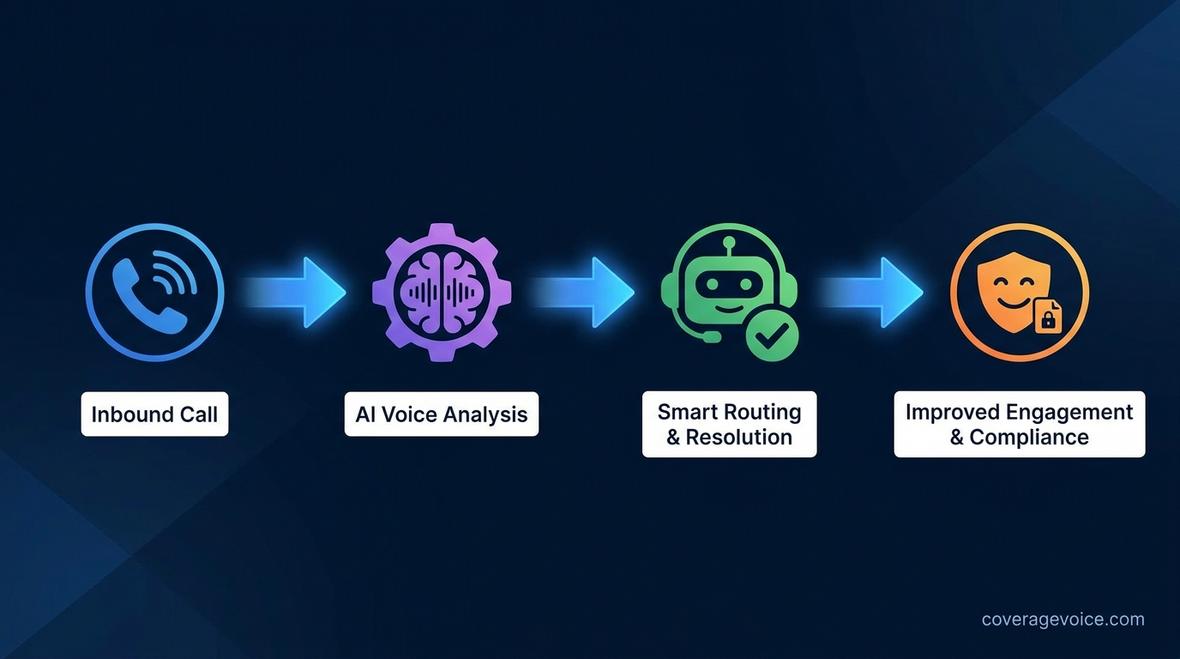
How AI Call Services Differ from Traditional Call Centers
Traditional call centers rely on human agents who require extensive training, incur significant labor costs, and face limitations in scalability during peak periods. AI agents versus live agents in Medicare present distinct operational differences. According to research from Forrester State of AI in Customer Service 2024, AI-driven contact centers achieve 25% higher first call resolution rates and 15% improvement in customer satisfaction scores compared to traditional setups, particularly vital for regulated industries like healthcare.
An AI call service eliminates wait times, operates 24/7 without fatigue, and scales instantly to handle thousands of simultaneous calls capabilities essential during Medicare enrollment periods when call volumes can spike 300-500% above baseline.
Medicare-Specific Applications of AI Call Services
The Medicare insurance ecosystem presents unique challenges that make AI call services particularly valuable. Organizations must balance high-volume lead processing with stringent compliance requirements, all while delivering personalized member experiences that drive enrollment and retention.
Intelligent Lead Qualification and Pre-Screening
One of the most valuable applications of an AI call service is automated lead qualification. Rather than having expensive agents spend time on unqualified prospects, AI systems can pre-screen incoming leads by verifying Medicare eligibility, assessing plan interest, identifying Special Enrollment Period (SEP) qualifications, and scheduling appointments only with genuinely interested, eligible prospects.
This pre-screening capability transforms lead economics. When Medicare marketing agencies spend $40-$150 per lead, ensuring that only qualified prospects reach licensed agents dramatically improves conversion rates and return on ad spend. Marketing agencies leveraging AI call services report 40-60% reductions in cost per enrollment by eliminating agent time spent on unqualified leads.
AEP and OEP Automation
The Annual Enrollment Period represents both the greatest opportunity and biggest operational challenge for Medicare organizations. Call volumes during October through December can overwhelm even well-staffed call centers, leading to abandoned calls, frustrated prospects, and lost enrollments.
An AI call service designed for AEP and OEP automation handles the surge by simultaneously managing thousands of conversations. The system can answer plan questions, explain benefit differences, schedule agent appointments, process simple enrollments, and provide 24/7 support even when your human agents are offline.
Organizations implementing AI call services for enrollment periods report handling 3-5 times more prospect interactions with the same or lower operational costs, while maintaining compliance with CMS marketing guidelines.
After-Hours and Weekend Coverage
Medicare prospects and members don't limit their questions to business hours. An after-hours AI agent ensures that every call receives immediate attention, whether it arrives at 2 PM or 2 AM. This capability is particularly valuable given that many Medicare beneficiaries are retirees with flexible schedules who may prefer calling outside traditional business hours.
After-hours AI call service capabilities include answering frequently asked questions, capturing callback requests for complex issues, scheduling appointments with licensed agents, providing plan information and benefit summaries, and processing simple transactions like appointment confirmations.
Member Retention and Renewal Automation
Acquiring new Medicare members costs significantly more than retaining existing ones, yet many organizations lack the resources to conduct proactive retention outreach. An AI call service enables scalable member retention and renewal campaigns that keep members engaged year-round.
Automated retention campaigns can conduct satisfaction check-ins, remind members of unused benefits, provide medication adherence support, offer preventive care scheduling, and proactively address concerns before members disenroll. These touchpoints create meaningful engagement that reduces churn while requiring minimal human agent involvement.
Compliance and Security in AI Call Services
For Medicare organizations, compliance isn't optional it's existential. CMS marketing regulations, HIPAA privacy requirements, and TCPA consent rules create a complex regulatory environment that AI call services must navigate flawlessly.
HIPAA-Compliant AI Architecture
Any AI call service handling Protected Health Information (PHI) must implement comprehensive HIPAA safeguards. This includes end-to-end encryption of voice data, secure storage with access controls, audit logging of all interactions, business associate agreements with all vendors, and regular security assessments and penetration testing.
Leading Medicare-focused AI call service providers like CoverageVoice build HIPAA-compliant AI voice automation into their core architecture, ensuring that every conversation meets federal privacy standards without requiring organizations to become security experts.
CMS Marketing and Enrollment Compliance
Medicare marketing activities face strict CMS oversight. AI call services must adhere to scope of appointment requirements, approved script language, prohibited marketing practices, documentation and recording retention, and agent licensing verification protocols.
Advanced AI call service platforms integrate compliance guardrails directly into conversation flows. The system can verify that proper disclosures have been provided, ensure agents (human or AI) don't make prohibited comparisons, document consent for each marketing interaction, and automatically flag potential compliance issues for review.
Organizations concerned about Medicare marketing compliance find that AI systems often maintain higher compliance rates than human agents because they never deviate from approved scripts or forget required disclosures.
TCPA Consent Management
The Telephone Consumer Protection Act requires express written consent before making marketing calls to mobile phones. An enterprise-grade AI call service includes sophisticated consent management that tracks consent status for each prospect, honors do-not-call requests immediately, maintains required consent documentation, and integrates with lead sources to verify consent provenance.
This consent infrastructure protects organizations from the significant legal and financial risks associated with TCPA violations, which can result in penalties of $500-$1,500 per call.
Implementing an AI Call Service: ROI and Business Impact
The decision to implement an AI call service represents a significant operational shift. Understanding the financial implications, implementation timeline, and expected outcomes helps organizations make informed decisions.
Cost Structure and ROI Calculation
Traditional Medicare call centers incur substantial costs: agent salaries averaging $35,000-$50,000 annually, benefits and payroll taxes adding 25-35%, training costs of $5,000-$10,000 per agent, facility and technology infrastructure, and supervisor and quality assurance overhead.
For a 20-agent call center, annual costs easily exceed $1.2-$1.5 million. An AI call service can handle equivalent call volume for 40-60% less, while providing 24/7 coverage and instant scalability. Organizations typically achieve ROI within 6-9 months when factoring in cost savings, increased conversion rates, and reduced abandoned calls.
The Medicare voice AI ROI calculator helps quantify these benefits based on your specific call volumes, conversion rates, and operational costs.
Real-World Performance: Case Study Results
Medicare organizations implementing AI call services report transformative results. One FMO documented that Medicare voice AI replaced 45 agents while maintaining service quality and improving key metrics. Another case study showed how Medicare voice AI cut resolution times by 30x, dramatically reducing caller frustration.
Perhaps most impressively, organizations focusing on member experience found that Medicare voice AI boosted Star Ratings by improving call response times, medication adherence support, and preventive care coordination directly impacting plan quality metrics and associated bonus payments.
Implementation Timeline and Change Management
Deploying an AI call service doesn't require months of development. Modern platforms designed for Medicare organizations offer rapid implementation, typically following this timeline: weeks 1-2 for discovery and script development, weeks 3-4 for system configuration and integration, week 5 for internal testing and refinement, and week 6 for pilot launch and monitoring.
Full production deployment typically occurs within 6-8 weeks, with ongoing optimization based on conversation analytics and performance data. This rapid timeline allows organizations to implement AI call services before AEP or in response to sudden operational needs.
Selecting the Right AI Call Service Provider
Not all AI call service platforms deliver equivalent value, particularly in the highly regulated Medicare space. Organizations should evaluate potential providers across several critical dimensions.
Medicare-Specific Expertise and Industry Knowledge
Generic AI call service platforms lack the specialized knowledge required for Medicare operations. Look for providers with demonstrated Medicare experience, pre-built conversation flows for common Medicare scenarios, built-in compliance guardrails for CMS regulations, integration with Medicare-specific systems (CRM, enrollment platforms), and understanding of Medicare terminology, plan types, and enrollment processes.
Platforms purpose-built for Medicare, such as CoverageVoice's Medicare call center solution, deliver faster implementation and better results because they incorporate Medicare domain expertise directly into the AI models.
Integration Capabilities and Technology Stack
An AI call service must integrate seamlessly with your existing technology ecosystem. Essential integration capabilities include CRM systems (Salesforce, HubSpot, Medicare-specific CRMs), telephony infrastructure (existing phone systems and carrier relationships), enrollment platforms (CMS HPMS, carrier portals), analytics and reporting tools, and marketing automation platforms.
Organizations can review available integrations to ensure compatibility with their current technology investments, avoiding costly custom development or data silos.
Conversation Quality and Natural Language Capabilities
The effectiveness of an AI call service ultimately depends on conversation quality. During vendor evaluation, test the system with realistic Medicare scenarios, assess how naturally the AI handles unexpected responses, evaluate the voice quality and conversational flow, verify that the system recognizes Medicare-specific terminology, and confirm that the AI can handle multiple topics within a single call.
Request recorded sample conversations or conduct live demonstrations with actual Medicare enrollment scenarios to assess whether the AI delivers the professional, helpful experience your members expect.
Advanced Features and Future Capabilities
Leading AI call service platforms continue to evolve, incorporating increasingly sophisticated capabilities that extend beyond basic call handling.
Omnichannel Coordination
Modern prospects and members engage across multiple channels phone calls, web forms, SMS, email, and chat. An advanced AI call service provides omnichannel client intake that maintains context across channels, ensuring consistent experiences regardless of how members choose to communicate.
This coordination enables scenarios like a prospect who submits a web form receiving an automated AI call within minutes, or a member who starts a conversation via SMS seamlessly transitioning to a phone call without repeating information.
Predictive Analytics and Intelligent Routing
AI call services increasingly incorporate predictive analytics that identify which prospects are most likely to convert, determine optimal contact timing and frequency, predict member churn risk based on conversation sentiment, and route complex calls to agents with relevant expertise.
These capabilities transform the AI call service from a simple automation tool into a strategic asset that actively improves business outcomes through data-driven decision-making.
Multilingual and Culturally Competent Communication
The Medicare population is increasingly diverse, with significant Spanish-speaking and other non-English speaking segments. Advanced AI call services offer native multilingual support, eliminating the need for separate agents or translation services while ensuring culturally appropriate communication that resonates with diverse member populations.
Comparing AI Call Service Providers for Medicare
Several vendors offer AI call service capabilities targeting healthcare and insurance markets. Medicare organizations should evaluate options carefully, considering both general-purpose platforms and Medicare-specialized solutions.
Medicare-Specialist vs. General-Purpose Platforms
General-purpose conversational AI platforms require significant customization to work effectively in Medicare contexts. Organizations considering alternatives should review comparisons such as Rivvi versus CoverageVoice or explore why many are seeking a Rivvi alternative for Medicare voice AI that better addresses industry-specific requirements.
Medicare-specialized platforms deliver faster time-to-value, require less customization, include built-in compliance features, and provide conversation flows designed specifically for enrollment, retention, and member service scenarios common in Medicare operations.
Getting Started with AI Call Service Implementation
Organizations ready to implement an AI call service should follow a structured approach that ensures successful deployment and rapid value realization.
Conduct an Initial Needs Assessment
Begin by documenting your current call center operations, including call volumes by time period, common call reasons and resolution patterns, agent costs and staffing challenges, compliance requirements and pain points, and integration needs with existing systems.
This assessment provides the foundation for vendor evaluation and helps establish baseline metrics against which you'll measure AI call service performance.
Start with a Focused Pilot
Rather than attempting to automate all call center functions immediately, successful organizations typically begin with a focused pilot addressing a specific use case like after-hours coverage, lead qualification and pre-screening, appointment scheduling and confirmation, or FAQs and basic member service inquiries.
This approach allows you to demonstrate value quickly, build organizational confidence in the technology, and refine the implementation before expanding to additional use cases.
Measure, Learn, and Optimize
AI call service platforms generate rich analytics about conversation patterns, resolution rates, sentiment trends, and operational efficiency. Establish a regular cadence of performance review, analyzing metrics such as call containment rate (percentage of calls resolved without agent escalation), average handle time, caller satisfaction scores, conversion rates for sales-focused calls, and compliance adherence rates.
Use these insights to continuously refine conversation flows, update knowledge bases, and optimize the AI's performance over time.
Frequently Asked Questions
Can an AI call service really understand Medicare's complexity?
Modern AI call services trained specifically for Medicare demonstrate strong understanding of plan types, enrollment rules, and benefit structures. While complex cases may still require human agent involvement, AI systems successfully handle 60-70% of typical Medicare calls independently, with that percentage increasing as the system learns from more interactions.
How do members react to speaking with an AI instead of a human?
Research indicates that when AI call services provide quick, accurate answers, most callers respond positively. The key is transparency (the AI should identify itself) and seamless escalation to human agents when needed. Many organizations find that members appreciate the elimination of hold times and 24/7 availability that AI call services provide.
What happens if the AI doesn't understand a caller's question?
Quality AI call service platforms include sophisticated fallback strategies. When the system encounters uncertainty, it can ask clarifying questions, offer related topics that might address the caller's need, or seamlessly transfer to a human agent with full context about the conversation. The system should never leave a caller frustrated or without resolution options.
How does pricing typically work for AI call service platforms?
Most Medicare-focused AI call service providers use subscription pricing based on call volume, with tiers such as per-minute usage fees, monthly subscription with included minutes, or annual contracts with volume commitments. Organizations should review pricing structures that align with their call patterns and growth projections.
Can we use our existing phone numbers and infrastructure?
Yes, enterprise AI call service platforms integrate with existing telephony infrastructure. You maintain your current phone numbers while routing calls to the AI system, which handles the conversation and transfers to agents when needed. This approach preserves your established contact points while adding AI capabilities.
Conclusion
An AI call service represents a transformative opportunity for Medicare organizations facing the dual challenges of increasing call volumes and operational cost pressures. By automating routine interactions, qualifying leads more effectively, and providing 24/7 member support while maintaining strict HIPAA and CMS compliance, AI call services deliver measurable ROI and competitive advantage. Organizations that implement these solutions report dramatic improvements in operational efficiency, conversion rates, and member satisfaction outcomes that directly impact both top-line revenue and bottom-line profitability. As the Medicare market becomes increasingly competitive and members demand more responsive service, adopting an AI call service transitions from innovative advantage to operational necessity for forward-thinking organizations.
Ready to Transform Your Medicare Enrollment Process?
See how Coverage Voice AI can help you automate Medicare enrollment.