AI Calling Service: Transform Medicare Lead Conversion & Compliance In 2026

Introduction: The Evolution of AI Calling Services in Healthcare
The healthcare industry is experiencing a transformative shift as AI calling service technology reshapes how Medicare organizations handle lead generation, member enrollment, and customer engagement. For managers and directors at marketing agencies, Field Marketing Organizations (FMOs), and health plan call centers, the challenge has never been more acute: how do you scale operations during high-volume periods like the Annual Enrollment Period (AEP) while maintaining strict HIPAA and CMS compliance?
An AI calling service represents more than automation it's a strategic tool that addresses the operational bottlenecks plaguing Medicare enrollment processes. With traditional call centers struggling to manage escalating costs, agent turnover, and compliance risks, intelligent voice AI solutions are emerging as the definitive answer to sustainable growth and operational excellence.
This comprehensive guide explores how AI calling services are revolutionizing Medicare operations, delivering measurable improvements in conversion rates, cost efficiency, and regulatory adherence while maintaining the personalized touch that members expect.
What Is an AI Calling Service?
An AI calling service leverages advanced conversational artificial intelligence, natural language processing (NLP), and machine learning to automate voice-based customer interactions. Unlike traditional interactive voice response (IVR) systems that follow rigid script trees, modern AI calling services understand context, respond naturally to member inquiries, and adapt conversations in real-time.
For Medicare organizations, these platforms handle critical functions including:
- Inbound call management: Answering beneficiary questions about plan benefits, eligibility, and enrollment processes
- Outbound dialing campaigns: Proactive member outreach for renewals, wellness checks, and benefit utilization
- Lead qualification: Pre-screening prospects to identify high-intent opportunities before routing to human agents
- Appointment scheduling: Coordinating broker consultations and enrollment meetings
- Post-enrollment follow-up: Welcome calls, benefit education, and satisfaction surveys
The differentiating factor for healthcare-specific AI calling services lies in their compliance architecture. These systems must navigate complex regulatory frameworks including HIPAA privacy rules, CMS marketing guidelines, and TCPA consent requirements capabilities that generic AI platforms cannot reliably deliver.
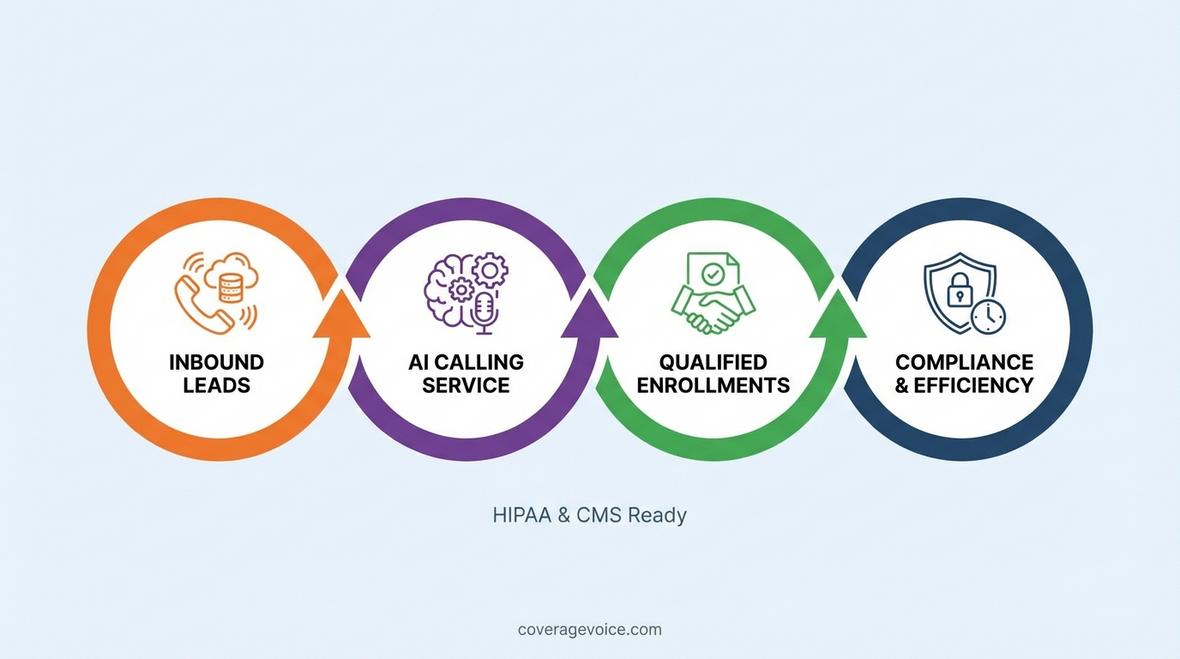
Key Benefits of AI Calling Services for Medicare Organizations
Operational Cost Reduction
The financial impact of implementing an AI calling service is substantial. Traditional Medicare call centers face per-agent costs ranging from $45,000 to $65,000 annually when factoring salaries, benefits, training, and infrastructure. During peak enrollment periods, these expenses multiply as organizations scramble to hire temporary staff.
AI voice agents operate at a fraction of this cost, handling thousands of simultaneous conversations without fatigue or quality degradation. Organizations implementing Medicare call center solutions report cost reductions of 60-75% compared to traditional staffing models while maintaining or improving key performance indicators.
Enhanced Lead Conversion Rates
Speed-to-lead represents one of the most critical variables in Medicare enrollment success. Research consistently demonstrates that contacting leads within five minutes of inquiry increases conversion probability by 900% compared to waiting 30 minutes. Human-operated call centers struggle to achieve this response velocity during high-volume periods.
An AI calling service eliminates this gap entirely. Inbound leads receive immediate engagement, qualification, and routing ensuring no opportunity languishes in queue. For organizations leveraging lead reactivation strategies, AI enables systematic re-engagement of dormant prospects through personalized outreach campaigns that would be prohibitively expensive with human agents.
Compliance Assurance and Risk Mitigation
Regulatory compliance represents an existential concern for Medicare organizations. CMS imposes strict marketing and enrollment guidelines, with violations resulting in sanctions, enrollment suspensions, and financial penalties. According to Capgemini: AI Adoption Trends and Digital Transformation in Healthcare, implementation success factors in healthcare customer service heavily depend on robust compliance frameworks embedded within AI systems.
Healthcare-grade AI calling services address compliance through multiple mechanisms:
- Automated consent verification: Recording and documenting TCPA consent before outbound calls
- Scope of Appointment (SOA) handling: Ensuring proper documentation and scheduling protocols
- Conversation monitoring: Real-time detection of prohibited language or benefit misrepresentation
- Audit trails: Comprehensive logging of all interactions for CMS review
Organizations concerned with Medicare marketing compliance find that AI systems provide greater consistency than human agents who may inadvertently deviate from approved scripts during complex conversations.
Scalability During AEP and OEP
The Annual Enrollment Period creates predictable capacity challenges. Organizations must suddenly handle 3-5x their baseline call volume while maintaining quality standards. Traditional solutions hiring temporary staff or outsourcing to third-party call centers introduce quality variability, training delays, and compliance risks.
An AI calling service scales instantaneously. Whether handling 100 or 10,000 simultaneous conversations, the system maintains consistent performance, messaging accuracy, and compliance adherence. Organizations leveraging AEP/OEP automation can redirect human agents to high-value activities like complex case resolution while AI handles routine inquiries and qualification.
Critical Use Cases for AI Calling Services in the Medicare Ecosystem
Inbound Lead Management and Qualification
When prospective members call after seeing advertisements or receiving direct mail, immediate response determines success. An AI calling service answers instantly, collects essential information (age, location, current coverage, special needs), qualifies intent, and routes high-priority leads to specialized agents all while documenting the interaction for compliance purposes.
For organizations running digital campaigns, PPC ad follow-up automation ensures that every click converting to a phone call receives professional handling, maximizing return on advertising spend.
Outbound Member Retention and Renewal Campaigns
Member acquisition costs in Medicare Advantage range from $300 to $1,200 per enrollment, making retention economics compelling. AI calling services enable proactive outreach campaigns that identify at-risk members, address concerns, and facilitate seamless renewals.
Systematic member retention and renewal programs powered by AI can reduce disenrollment rates by 15-25%, directly impacting revenue stability and Medicare Star Ratings performance.
24/7 After-Hours Coverage
Medicare beneficiaries often have questions outside traditional business hours. Maintaining staffed call centers around the clock is cost-prohibitive for most organizations, yet missed calls represent lost opportunities and diminished member experience.
An after-hours AI agent provides continuous availability, capturing inquiries, scheduling callbacks, and resolving routine questions regardless of time zone or business hours. This capability proves particularly valuable for organizations serving geographically dispersed populations.
Dual-Eligible and Special Needs Population Outreach
Reaching dual-eligible beneficiaries and Low-Income Subsidy (LIS) populations requires specialized outreach strategies. These members often face communication barriers, limited digital access, and complex eligibility scenarios.
AI calling services configured for dual-eligible and LIS outreach can conduct high-volume screening campaigns, identify eligible individuals, and facilitate enrollment assistance all while maintaining sensitivity to the unique needs of these populations.
Implementation Considerations for Medicare Organizations
Build vs. Buy: The Strategic Decision
Organizations evaluating AI calling services face a fundamental choice: develop proprietary technology or partner with specialized vendors. The build approach offers customization potential but requires substantial investment in AI engineering talent, healthcare compliance expertise, and ongoing maintenance.
For most Medicare organizations, partnering with established platforms like CoverageVoice delivers faster time-to-value, lower risk, and access to continuously improving AI models trained specifically for healthcare conversations. Organizations can review detailed pricing structures to understand total cost of ownership compared to internal development.
Integration with Existing Technology Ecosystems
An effective AI calling service must connect seamlessly with Customer Relationship Management (CRM) systems, enrollment platforms, and compliance documentation tools. Organizations should prioritize solutions offering pre-built integrations with common Medicare technology stacks, reducing implementation complexity and enabling real-time data synchronization.
Training and Change Management
Introducing AI calling services requires organizational change management. Human agents may perceive AI as threatening their roles rather than augmenting their capabilities. Successful implementations position AI as handling repetitive, low-complexity interactions while elevating human agents to complex problem-solving, relationship building, and specialized case management.
Training programs should emphasize the collaborative model: AI qualifies and routes leads, handles routine inquiries, and manages after-hours coverage, while human experts focus on nuanced conversations requiring empathy, judgment, and complex decision-making.
Measuring ROI and Performance Metrics
Organizations must establish clear key performance indicators (KPIs) to evaluate AI calling service effectiveness:
- Cost per qualified lead: Total AI service costs divided by leads meeting qualification criteria
- Conversion rate: Percentage of AI-qualified leads ultimately enrolling in plans
- Average handle time: Duration of AI-managed conversations compared to human baselines
- First-call resolution rate: Percentage of inquiries resolved without human escalation
- Compliance score: Adherence to CMS marketing guidelines and HIPAA requirements
- Member satisfaction: Post-interaction surveys measuring experience quality
Organizations implementing comprehensive voice AI Medicare enrollment automation typically observe ROI realization within 3-6 months as cost savings and conversion improvements compound.
Future Trends in AI Calling Services for Healthcare
The trajectory of AI calling service technology points toward increasingly sophisticated capabilities:
Multimodal interactions: Integration of voice, SMS, email, and web chat into unified AI-managed conversations, providing members with seamless omnichannel experiences.
Predictive analytics: AI systems that anticipate member needs based on utilization patterns, demographic factors, and social determinants of health, enabling proactive outreach before issues arise.
Emotional intelligence: Advanced sentiment analysis detecting frustration, confusion, or satisfaction during conversations, allowing real-time adaptation of communication strategies.
Regulatory automation: AI that automatically adapts to evolving CMS guidelines, HIPAA requirements, and state-specific insurance regulations without manual reprogramming.
Organizations positioning themselves at the forefront of these innovations will gain significant competitive advantages in member acquisition, retention, and operational efficiency.
Evaluating AI Calling Service Vendors
When selecting an AI calling service provider, Medicare organizations should assess:
- Healthcare specialization: Generic AI platforms lack the compliance architecture and domain knowledge required for Medicare operations
- Compliance certifications: HIPAA compliance, SOC 2 attestation, and demonstrated CMS guideline adherence
- Customization capabilities: Ability to tailor conversation flows, branding, and integration points to organizational requirements
- Transparent pricing: Clear cost structures avoiding hidden fees or usage surprises
- Vendor stability: Financial health, customer retention rates, and long-term viability
- Support and training: Onboarding resources, ongoing optimization assistance, and responsive technical support
Organizations comparing solutions can reference detailed vendor comparisons such as Rivvi vs CoverageVoice to understand capability differences and implementation approaches.
Common Implementation Challenges and Mitigation Strategies
Member Acceptance of AI Interactions
Some beneficiaries may initially prefer human agents over AI systems. Successful implementations address this through transparency (clearly identifying AI agents), seamless escalation pathways to humans when requested, and demonstrable value (faster response times, 24/7 availability).
Complex Scenario Handling
Medicare conversations often involve nuanced eligibility questions, plan comparisons, and special circumstance evaluations. AI systems must recognize complexity thresholds and route appropriately rather than attempting resolution beyond their capabilities.
Data Quality and Integration Issues
AI effectiveness depends on accurate, current data about plans, benefits, provider networks, and member information. Organizations must ensure robust data governance, regular updates, and validation processes to maintain AI accuracy.
Frequently Asked Questions
How does an AI calling service maintain HIPAA compliance?
Healthcare-grade AI calling services implement multiple HIPAA safeguards including end-to-end encryption of voice data, secure storage with access controls, comprehensive audit logging, Business Associate Agreements (BAAs), and regular security assessments. These systems are specifically architected to handle Protected Health Information (PHI) according to HIPAA technical, administrative, and physical safeguard requirements.
Can AI calling services handle multiple languages for diverse Medicare populations?
Advanced AI calling services support multilingual conversations, enabling organizations to serve Spanish-speaking, Chinese-speaking, and other language-preference populations without maintaining specialized human agent teams for each language. This capability proves particularly valuable for organizations serving diverse metropolitan areas or specific ethnic communities.
What happens when an AI calling service encounters a question it cannot answer?
Properly designed systems recognize uncertainty and seamlessly transfer to human agents rather than providing potentially inaccurate information. The AI provides the human agent with full conversation context, eliminating the need for members to repeat information. This hybrid approach ensures members receive accurate responses while maximizing automation efficiency.
How quickly can organizations implement an AI calling service?
Implementation timelines vary based on complexity, but specialized Medicare AI platforms typically achieve initial deployment within 2-4 weeks for standard use cases. This includes system configuration, integration with existing CRM systems, conversation flow customization, compliance review, and staff training. More complex implementations involving custom integrations or specialized workflows may require 6-8 weeks.
Do AI calling services replace human agents entirely?
The most effective implementations utilize AI to augment rather than replace human expertise. AI handles high-volume, routine interactions (appointment scheduling, basic eligibility questions, lead qualification), while human agents focus on complex cases, relationship building, and situations requiring empathy and judgment. This division of labor improves both efficiency and member experience.
Conclusion
The AI calling service represents a transformative technology for Medicare organizations navigating the dual imperatives of operational efficiency and regulatory compliance. By automating routine interactions, accelerating lead response, and maintaining 24/7 availability, these systems address the fundamental capacity constraints limiting traditional call center operations.
For managers and directors responsible for enrollment performance, member retention, and cost management, AI calling services deliver measurable improvements across every key metric while reducing compliance risk. As the Medicare landscape grows increasingly competitive and regulatory scrutiny intensifies, organizations leveraging intelligent automation will gain decisive advantages in member acquisition, satisfaction, and long-term value creation. The question is no longer whether to adopt AI calling services, but how quickly organizations can implement them to capture these benefits.
Ready to Transform Your Medicare Enrollment Process?
See how Coverage Voice AI can help you automate Medicare enrollment.