AI Calling Software: The Complete Guide To Intelligent Automation For Medicare Organizations In 2026

The healthcare industry is experiencing a seismic shift in how organizations manage member engagement, enrollment, and operational efficiency. AI calling software has emerged as a transformative solution, particularly for Medicare-focused organizations navigating the complexities of compliance, high-volume periods, and cost pressures. This comprehensive guide explores how AI calling software is revolutionizing Medicare operations, from lead qualification to member retention.
What Is AI Calling Software?
AI calling software represents a sophisticated technological platform that leverages artificial intelligence, natural language processing, and machine learning to automate and enhance voice-based communications. Unlike traditional automated phone systems, modern AI calling software can conduct natural, contextually aware conversations with leads, members, and patients handling everything from appointment scheduling to complex enrollment processes.
For Medicare organizations, AI calling software addresses critical operational challenges: reducing staffing costs during peak enrollment periods, maintaining HIPAA and CMS compliance, improving lead conversion rates, and delivering consistent member experiences across thousands of interactions. According to research from HealthIT.gov, healthcare organizations implementing intelligent automation solutions report significant improvements in operational efficiency and patient satisfaction metrics.
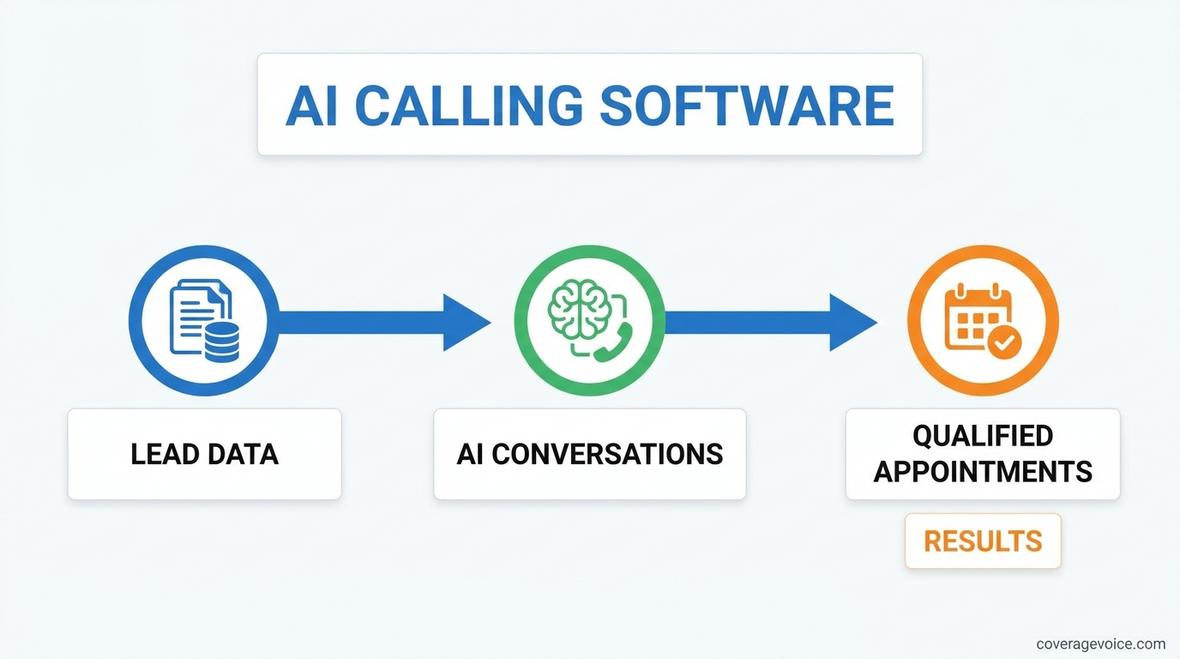
Core Components of AI Calling Software
Effective AI calling software integrates several essential components that work together to deliver intelligent automation:
- Natural Language Processing (NLP): Enables the system to understand caller intent, context, and sentiment in real-time
- Speech Recognition: Accurately transcribes and interprets spoken language with high accuracy rates
- Conversational AI: Facilitates dynamic, human-like dialogue flows that adapt based on caller responses
- Integration Capabilities: Connects seamlessly with existing CRM systems, scheduling platforms, and compliance frameworks
- Analytics Dashboard: Provides actionable insights into call performance, conversion metrics, and quality assurance
How AI Calling Software Transforms Medicare Operations
Medicare organizations face unique operational challenges that make AI calling software particularly valuable. From FMOs managing thousands of broker relationships to health plans navigating Annual Enrollment Period (AEP) surges, intelligent automation delivers measurable impact across multiple use cases.
Lead Qualification and Conversion
Traditional lead qualification processes often waste valuable agent time on unqualified prospects. AI-powered pre-screening enables organizations to automatically contact incoming leads, verify eligibility criteria, and route only qualified prospects to human agents. This approach typically improves agent productivity by 40-60% while reducing cost per qualified lead.
The ai calling software can handle complex qualification scenarios, including verifying Medicare eligibility windows, confirming geographic service areas, and assessing plan preference indicators all while maintaining detailed compliance records for CMS audit purposes.
Annual Enrollment Period Automation
The Annual Enrollment Period represents the most operationally intensive time for Medicare organizations. AEP automation through AI calling software enables organizations to scale capacity without proportionally increasing headcount.
During the 2025 AEP, organizations utilizing ai calling software reported handling 3-5 times more member contacts than previous years with the same core team size. The software manages routine inquiries, appointment scheduling, and plan information requests, allowing human agents to focus exclusively on complex enrollment scenarios and relationship-building activities.
Member Retention and Engagement
Member retention strategies benefit significantly from AI calling software's ability to conduct proactive outreach at scale. The technology can identify members at risk of disenrollment based on behavioral indicators and automatically initiate retention conversations.
Post-enrollment engagement is equally critical. New member welcome calls conducted by AI agents ensure consistent messaging, verify understanding of benefits, and identify early engagement opportunities all factors that correlate with improved member satisfaction and reduced rapid disenrollment rates.
HIPAA and CMS Compliance in AI Calling Software
Regulatory compliance represents a non-negotiable requirement for Medicare organizations considering ai calling software implementation. The intersection of artificial intelligence and protected health information demands rigorous attention to security, privacy, and documentation standards.
HIPAA Compliance Framework
Any AI calling software handling Medicare member information must maintain comprehensive HIPAA compliance, including encrypted data transmission, secure storage protocols, access controls, and detailed audit trails. Organizations should verify that vendors provide Business Associate Agreements (BAAs) and demonstrate regular security assessments.
The software must implement safeguards ensuring that conversations containing Protected Health Information (PHI) are appropriately secured both in transit and at rest. This includes encryption standards meeting or exceeding industry requirements and role-based access controls limiting PHI exposure to authorized personnel only.
CMS Marketing and Communication Guidelines
Medicare Advantage and Part D organizations must ensure their ai calling software adheres to CMS marketing guidelines, including proper disclosures, scope of appointment protocols, and documentation requirements. Medicare marketing compliance features should be built directly into the AI platform rather than managed as separate processes.
The software should automatically document when disclosures are made, track consent for marketing communications, and maintain records demonstrating compliance with CMS contact frequency limitations. These capabilities transform compliance from a manual burden into an automated control.
Implementing AI Calling Software: A Strategic Framework
Successful ai calling software implementation requires thoughtful planning, stakeholder alignment, and phased deployment approaches that minimize disruption while maximizing adoption.
Assessment and Planning Phase
Begin by conducting a comprehensive assessment of current calling operations, identifying pain points, volume patterns, and specific use cases where automation delivers maximum value. Organizations should quantify baseline metrics including cost per contact, conversion rates, average handle time, and member satisfaction scores to establish clear ROI benchmarks.
Medicare-focused call center solutions should align with organizational priorities whether that's reducing AEP staffing costs, improving lead conversion rates, or enhancing member retention metrics.
Vendor Selection Criteria
When evaluating ai calling software vendors, Medicare organizations should prioritize platforms demonstrating:
- Medicare-Specific Expertise: Understanding of enrollment processes, compliance requirements, and industry terminology
- Integration Capabilities: Native connections to popular Medicare CRM platforms and scheduling systems
- Compliance Infrastructure: Built-in HIPAA and CMS compliance features rather than bolt-on solutions
- Scalability: Ability to handle volume surges during AEP without performance degradation
- Customization Options: Flexibility to adapt conversation flows to organizational needs
Pilot Deployment and Optimization
Launch ai calling software through controlled pilot programs targeting specific use cases before full-scale deployment. This approach enables organizations to refine conversation flows, test integration points, and build internal confidence in the technology's capabilities.
Monitor key performance indicators throughout the pilot phase, including call completion rates, conversion metrics, member satisfaction scores, and compliance adherence. Use these insights to optimize AI agent performance before expanding to additional use cases.
Cost-Benefit Analysis: ROI of AI Calling Software
Financial justification for ai calling software typically centers on three primary value drivers: labor cost reduction, conversion rate improvement, and operational scalability.
Direct Labor Cost Savings
Traditional call center operations for Medicare organizations carry significant labor costs, particularly during high-volume periods. Organizations report that AI calling software can handle 60-80% of routine inquiries and transactions without human intervention, translating to substantial staffing cost reductions.
For a mid-sized FMO processing 50,000 member contacts during AEP, shifting even 50% of routine interactions to ai calling software can reduce seasonal staffing costs by $200,000-$400,000 annually while improving response consistency and availability.
Conversion Rate Enhancement
Perhaps the most significant ROI driver comes from improved lead conversion rates. AI-powered lead reactivation ensures that no qualified prospect falls through the cracks due to timing or staffing constraints.
By contacting leads within minutes rather than hours or days, ai calling software typically improves conversion rates by 25-40%. For organizations investing $50-$150 per Medicare lead, these conversion improvements directly impact bottom-line profitability.
Scalability and Flexibility Benefits
Unlike human staffing models that require weeks of hiring, training, and onboarding, AI calling software scales instantaneously to meet demand fluctuations. This capability proves particularly valuable during AEP versus OEP periods when contact volumes vary dramatically.
Organizations maintain operational flexibility without carrying excess labor capacity during off-peak periods or scrambling to staff up when volumes surge unexpectedly.
Advanced AI Calling Software Capabilities
Modern ai calling software platforms extend well beyond basic call handling, incorporating sophisticated capabilities that drive strategic value for Medicare organizations.
Omnichannel Communication Integration
Omnichannel client intake capabilities enable AI agents to seamlessly coordinate across voice, SMS, email, and web chat channels. Members can begin interactions via phone and continue through text or email without losing context or requiring repetition.
This integrated approach reduces friction in member journeys while providing organizations with comprehensive interaction histories that inform both AI and human agent engagements.
Intelligent Call Routing and Transfer
When ai calling software identifies scenarios requiring human expertise, intelligent routing ensures seamless transfers to the most appropriate agent based on specialization, language preference, or relationship history. The AI agent provides the human counterpart with complete interaction context, eliminating the frustrating 'start from the beginning' experience that erodes member satisfaction.
Predictive Analytics and Insights
Advanced AI calling software platforms incorporate predictive analytics that identify patterns across thousands of interactions. These insights reveal optimal contact timing, messaging approaches that drive higher conversion rates, and early warning indicators for member dissatisfaction or disenrollment risk.
Medicare organizations leverage these analytics to continuously refine strategies, prioritize outreach efforts, and allocate resources to highest-value activities.
The Future of AI Calling Software in Medicare
The trajectory of ai calling software development points toward increasingly sophisticated capabilities that will further transform Medicare operations over the coming years.
Enhanced Emotional Intelligence
Next-generation AI calling software will incorporate advanced sentiment analysis and emotional intelligence capabilities, enabling systems to detect frustration, confusion, or satisfaction in real-time and adapt conversational approaches accordingly. This emotional awareness will narrow the gap between AI and human agent performance in complex, emotionally charged scenarios.
Expanded Multilingual Support
As Medicare populations become increasingly diverse, ai calling software will offer seamless multilingual capabilities that extend beyond simple translation to culturally appropriate communication styles. This development will prove particularly valuable for organizations serving dual-eligible populations and addressing health equity initiatives.
Regulatory and Compliance Evolution
As AI adoption accelerates across healthcare, regulatory frameworks will evolve to address technology-specific considerations. Forward-thinking Medicare organizations should partner with AI calling software vendors who actively participate in industry standards development and maintain transparent communication about compliance capabilities.
AI Calling Software Implementation Checklist
Organizations preparing to implement ai calling software should ensure they address the following critical elements:
- Stakeholder Alignment: Secure executive sponsorship and engage compliance, operations, and IT teams early
- Use Case Definition: Clearly define initial use cases with specific, measurable success criteria
- Data Preparation: Audit and clean contact databases to ensure AI agents work with accurate information
- Integration Planning: Map integration requirements with existing CRM, scheduling, and compliance systems
- Compliance Verification: Validate vendor HIPAA and CMS compliance capabilities through detailed documentation review
- Training Development: Create training programs for staff who will work alongside AI agents
- Performance Monitoring: Establish KPIs and monitoring protocols to track AI agent performance
- Continuous Optimization: Plan for ongoing refinement of conversation flows and agent capabilities
Overcoming Common AI Calling Software Challenges
While ai calling software delivers substantial benefits, organizations should anticipate and prepare for common implementation challenges.
Managing Change Resistance
Human agents may initially perceive AI calling software as a threat rather than a productivity enhancement tool. Address this concern through transparent communication emphasizing how automation handles routine tasks while enabling agents to focus on complex, relationship-building activities that leverage uniquely human capabilities.
Ensuring Conversation Quality
AI agents require ongoing monitoring and optimization to maintain conversation quality standards. Implement regular quality assurance reviews, leverage member feedback mechanisms, and establish continuous improvement processes that refine AI performance based on real-world interactions.
Integration Complexity
Connecting ai calling software with legacy systems can present technical challenges. Work with vendors offering pre-built integrations with common Medicare technology platforms and allocate sufficient IT resources to support implementation.
Selecting the Right AI Calling Software for Your Organization
The Medicare AI calling software market includes numerous vendors with varying capabilities, specializations, and pricing models. Organizations should evaluate options based on their specific operational context, use case priorities, and technical infrastructure.
When comparing solutions, request detailed demonstrations using your actual use cases, verify compliance credentials through independent validation, and speak with reference customers in similar market segments. Transparent pricing models that align costs with value delivery typically indicate vendor confidence in their solution's capabilities.
Medicare brokers and FMOs should particularly evaluate platforms designed specifically for their operational needs, such as solutions built for Medicare brokers and FMOs, which incorporate industry-specific workflows and compliance frameworks.
Frequently Asked Questions About AI Calling Software
How quickly can AI calling software be implemented?
Implementation timelines vary based on use case complexity and integration requirements, but most organizations can launch initial pilot programs within 4-6 weeks. Full-scale deployment across multiple use cases typically requires 8-12 weeks including staff training and optimization.
Can AI calling software handle complex Medicare enrollment scenarios?
Modern ai calling software can manage increasingly complex scenarios including multi-plan comparisons, Special Enrollment Period verification, and benefit explanation. However, the most sophisticated implementations use AI to handle routine elements while seamlessly transferring complex cases to specialized human agents with full context.
What happens when the AI agent cannot answer a question?
Quality AI calling software recognizes the limits of its knowledge and gracefully transfers to human agents rather than providing inaccurate information. The best platforms provide the human agent with complete interaction context so members don't need to repeat information.
How does AI calling software ensure HIPAA compliance?
Enterprise-grade ai calling software incorporates encryption, access controls, audit logging, and security protocols that meet or exceed HIPAA requirements. Vendors should provide Business Associate Agreements and demonstrate regular security assessments by independent auditors.
What is the typical ROI timeframe for AI calling software?
Most Medicare organizations realize positive ROI within 3-6 months of implementation, driven primarily by labor cost savings and improved conversion rates. Organizations implementing during AEP often see immediate returns due to avoided seasonal staffing costs.
Conclusion
AI calling software represents a transformative technology for Medicare organizations facing mounting pressure to improve operational efficiency, enhance member experiences, and maintain rigorous compliance standards. By automating routine interactions while enabling human agents to focus on complex, high-value activities, intelligent automation delivers measurable improvements across key performance metrics. Organizations that strategically implement AI calling software position themselves to thrive in an increasingly competitive Medicare marketplace while delivering superior member experiences at sustainable cost structures. The question facing Medicare leaders is no longer whether to adopt AI calling software, but how quickly they can implement it to capture competitive advantages.
Ready to Transform Your Medicare Enrollment Process?
See how Coverage Voice AI can help you automate Medicare enrollment.