AI Phone Agents: The Complete Guide To Transforming Medicare Enrollment & Healthcare Operations In 2026

Introduction: The Rise of AI Phone Agents in Healthcare
Healthcare organizations are facing unprecedented operational challenges in 2026. From staffing shortages to escalating member expectations during critical enrollment periods, the pressure to deliver exceptional service while maintaining compliance has never been higher. AI phone agents have emerged as a transformative solution, enabling Medicare brokers, FMOs, health plans, and call centers to automate patient engagement, streamline enrollment workflows, and maintain regulatory adherence at scale.
Unlike traditional call center models that rely exclusively on human agents, AI phone agents leverage conversational AI, natural language processing, and machine learning to handle inbound and outbound communications autonomously. According to AI Agents Transform Healthcare Operations and Patient Engagement in 2026, ambient AI scribes and clinical assistants are already reducing physician administrative burden and compressing documentation time, demonstrating the profound impact of agentic AI across healthcare workflows.
This comprehensive guide explores how AI phone agents are revolutionizing Medicare enrollment, member engagement, and operational efficiency while addressing the critical compliance requirements unique to the healthcare industry.
What Are AI Phone Agents?
AI phone agents are intelligent, voice-enabled systems designed to conduct natural, human-like conversations over the phone without human intervention. These agents can handle a wide range of tasks including appointment scheduling, lead qualification, member outreach, enrollment support, and after-hours inquiries.
Key capabilities of AI phone agents include:
- Natural Language Understanding: Interpreting caller intent, context, and sentiment in real-time
- Dynamic Conversation Flow: Adapting responses based on caller needs and historical data
- System Integration: Connecting to CRMs, enrollment platforms, and compliance databases
- Multi-Channel Coordination: Orchestrating communication across voice, SMS, and email
- Compliance Monitoring: Ensuring HIPAA and CMS adherence throughout every interaction
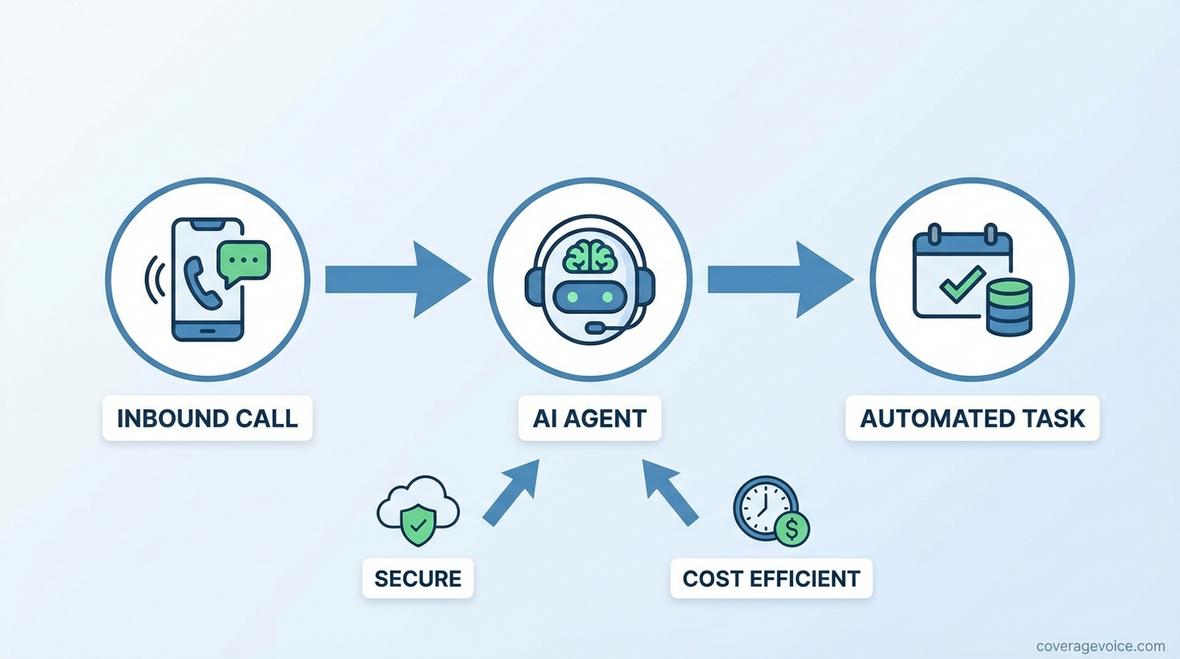
The visual above illustrates the fundamental workflow of AI phone agents: inbound calls are routed to the AI agent, which processes requests securely and cost-efficiently before triggering automated tasks such as appointment confirmations, data updates, or follow-up sequences.
Market Growth and Industry-Wide Adoption
The healthcare AI market is experiencing explosive growth. Research from Digital Health Technology Market Growth: $300 Billion in 2026 indicates that the digital health technology market is estimated to grow to over $300 billion in 2026, driven primarily by AI-powered clinical decision support, ambient documentation tools, and interoperability solutions.
Major technology vendors are rapidly deploying AI agents across healthcare operations. According to AI Agents Rapidly Spreading in Healthcare: Epic, Google, Microsoft, Oracle Deployment, companies including Epic, Google, Microsoft, and Oracle are moving from experimental adoption to full operational deployment, with a sharp focus on validation, testing, and compliance frameworks.
For Medicare-specific organizations, this trend translates to immediate operational benefits. Medicare call centers are leveraging AI phone agents to handle high call volumes during AEP and OEP, while Medicare brokers and FMOs use these systems to qualify leads, schedule appointments, and nurture prospects without expanding headcount.
Core Use Cases for AI Phone Agents in Medicare and Healthcare
Appointment Scheduling and Lead Qualification
One of the most immediate applications of AI phone agents is automating the scheduling and qualification process. When a prospective member calls or responds to a marketing campaign, the AI phone agent can:
- Verify eligibility based on age, ZIP code, and coverage status
- Ask qualifying questions to determine plan suitability
- Schedule appointments directly into agent calendars
- Send confirmation and reminder messages via SMS or email
This workflow drastically reduces the time agents spend on administrative tasks, allowing them to focus on high-value enrollment conversations. Organizations using appointment scheduling automation report significant improvements in conversion rates and agent productivity.
AEP and OEP Enrollment Automation
The Annual Enrollment Period and Open Enrollment Period represent the busiest times for Medicare organizations. AI phone agents can manage thousands of concurrent conversations, handling tasks such as:
- Outbound member outreach to discuss plan changes
- Inbound inquiries about benefits, premiums, and coverage options
- Pre-enrollment data collection and verification
- Post-enrollment confirmation and welcome calls
By deploying AEP and OEP automation, organizations can scale their operations without the cost and complexity of hiring seasonal staff, while maintaining consistent service quality and compliance.
Member Retention and Renewal Campaigns
Retention is just as critical as acquisition in the Medicare market. AI phone agents excel at proactive member engagement, conducting automated outreach to:
- Remind members of upcoming renewal deadlines
- Address concerns or confusion about plan changes
- Collect feedback on member satisfaction
- Identify at-risk members for escalation to human agents
Organizations focused on member retention and renewals use AI phone agents to maintain consistent touchpoints throughout the year, reducing churn and maximizing lifetime value.
After-Hours and Overflow Call Management
Healthcare inquiries don't stop at 5 PM. AI phone agents provide 24/7 availability, ensuring that every call is answered regardless of time or staffing constraints. This capability is particularly valuable for:
- Emergency eligibility verification
- Appointment rescheduling requests
- General plan inquiries outside business hours
- Lead capture from late-night marketing campaigns
With after-hours AI agent capabilities, organizations never miss an opportunity to engage with prospects or support existing members.
HIPAA and CMS Compliance Considerations
Compliance is non-negotiable in Medicare operations. AI phone agents must adhere to strict regulatory standards, including:
- HIPAA Privacy and Security Rules: Ensuring all Protected Health Information (PHI) is encrypted, stored securely, and accessed only by authorized systems
- CMS Marketing and Enrollment Guidelines: Following scripting requirements, documentation standards, and prohibited marketing practices
- TCPA Compliance: Obtaining proper consent before initiating outbound calls, especially to mobile numbers
- Recording and Consent: Capturing and storing call recordings with appropriate disclosure and member consent
Leading AI phone agent platforms are purpose-built for healthcare, with embedded compliance controls, audit trails, and real-time monitoring to ensure every interaction meets regulatory standards. Organizations should prioritize vendors with proven track records in Medicare marketing compliance.
Cost Efficiency and ROI of AI Phone Agents
The economic case for AI phone agents is compelling. Traditional call center models incur significant costs related to hiring, training, turnover, and infrastructure. AI phone agents eliminate or drastically reduce these expenses by:
- Reducing per-call costs: AI agents handle routine inquiries at a fraction of the cost of human agents
- Eliminating idle time: AI systems operate continuously without breaks, maximizing utilization
- Minimizing training overhead: Updates and improvements are deployed instantly across the entire system
- Improving conversion rates: Consistent, optimized interactions increase lead-to-enrollment ratios
Organizations implementing AI phone agents typically see ROI within the first enrollment period, driven by higher lead conversion, reduced staffing costs, and improved member satisfaction.
Integration with Existing Systems and Workflows
AI phone agents deliver maximum value when seamlessly integrated into existing technology ecosystems. Key integration points include:
- CRM Platforms: Syncing contact records, call logs, and disposition data
- Enrollment Systems: Pre-populating applications with data collected during AI conversations
- Calendaring Tools: Automatically scheduling and updating agent appointments
- Marketing Automation: Triggering follow-up campaigns based on AI agent interactions
- Analytics Dashboards: Providing real-time visibility into call volume, conversion metrics, and compliance status
Organizations can explore available integrations to ensure their AI phone agent solution fits seamlessly into their operational workflows.
Real-World Case Studies: AI Phone Agents in Action
Medicare Voice AI Replaces 45 Agents
A large Medicare FMO deployed AI phone agents to handle inbound qualification and appointment scheduling. Within three months, the AI system was managing the workload previously handled by 45 human agents, reducing operational costs by over 60% while improving response times and member satisfaction. Read the full case study here.
Medicare Voice AI Cuts Resolution Time by 30x
A health plan call center implemented AI phone agents for benefits verification and general inquiries. The average resolution time dropped from several minutes to under 10 seconds for routine questions, freeing human agents to focus on complex cases requiring empathy and judgment. Explore the full case study.
Building vs. Buying: What Medicare Organizations Need to Know
Organizations considering AI phone agents face a critical decision: build internally or partner with a specialized vendor. Key considerations include:
- Time to Market: Building requires months or years; vendor solutions deploy in weeks
- Compliance Expertise: Purpose-built platforms include Medicare-specific compliance controls
- Ongoing Maintenance: Vendors handle updates, improvements, and regulatory changes
- Cost Predictability: Subscription models offer predictable pricing vs. uncertain build costs
For most Medicare organizations, partnering with an experienced vendor offers faster ROI, lower risk, and superior compliance outcomes.
Choosing the Right AI Phone Agent Platform
When evaluating AI phone agent solutions, Medicare organizations should prioritize:
- Healthcare-Specific Design: Platforms built for Medicare workflows, not generic call centers
- Compliance Certifications: HIPAA compliance, BAA availability, and CMS expertise
- Integration Capabilities: Pre-built connectors to popular CRMs and enrollment platforms
- Customization Flexibility: Ability to tailor scripts, workflows, and branding
- Transparent Pricing: Clear, predictable cost structures aligned with usage
- Vendor Track Record: Proven success in Medicare and healthcare verticals
Organizations can review detailed pricing options and compare platform capabilities to make informed decisions.
Future Trends: What's Next for AI Phone Agents in Healthcare
The evolution of AI phone agents is accelerating. Emerging trends include:
- Multimodal Interactions: Combining voice, text, and video in a single conversation
- Predictive Engagement: Proactively reaching out to members based on behavioral signals and risk indicators
- Emotion Detection: Analyzing tone and sentiment to route sensitive calls to human agents
- Hyper-Personalization: Tailoring every interaction based on comprehensive member profiles
- Expanded Language Support: Serving diverse populations with multilingual capabilities
Research from Google Cloud 2026 AI Agent Trends Report: Top 5 Healthcare Transformation Trends highlights how agentic AI is reshaping healthcare and life sciences, providing strategic insights for organizations planning their AI roadmaps.
Implementation Best Practices
Successful AI phone agent deployments follow a structured approach:
- Define Clear Objectives: Identify specific use cases, target metrics, and success criteria
- Start Small, Scale Fast: Pilot with a single workflow before expanding to additional use cases
- Prioritize Compliance: Engage legal and compliance teams early in the planning process
- Train and Monitor: Continuously refine AI scripts based on real-world interactions and outcomes
- Measure and Optimize: Track KPIs such as conversion rate, cost per lead, and member satisfaction
- Communicate Change: Prepare staff and members for the introduction of AI-powered interactions
Frequently Asked Questions
How much do AI phone agents cost?
Pricing varies based on call volume, feature complexity, and integration requirements. Most vendors offer per-minute or per-call pricing models, with typical costs ranging from $0.10 to $0.50 per minute. Organizations can explore detailed pricing structures to estimate total costs.
Are AI phone agents HIPAA compliant?
Leading AI phone agent platforms designed for healthcare are HIPAA compliant and provide Business Associate Agreements (BAAs). It's essential to verify compliance certifications and data handling practices before deployment.
Will AI phone agents replace human agents?
AI phone agents augment, rather than replace, human agents. They handle routine, repetitive tasks, allowing human agents to focus on complex, high-value interactions requiring empathy, judgment, and relationship-building.
How long does it take to integrate AI phone agents?
Implementation timelines vary but typically range from 2-6 weeks, depending on integration complexity and customization requirements. Vendors with pre-built connectors and Medicare-specific templates can accelerate deployment.
Do AI phone agents support multiple languages?
Yes, many AI phone agent platforms support multiple languages, enabling organizations to serve diverse member populations and comply with language access requirements.
Conclusion
AI phone agents represent a paradigm shift in how Medicare organizations manage member engagement, enrollment, and operational efficiency. By automating routine interactions, ensuring 24/7 availability, and maintaining rigorous compliance standards, these intelligent systems empower healthcare organizations to scale operations, reduce costs, and deliver exceptional member experiences. As the digital health market surges toward $300 billion in 2026 and major technology vendors accelerate deployment, the question is no longer whether to adopt AI phone agents, but how quickly organizations can implement them to maintain competitive advantage. Organizations ready to transform their Medicare operations should evaluate platforms purpose-built for healthcare, prioritize compliance and integration capabilities, and start with focused pilot programs that demonstrate measurable ROI.
Ready to Transform Your Medicare Enrollment Process?
See how Coverage Voice AI can help you automate Medicare enrollment.