AI Phone Call Assistant For Medicare: Transform Your Enrollment And Member Engagement

Introduction
The Medicare insurance landscape is evolving rapidly, and organizations are under immense pressure to handle high call volumes, maintain compliance, and convert leads efficiently. An AI phone call assistant has emerged as a transformative solution that addresses these challenges head-on. For Medicare brokers, FMOs, health plans, and marketing agencies, implementing an intelligent phone assistant isn't just about automation it's about revolutionizing how you engage with members and prospects while reducing operational costs and ensuring regulatory compliance.
This comprehensive guide explores how AI phone call assistants are reshaping Medicare enrollment, what features matter most, and how organizations can leverage this technology to gain a competitive advantage during critical periods like the Annual Enrollment Period (AEP).
What Is an AI Phone Call Assistant?
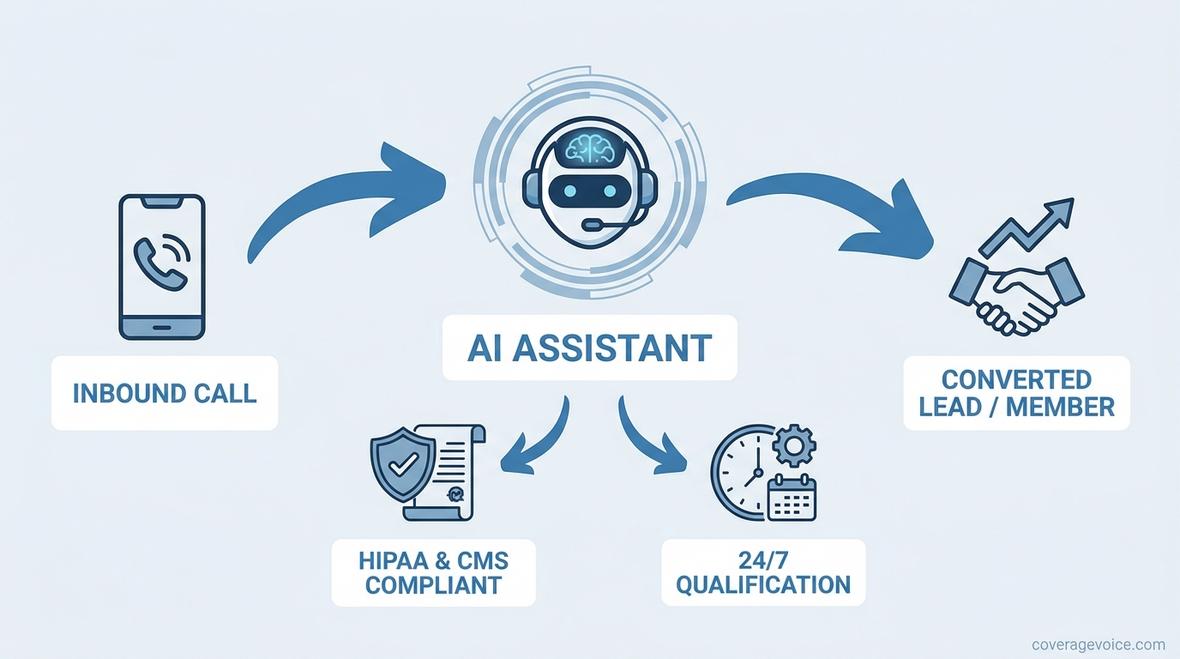
An AI phone call assistant is an intelligent voice automation system that handles inbound and outbound phone conversations using natural language processing and machine learning. Unlike traditional interactive voice response (IVR) systems that rely on rigid menu options, modern AI phone assistants engage in natural, human-like conversations that can qualify leads, answer complex questions, schedule appointments, and even complete enrollment processes.
For Medicare organizations, these assistants are specifically trained on healthcare terminology, CMS guidelines, and HIPAA compliance requirements. They can discuss plan benefits, compare coverage options, verify eligibility, and guide prospects through the enrollment journey all while maintaining the conversational quality that builds trust and rapport.
Key Capabilities of Medicare-Focused AI Phone Assistants
Modern AI phone call assistants designed for the Medicare sector offer several specialized capabilities that differentiate them from generic chatbots or basic IVR systems:
- Natural Conversation Flow: Advanced natural language understanding enables these systems to handle complex questions, interruptions, and multi-topic conversations without losing context.
- Compliance-First Design: Built-in guardrails ensure all conversations adhere to CMS marketing and communication guidelines, TCPA regulations, and HIPAA privacy requirements.
- Omnichannel Integration: Seamless connection with existing CRM systems, scheduling platforms, and enrollment tools creates a unified experience across phone, SMS, and email channels.
- Intelligent Call Routing: Smart escalation protocols identify when human intervention is necessary and transfer calls to the appropriate agent with full context.
- Real-Time Data Access: Integration with eligibility verification systems and plan databases enables assistants to provide accurate, personalized information instantly.
Why Medicare Organizations Need AI Phone Call Assistants
The Medicare insurance sector faces unique operational challenges that make AI phone assistants not just beneficial, but increasingly essential for competitive success.
Managing AEP Call Volume Surge
During the Annual Enrollment Period, Medicare organizations experience call volumes that can increase by 300-500% compared to off-season periods. Traditional staffing models struggle to scale efficiently for this seasonal spike. An AI phone call assistant provides instant scalability, handling unlimited concurrent calls without additional hiring, training, or infrastructure costs. Organizations using AEP automation solutions report significant reductions in wait times and abandonment rates during peak periods.
Cost Reduction Without Sacrificing Quality
The average cost per call in Medicare call centers ranges from $8 to $15 when factoring in agent salaries, benefits, training, technology, and overhead. AI phone assistants reduce this cost to approximately $0.50-$2.00 per conversation while maintaining consistent quality. For organizations processing thousands of calls monthly, this represents substantial savings that can be reinvested into growth initiatives. A detailed analysis of how Medicare voice AI replaced 45 agents demonstrates the potential financial impact.
Ensuring Compliance Consistency
Human agents, despite best intentions and training, can inadvertently make compliance errors especially under pressure during high-volume periods. AI phone call assistants follow scripted compliance protocols perfectly every time, eliminating risks associated with off-script conversations, forgotten disclaimers, or improper benefit representations. Every interaction is automatically documented and auditable, simplifying compliance reviews and reducing regulatory risk.
24/7 Availability and After-Hours Support
Medicare prospects and members don't limit their questions to business hours. Research indicates that nearly 40% of initial contact attempts occur outside traditional 9-5 schedules. An after-hour AI agent ensures no opportunity is missed, qualifying leads, scheduling callbacks, and providing information around the clock without requiring night shift staffing.
Critical Features for Medicare AI Phone Call Assistants
Not all AI phone assistants are created equal. When evaluating solutions for Medicare applications, organizations should prioritize these essential features:
HIPAA and CMS Compliance Architecture
Healthcare-specific compliance isn't optional it's foundational. Your AI phone call assistant must be built on a HIPAA-compliant infrastructure with Business Associate Agreement (BAA) support, encrypted data transmission and storage, and audit logging capabilities. Additionally, the system should incorporate CMS-approved language and scripts, with built-in guardrails preventing prohibited marketing practices. Organizations can learn more about maintaining compliance through comprehensive Medicare marketing compliance solutions.
Advanced Conversational Intelligence
The quality of conversation directly impacts conversion rates. Look for systems that demonstrate:
- Context retention across multi-turn conversations
- Ability to handle interruptions and topic changes naturally
- Emotion detection and appropriate response adjustment
- Multi-language support for diverse member populations
- Accent and dialect recognition for improved understanding
Comprehensive Integration Ecosystem
Your AI assistant should seamlessly connect with existing technology infrastructure, including CRM platforms (Salesforce, HubSpot, custom systems), calendar and scheduling tools, enrollment platforms and carrier systems, telephony infrastructure (VoIP, contact center solutions), and analytics and reporting dashboards. Review available integrations to ensure compatibility with your current technology stack.
Intelligent Lead Qualification and Routing
Effective AI phone call assistants don't just answer questions they actively qualify prospects based on eligibility criteria, plan preferences, urgency indicators, and enrollment readiness. This intelligent qualification ensures that human agents receive only the most promising, well-qualified leads, dramatically improving conversion rates and agent productivity.
Implementation Best Practices for AI Phone Call Assistants
Successfully deploying an AI phone assistant in a Medicare environment requires thoughtful planning and execution. These proven practices help ensure smooth implementation and maximum ROI.
Start with Clearly Defined Use Cases
Rather than attempting to automate everything at once, identify specific high-impact use cases for initial deployment. Common starting points include pre-screening and lead qualification, appointment scheduling and confirmation, frequently asked questions about plans and benefits, eligibility verification and benefit checks, and post-enrollment welcome calls and onboarding. Success with focused implementations builds organizational confidence and provides learning opportunities before expanding to more complex use cases.
Prioritize Training Data Quality
AI phone assistants learn from data, making the quality of training information critical to performance. Invest time in developing comprehensive training datasets that include actual recorded calls (with appropriate consent and anonymization), documented objection handling scenarios, product and benefit information across all plans, regional variations in terminology and questions, and edge cases and exception handling protocols. The more diverse and representative your training data, the better your AI assistant will perform in real-world scenarios.
Design for Human-AI Collaboration
The most effective implementations don't replace human agents entirely they create a collaborative model where AI handles routine, high-volume interactions while humans focus on complex situations, emotional conversations, and relationship building. Establish clear escalation criteria and ensure seamless handoffs between AI and human agents. Organizations implementing Medicare call center solutions find that this hybrid approach maximizes both efficiency and member satisfaction.
Implement Continuous Monitoring and Optimization
AI performance isn't 'set and forget.' Establish processes for regular review of conversation transcripts, monitoring key performance indicators (call completion rates, qualification accuracy, member satisfaction), identifying common failure points or confusion, updating scripts and knowledge bases based on new products or regulations, and conducting periodic compliance audits. Leading organizations treat their AI phone call assistant as a continuously improving asset that gets smarter with each interaction.
Measuring ROI: Key Performance Indicators
To justify investment and guide optimization efforts, track these critical metrics for your AI phone call assistant implementation:
Operational Efficiency Metrics
Monitor cost per conversation compared to human-handled calls, average handle time for different interaction types, call volume capacity and concurrent call handling, after-hours call capture rate, and reduction in call abandonment and wait times. These metrics demonstrate the direct operational impact and cost savings achieved through automation.
Quality and Compliance Metrics
Track first-call resolution rate, member satisfaction scores (CSAT, NPS), compliance incident rate, script adherence percentage, and escalation rate to human agents. These indicators ensure that efficiency gains don't come at the expense of quality or regulatory compliance.
Business Outcome Metrics
Ultimately, AI phone assistants should drive business results. Measure lead qualification rate and quality, appointment show rates for AI-scheduled meetings, conversion rates from qualified lead to enrollment, member retention rates, and revenue per conversation. Organizations tracking these metrics often discover that AI assistants not only cost less but actually improve conversion rates compared to traditional approaches.
Industry-Specific Applications Across Medicare Ecosystem
Different segments of the Medicare ecosystem benefit from AI phone call assistants in unique ways.
Field Marketing Organizations and Brokers
For FMOs and independent brokers, AI phone assistants excel at handling initial lead contact and qualification, scheduling appointments with appropriate agents based on specialization, following up on marketing campaign responses, reactivating aged leads during enrollment periods, and providing comparative plan information without bias. Specialized solutions for Medicare brokers and FMOs address the unique needs of this segment, including multi-carrier quoting and agent routing based on commission structures.
Medicare Advantage Plans and Payers
Health plans leverage AI assistants for member services inquiries, benefits explanation and utilization guidance, enrollment and disenrollment processing, annual wellness visit scheduling, and Stars rating improvement through enhanced member engagement. The capability to handle complex benefit inquiries while maintaining CMS compliance makes AI particularly valuable for payers focused on member engagement.
Marketing Agencies Serving Medicare Clients
Agencies use AI phone assistants to maximize return on advertising spend through immediate lead response, qualify leads before passing to client sales teams, provide 24/7 coverage for campaign-generated calls, track campaign performance through conversation analytics, and demonstrate clear ROI through detailed reporting. Marketing agencies find that AI phone assistants bridge the critical gap between lead generation and sales conversion, dramatically improving overall campaign effectiveness.
Future Trends in AI Phone Call Assistants for Medicare
The technology continues to evolve rapidly, with several emerging capabilities that will further transform Medicare operations:
Predictive Engagement and Proactive Outreach
Next-generation systems will identify members at risk of disenrollment and initiate retention conversations, predict optimal times to contact prospects based on behavioral patterns, proactively reach out regarding coverage gaps or needed preventive services, and anticipate questions based on member demographics and plan selection. These predictive capabilities transform AI from reactive responders to proactive engagement partners.
Enhanced Emotional Intelligence
Advances in sentiment analysis and emotion recognition will enable AI assistants to detect frustration, confusion, or distress in caller voices, adjust tone, pace, and approach based on emotional cues, recognize when empathetic human intervention is needed, and provide appropriate emotional support within compliance boundaries. This emotional intelligence will further close the gap between AI and human interaction quality.
Multilingual and Cultural Adaptation
As Medicare populations become increasingly diverse, AI phone assistants will offer seamless multilingual conversations without language-specific routing, cultural context awareness in communication approaches, dialect and regional variation handling, and accessibility features for hearing or speech impaired callers. These capabilities will be essential for organizations serving diverse communities and addressing health equity goals.
Selecting the Right AI Phone Call Assistant Solution
With numerous vendors entering the Medicare AI space, selecting the optimal solution requires careful evaluation across multiple dimensions.
Key Evaluation Criteria
Assess potential solutions based on Medicare-specific expertise and industry knowledge, proven HIPAA and CMS compliance track record, integration capabilities with your existing technology stack, scalability to handle seasonal volume fluctuations, customization options for your unique processes and offerings, transparent pricing models aligned with your business structure, vendor stability, support quality, and roadmap vision, and documented case studies and references from similar organizations. Organizations can compare leading solutions through resources like vendor comparison analyses to understand relative strengths and capabilities.
Critical Questions to Ask Vendors
During the evaluation process, ensure you receive clear answers to: How is PHI handled and protected in your system? What specific CMS marketing rules are built into your compliance framework? How do you handle call recording and consent requirements? What is your process for updating the system when regulations change? Can you demonstrate the system handling complex, multi-topic Medicare conversations? How quickly can the system be trained on our specific plans and processes? What level of customization is possible without custom development? What analytics and reporting capabilities are included? How do you measure and ensure conversation quality? What is your escalation and support process when issues arise?
Overcoming Common Implementation Challenges
Organizations implementing AI phone call assistants often encounter predictable challenges. Anticipating these obstacles enables proactive mitigation.
Agent and Staff Resistance
Human agents may fear job displacement when AI automation is introduced. Address this through transparent communication about the collaborative model, retraining programs focusing on higher-value activities, involvement of agents in AI training and optimization, clear career pathways in the AI-augmented environment, and sharing success stories demonstrating how AI improves rather than replaces agent roles. When properly positioned, most agents welcome AI assistance that eliminates repetitive tasks and allows them to focus on meaningful member relationships.
Technology Integration Complexity
Connecting AI phone assistants to legacy systems can present technical challenges. Mitigate these through phased integration approaches starting with simpler connections, engaging experienced implementation partners with Medicare system expertise, allocating sufficient technical resources and timeline for integration work, thorough testing in staging environments before production deployment, and maintaining parallel systems during transition periods to minimize risk. The investment in proper integration pays dividends in long-term system reliability and performance.
Maintaining Conversation Quality and Consistency
Early implementations may experience inconsistent performance as the AI learns. Improve quality through extensive testing with diverse scenarios before full deployment, establishing quality review processes with regular transcript audits, creating feedback loops from agents and members to inform improvements, developing comprehensive knowledge bases with detailed product information, and setting realistic expectations about learning curves and continuous improvement timelines. Quality improves steadily with proper attention and optimization processes.
Frequently Asked Questions
How does an AI phone call assistant differ from a traditional IVR system?
Traditional IVR systems rely on menu-driven navigation and keyword recognition, while AI phone call assistants engage in natural, conversational dialogue using advanced natural language processing. AI assistants understand context, handle complex questions, and adapt responses based on the conversation flow creating an experience much closer to speaking with a human agent. For Medicare applications, this means prospects can ask questions in their own words and receive personalized, detailed answers rather than navigating frustrating menu trees.
Can AI phone assistants really maintain HIPAA compliance?
Yes, when properly designed and implemented. Medicare-specific AI phone call assistants are built on HIPAA-compliant infrastructure with encrypted data transmission and storage, automatic audit logging of all interactions, Business Associate Agreements with appropriate safeguards, and access controls limiting who can view protected health information. The key is selecting a vendor with demonstrated healthcare compliance expertise rather than adapting general-purpose AI tools. Resources on HIPAA-compliant AI voice automation provide additional implementation guidance.
What happens when the AI assistant encounters a question it cannot answer?
Quality AI phone call assistants incorporate intelligent escalation protocols. When the system detects uncertainty, encounters a question outside its knowledge base, or identifies emotional distress requiring human empathy, it smoothly transfers the call to a human agent along with full conversation context. This ensures callers receive appropriate assistance without frustration while continuously identifying knowledge gaps that can be addressed through system updates.
How long does it typically take to implement an AI phone call assistant?
Implementation timelines vary based on complexity, but typical Medicare deployments range from 4-12 weeks. Simple implementations focusing on appointment scheduling or basic qualification can launch in 4-6 weeks, while comprehensive deployments with extensive CRM integration, custom workflows, and multiple use cases may require 8-12 weeks. The timeline includes system configuration, knowledge base development, integration with existing systems, testing and quality assurance, agent training on working with the AI, and phased rollout with monitoring.
Will members and prospects accept speaking with an AI instead of a human?
Research consistently shows that when AI phone call assistants provide accurate, helpful information efficiently, most callers are satisfied regardless of whether they're speaking with AI or a human. The key factors are conversation quality, response accuracy, and respect for caller preferences. Best practice implementations inform callers they're speaking with an AI assistant and offer immediate transfer to a human agent if preferred. Many organizations find that satisfaction scores for AI-handled calls match or exceed those for human-handled interactions, particularly for routine inquiries.
Conclusion
The AI phone call assistant represents a fundamental shift in how Medicare organizations manage member and prospect communications. By combining advanced conversational AI with healthcare-specific compliance and integration capabilities, these systems deliver simultaneous improvements in cost efficiency, scalability, compliance consistency, and member experience outcomes that traditional approaches cannot match. For Medicare brokers, FMOs, health plans, and marketing agencies facing intensifying competitive pressure and regulatory complexity, AI phone assistants have evolved from interesting innovation to strategic imperative. Organizations that embrace this technology thoughtfully, with proper planning and continuous optimization, position themselves to thrive in an increasingly automated Medicare ecosystem while those that delay risk falling behind competitors who leverage AI advantages. The question is no longer whether to implement an AI phone call assistant, but how quickly you can deploy one effectively.
Ready to Transform Your Medicare Enrollment Process?
See how Coverage Voice AI can help you automate Medicare enrollment.