AI Voice Agent For Healthcare: Complete Guide To Medicare Enrollment & Patient Engagement
Introduction
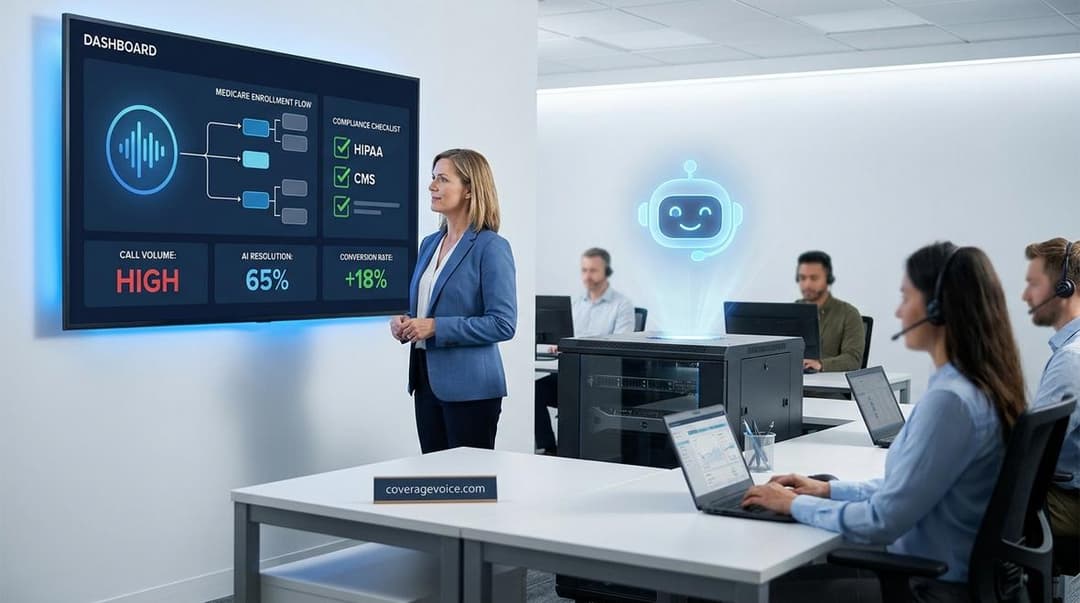
The healthcare industry is experiencing a transformative shift as artificial intelligence reshapes patient interactions, operational efficiency, and member engagement. At the forefront of this revolution stands the AI voice agent for healthcare, a technology that is fundamentally changing how Medicare organizations, health plans, and call centers manage their most critical communications. With AI in healthcare market projected to grow at 37.79% CAGR from 2025-2030, organizations can no longer afford to overlook this powerful automation tool.
For Medicare insurance professionals particularly managers and directors at Field Marketing Organizations (FMOs), marketing agencies, and health plan call centers the pressure to maintain HIPAA and CMS compliance while reducing operational costs and improving conversion rates has never been greater. The Annual Enrollment Period (AEP) brings overwhelming call volumes that traditional staffing models simply cannot handle efficiently. This is where AI voice agents offer a game-changing solution, enabling organizations to scale their operations without sacrificing quality or compliance.
Understanding AI Voice Agents in Healthcare
An AI voice agent for healthcare is an advanced conversational AI system designed to handle patient and member interactions through natural language processing and machine learning. Unlike traditional Interactive Voice Response (IVR) systems that rely on rigid menu options, modern AI voice agents engage in human-like conversations, understand context, and adapt their responses based on the interaction's flow.
These intelligent systems can handle a wide range of healthcare-specific tasks including appointment scheduling, benefit verification, lead qualification, member enrollment, and post-enrollment engagement. For Medicare organizations, this means automating thousands of routine interactions while ensuring every conversation remains compliant with stringent healthcare regulations.
Key Components of Healthcare Voice AI
Effective AI voice agents for healthcare integrate several critical components that distinguish them from generic chatbot solutions. These include speech recognition engines trained on healthcare terminology, natural language understanding modules that grasp medical context, compliance monitoring systems that ensure HIPAA and CMS adherence, and integration capabilities with existing CRM and enrollment platforms.
The most sophisticated systems also incorporate emotional intelligence, detecting caller frustration or confusion and adjusting their approach accordingly. This level of nuanced interaction is particularly valuable during Medicare call center operations where members may be elderly, anxious about their coverage, or unfamiliar with healthcare terminology.
Benefits for Medicare Organizations
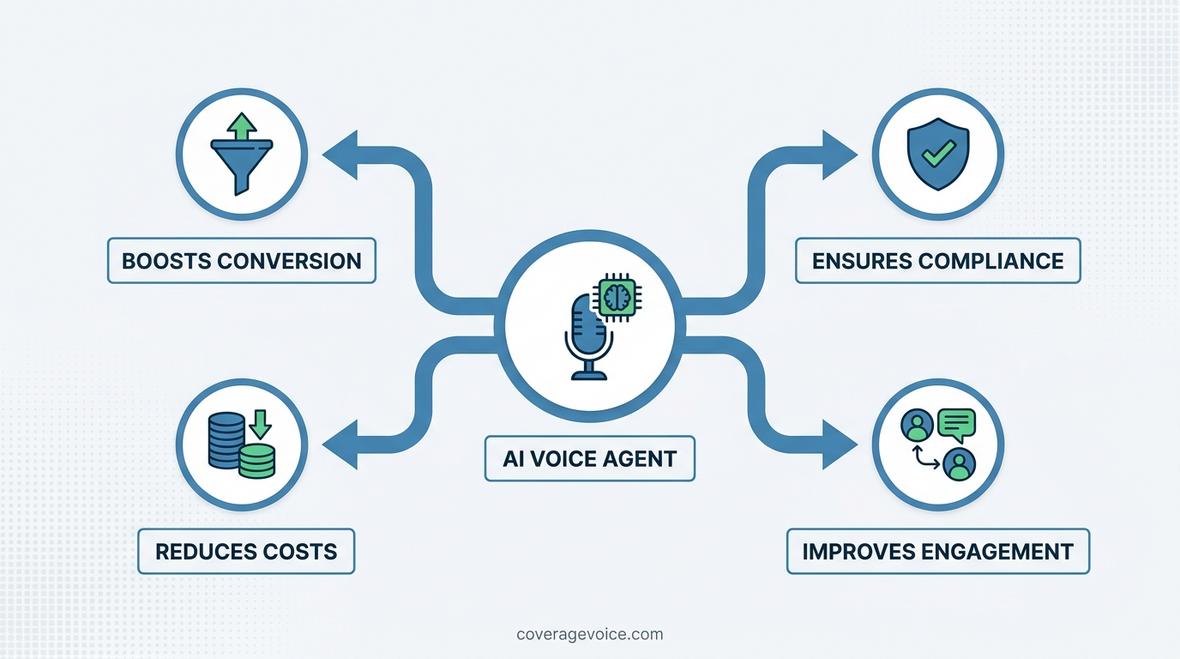
The implementation of an AI voice agent for healthcare delivers transformative benefits across multiple operational dimensions. Understanding these advantages is essential for decision-makers evaluating automation investments.
Dramatic Cost Reduction
Healthcare organizations consistently report 60-80% reductions in operational costs after implementing AI voice agents. Traditional call centers require significant investments in recruitment, training, infrastructure, and ongoing management. Human agents cost approximately $35,000-$50,000 annually when accounting for salaries, benefits, and overhead.
In contrast, AI voice agents operate 24/7 without breaks, vacation time, or sick leave. They handle multiple concurrent conversations without quality degradation and scale instantly during peak periods like AEP without additional hiring. For organizations managing AEP and OEP automation, this scalability represents the difference between capturing opportunities and losing prospects to competitors.
Enhanced Conversion Rates
Speed to lead is critical in Medicare enrollment. Research consistently shows that contacting leads within five minutes increases conversion rates by 400% compared to waiting 30 minutes. AI voice agents excel at immediate response, engaging prospects the moment they express interest.
These systems also maintain conversation quality consistency. While human agent performance varies based on experience, fatigue, and mood, AI voice agents deliver the same high-quality interaction to every caller. They never forget to ask qualifying questions, always present information in the approved compliance framework, and consistently follow the optimal conversation path developed through thousands of interactions.
Guaranteed Compliance
HIPAA and CMS regulations create significant liability for Medicare organizations. A single compliance violation can result in penalties ranging from $100 to $50,000 per violation, with annual maximums reaching $1.5 million. Human errors mishandling protected health information, making unapproved claims, or failing to document consent represent constant risk.
AI voice agents eliminate these risks through programmed compliance. Every interaction follows pre-approved scripts, all conversations are recorded for audit purposes, and the system automatically documents required disclosures and consents. For organizations focused on Medicare marketing compliance, this built-in protection is invaluable.
Improved Member Engagement
Member retention directly impacts profitability in Medicare Advantage plans. Acquiring a new member costs 5-7 times more than retaining an existing one, yet many organizations struggle with post-enrollment engagement due to resource constraints.
AI voice agents enable proactive outreach at scale, conducting new member welcome calls, medication adherence reminders, and annual wellness visit scheduling without human resource limitations. This consistent engagement improves member satisfaction and reduces disenrollment rates, directly impacting plan profitability and Star Ratings.
Critical Use Cases for Medicare Organizations
The versatility of AI voice agents for healthcare extends across the entire member lifecycle. Understanding these specific applications helps organizations identify their highest-value implementation opportunities.
Intelligent Lead Qualification
Not all Medicare leads are created equal. Organizations waste significant resources pursuing prospects who are ineligible, uninterested, or unlikely to convert. AI voice agents transform this process through automated pre-screening that instantly qualifies leads based on age, location, current coverage, health conditions, and purchasing timeline.
This intelligent filtering ensures human agents spend their time exclusively with high-quality prospects ready for enrollment conversations. The system automatically routes qualified leads to the appropriate agent based on specialization, language preference, and availability, maximizing conversion efficiency.
Automated Appointment Scheduling
Scheduling complexity represents a significant operational burden for Medicare agencies. Prospects request appointments outside business hours, agents play phone tag trying to confirm meetings, and no-shows waste valuable selling time.
AI voice agents solve this through intelligent appointment scheduling that operates 24/7. The system checks agent availability in real-time, sends automated reminders via text and email, and even conducts confirmation calls the day before scheduled appointments. Organizations report 40-60% reductions in no-show rates after implementing these automated reminder systems.
Enrollment Process Automation
The Medicare enrollment process involves multiple steps: application completion, document collection, benefit explanation, plan comparison, and final enrollment submission. Each step presents opportunities for prospect dropout and compliance errors.
AI voice agents guide prospects through this journey with enrollment automation that ensures completeness and compliance. The system collects required information conversationally, validates data in real-time, explains benefits clearly using approved language, and even handles electronic signature collection through integrated document platforms.
After-Hours Coverage
Medicare prospects often have questions outside standard business hours. Missing these calls means losing enrollments to competitors with better availability. However, staffing 24/7 call centers is prohibitively expensive for most organizations.
AI voice agents provide comprehensive after-hours support without additional cost. They answer common questions about benefits, premiums, and coverage options, schedule callbacks with human agents, and even complete enrollments for straightforward cases. This extended availability captures opportunities that would otherwise be lost while maintaining cost efficiency.
Proactive Member Retention
Member disenrollment creates significant revenue loss for Medicare Advantage plans. Early identification of at-risk members and proactive intervention can dramatically reduce churn rates.
AI voice agents enable scaled member retention outreach, conducting satisfaction surveys, addressing concerns before they escalate, and educating members about underutilized benefits. The system flags members showing disenrollment signals missed appointments, benefit inquiries, or competitor contact allowing human intervention before it's too late.
Implementation Considerations for Healthcare Organizations
Successfully deploying an AI voice agent for healthcare requires careful planning across several dimensions. Organizations that approach implementation strategically achieve faster ROI and higher adoption rates.
Compliance Framework
Before implementing any AI system in healthcare, organizations must establish a comprehensive compliance framework. This includes conducting privacy impact assessments, developing data handling protocols that meet HIPAA requirements, creating audit trails for all AI interactions, and establishing human oversight mechanisms for complex cases.
Working with vendors who specialize in HIPAA compliant AI voice automation significantly reduces implementation risk. These specialized providers understand CMS marketing requirements, maintain appropriate Business Associate Agreements, and build compliance monitoring into their core platform architecture.
System Integration
AI voice agents deliver maximum value when integrated with existing technology infrastructure. Key integration points include CRM systems for lead management and enrollment tracking, scheduling platforms for appointment coordination, document management systems for enrollment materials, and analytics platforms for performance monitoring.
Organizations should evaluate potential vendors based on their integration capabilities with commonly used Medicare software platforms. Pre-built integrations accelerate deployment and reduce technical complexity, enabling faster time-to-value.
Conversation Design and Training
The quality of AI voice agent interactions depends heavily on conversation design and training data. Organizations should invest time developing conversation flows that reflect their brand voice, address common member questions comprehensively, and guide prospects smoothly toward enrollment.
Initial training requires representative samples of actual member interactions, including various accents, speech patterns, and question types. The system continuously improves through machine learning, but starting with high-quality training data accelerates the learning curve and reduces early-stage errors.
Measuring Success and ROI
Quantifying the impact of AI voice agent implementation enables data-driven optimization and justifies ongoing investment. Healthcare organizations should track key performance indicators across multiple dimensions.
Operational Metrics
Core operational metrics include call handling capacity (calls per hour), average handle time, first-call resolution rate, and after-hours coverage percentage. These metrics directly impact staffing requirements and operational costs, making them essential for calculating ROI.
Conversion and Revenue Metrics
Business impact metrics focus on lead-to-enrollment conversion rates, cost per acquisition, member lifetime value, and revenue per interaction. These figures demonstrate the AI voice agent's contribution to organizational profitability and growth.
Compliance and Quality Metrics
Regulatory adherence metrics include compliance violation rate, script adherence percentage, proper disclosure completion rate, and audit readiness score. These metrics protect organizations from regulatory penalties and reputational damage.
Future Trends in Healthcare Voice AI
The AI voice agent for healthcare continues evolving rapidly, with several emerging trends poised to enhance capabilities further. Emotion AI will enable systems to detect caller sentiment and adjust tone accordingly, creating more empathetic interactions. Multilingual capabilities will expand, enabling seamless conversations in dozens of languages without specialized agents.
Predictive analytics integration will allow AI voice agents to anticipate member needs based on historical patterns, proactively addressing concerns before they escalate. And advanced personalization will enable each interaction to reflect the member's complete history, preferences, and communication style, creating truly individualized experiences at scale.
Frequently Asked Questions
How does an AI voice agent differ from traditional IVR systems?
Traditional IVR systems use rigid menu structures and touch-tone navigation, frustrating callers with limited options and poor user experience. AI voice agents engage in natural conversations, understand context and intent, and adapt responses based on the caller's needs. They can handle complex questions, transfer seamlessly to human agents when necessary, and learn from each interaction to improve performance continuously.
Is an AI voice agent truly HIPAA compliant?
When properly implemented with specialized healthcare vendors, AI voice agents can achieve full HIPAA compliance. This requires encrypted data transmission and storage, appropriate Business Associate Agreements, comprehensive audit logging, access controls, and regular security assessments. Organizations should only work with vendors who demonstrate deep healthcare compliance expertise and maintain appropriate certifications.
What implementation timeline should organizations expect?
Implementation timelines vary based on complexity, but most organizations can deploy basic AI voice agent functionality within 4-8 weeks. This includes system configuration, conversation design, integration with existing platforms, compliance review, and initial testing. More complex deployments with extensive customization and multiple integration points may require 12-16 weeks for full implementation.
How do AI voice agents handle complex or unusual questions?
Advanced AI voice agents use confidence scoring to assess their ability to answer questions accurately. When confidence falls below a threshold, the system smoothly transfers the caller to a human agent with full context about the conversation history. This hybrid approach ensures complex situations receive appropriate human attention while routine interactions benefit from AI efficiency.
Can AI voice agents really improve member satisfaction?
Yes, when implemented thoughtfully. Members appreciate immediate response without hold times, 24/7 availability for questions, consistent information quality, and efficient resolution of routine requests. However, organizations must design experiences that offer easy escalation to human agents when needed and ensure the AI voice agent's tone and approach align with member expectations for healthcare interactions.
Conclusion
The AI voice agent for healthcare represents a fundamental shift in how Medicare organizations manage member interactions, operational efficiency, and compliance requirements. With proven cost reductions of 60-80%, dramatic improvements in conversion rates, and guaranteed regulatory adherence, these systems deliver compelling ROI for FMOs, health plans, and marketing agencies.
As the healthcare AI market continues its rapid growth trajectory, organizations that embrace this technology position themselves for competitive advantage in an increasingly digital marketplace. The question is no longer whether to implement AI voice agents, but how quickly organizations can deploy them to capture the benefits of intelligent automation while maintaining the human touch that healthcare members value.
Ready to Transform Your Medicare Enrollment Process?
See how Coverage Voice AI can help you automate Medicare enrollment.