AI Voice Agents For Medicare: The Complete 2026 Guide To Intelligent Automation & Enrollment

Understanding AI Voice Agents in Healthcare
AI voice agents are revolutionizing how Medicare organizations handle member engagement, enrollment, and operational workflows. These intelligent systems leverage natural language processing, machine learning, and conversational AI to interact with members, qualify leads, schedule appointments, and complete enrollment processes without human intervention. For Medicare brokers, FMOs, health plans, and call centers facing the pressure of Annual Enrollment Period (AEP) surges, compliance requirements, and staffing challenges, AI voice agents represent a transformative solution that balances efficiency with regulatory adherence.
The healthcare industry is experiencing a fundamental shift in patient communication. Scalable patient communication via generative AI voice agents demonstrates how these technologies transform patient engagement by providing dynamic, context-sensitive natural speech interactions while addressing time constraints, staffing shortages, and administrative burdens. This technological evolution is particularly crucial for Medicare organizations where compliance, member satisfaction, and operational efficiency must coexist seamlessly.
Unlike traditional interactive voice response (IVR) systems that rely on rigid menu trees, modern AI voice agents understand context, remember conversation history, and adapt responses based on member needs. This capability is essential in Medicare environments where personalized guidance through complex plan options, eligibility verification, and enrollment documentation requires both technical precision and human-like empathy.
How AI Voice Agents Work: Technology Behind the Transformation
AI voice agents combine several sophisticated technologies to deliver seamless conversational experiences. At their core, these systems integrate automatic speech recognition (ASR) to transcribe spoken language, natural language understanding (NLU) to interpret intent, dialogue management to control conversation flow, and text-to-speech (TTS) synthesis to generate natural-sounding responses.
For Medicare applications, AI voice agents are trained on healthcare-specific language models that understand insurance terminology, plan types, eligibility criteria, and enrollment requirements. These agents can access real-time data from CRM systems, eligibility databases, and enrollment platforms to provide accurate, personalized information during every interaction.
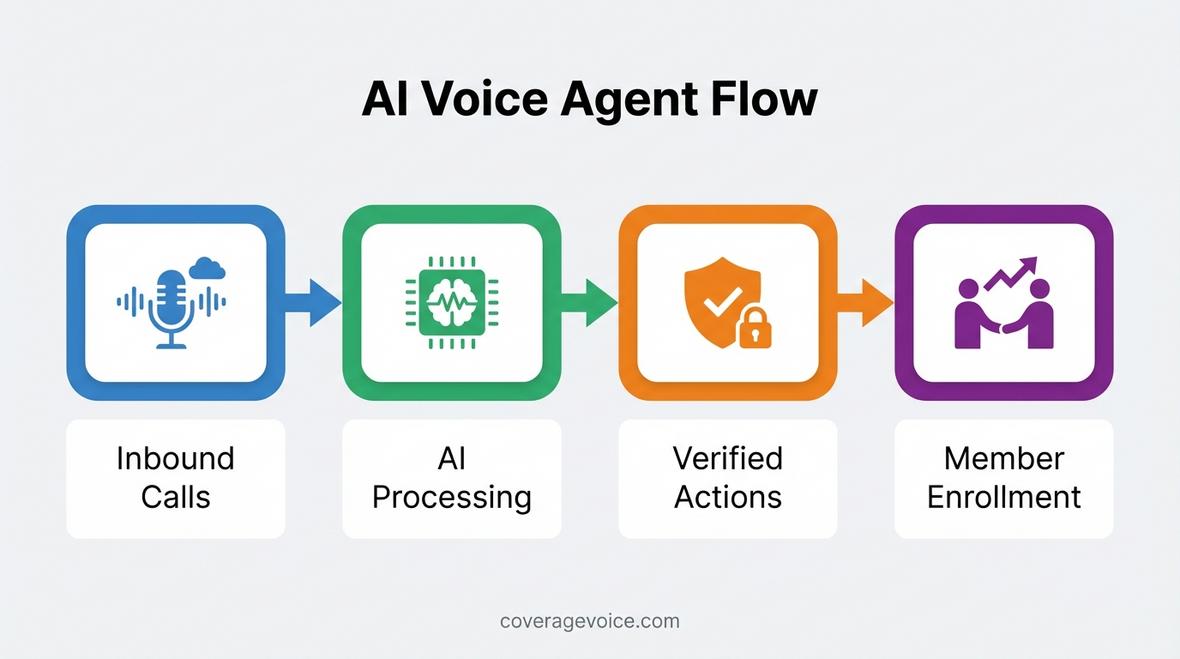
The workflow illustrated above demonstrates how AI voice agents process inbound calls through intelligent automation layers. First, the system captures voice input from incoming calls. Second, AI processing analyzes intent, extracts relevant information, and determines appropriate actions. Third, verified actions ensure all processes meet HIPAA and CMS compliance standards. Finally, successful member enrollment is achieved through automated workflows that previously required multiple human touchpoints.
What distinguishes advanced AI voice agents from simpler chatbots is their ability to handle interruptions, recognize emotional cues, transfer seamlessly to human agents when necessary, and maintain context across multiple interactions. For organizations managing thousands of enrollment calls during AEP, this technological sophistication translates directly to improved conversion rates and operational scalability.
Medicare-Specific Applications of AI Voice Agents
Automated Enrollment Processing
Medicare enrollment involves complex verification steps, plan comparisons, and documentation requirements. AI voice agents streamline this process by guiding members through eligibility verification, plan selection, and application completion. These systems can access real-time plan availability, compare benefits based on member preferences, and initiate enrollment workflows that integrate directly with carrier systems. Organizations implementing Medicare enrollment automation report significant reductions in processing time and improved accuracy compared to manual methods.
Intelligent Lead Qualification
Not all leads are created equal, and AI voice agents excel at rapidly qualifying prospects based on eligibility, plan preferences, location, and enrollment readiness. By conducting initial screening conversations, these agents filter high-intent leads for human agents while nurturing prospects who need additional education or time. This stratification ensures expensive human resources focus on the most promising opportunities while maintaining engagement with the broader lead pool.
AEP and OEP Surge Management
The Annual Enrollment Period creates predictable capacity challenges for Medicare organizations. AI voice agents provide elastic scalability, handling hundreds of simultaneous calls without degradation in service quality. Organizations can deploy AEP and OEP automation solutions that maintain member experience standards while containing labor costs during peak periods. This scalability extends beyond inbound call handling to proactive outreach campaigns for renewals, plan changes, and retention initiatives.
24/7 After-Hours Engagement
Medicare members often have questions outside traditional business hours. AI voice agents provide continuous availability, capturing leads and providing information when human staff are unavailable. This capability is particularly valuable for organizations running digital marketing campaigns that generate leads around the clock. Implementing after-hours AI agents ensures no opportunity is lost due to timing constraints while demonstrating commitment to member accessibility.
Operational Benefits for Medicare Organizations
Dramatic Cost Reduction
Labor represents the largest operational expense for Medicare call centers and broker organizations. Research shows huge potential savings for healthcare executives using AI voice agents, with cost-utility analysis demonstrating significant savings for routine monitoring and enrollment tasks. By automating repetitive interactions, organizations reduce per-enrollment costs while maintaining or improving conversion quality.
The economics are compelling: a single AI voice agent can handle the workload equivalent to multiple full-time employees, operates 24/7 without breaks, requires no benefits or overtime, and scales instantly during demand spikes. Organizations implementing comprehensive voice AI solutions typically achieve ROI within the first enrollment period.
Enhanced HIPAA and CMS Compliance
Regulatory compliance is non-negotiable in Medicare operations. AI voice agents provide inherent advantages for compliance management through consistent script adherence, automatic call documentation, real-time compliance monitoring, and complete interaction recording. Unlike human agents who may inadvertently deviate from approved language or forget disclosure requirements, AI voice agents execute every conversation according to programmed compliance parameters.
Organizations concerned about regulatory risk can implement Medicare marketing compliance solutions that embed CMS scope of appointment requirements, TCPA consent verification, and Do Not Call list management directly into the conversation flow. This proactive approach reduces audit exposure while demonstrating organizational commitment to regulatory excellence.
Improved Conversion Rates
Speed to contact is the strongest predictor of lead conversion in Medicare sales. AI voice agents contact leads within seconds of submission, dramatically improving connection rates compared to human follow-up that may occur hours or days later. Once connected, these agents maintain consistent energy, never experience fatigue, and follow proven conversion frameworks without variation.
Organizations tracking performance metrics consistently report higher conversion rates with AI voice agents handling initial qualification and education, with human agents closing enrollments after warm transfers. This hybrid approach leverages the strengths of both technologies while compensating for their respective limitations.
Key Implementation Considerations
Choosing the Right Technology Partner
Not all AI voice agent platforms are created equal, particularly for highly regulated Medicare applications. Organizations must evaluate providers based on HIPAA compliance certifications, CMS regulation understanding, Medicare-specific training data, integration capabilities with existing systems, and track record with similar organizations. Platforms designed specifically for healthcare and insurance applications offer significant advantages over generic conversational AI tools.
When evaluating options, Medicare organizations should consider whether to build custom solutions or implement proven platforms. The analysis comparing build versus buy costs for Medicare voice AI demonstrates that specialized platforms typically deliver faster implementation, lower total cost of ownership, and reduced technical risk compared to custom development.
System Integration Requirements
AI voice agents deliver maximum value when integrated with existing technology infrastructure. Critical integration points include CRM systems for lead and member data, eligibility verification platforms, carrier enrollment systems, appointment scheduling tools, and compliance documentation repositories. Organizations should prioritize platforms offering pre-built integrations with common Medicare technology systems to accelerate deployment and reduce integration complexity.
Staff Training and Change Management
Introducing AI voice agents requires thoughtful change management to address staff concerns about job displacement and workflow changes. Successful implementations position AI as augmentation rather than replacement, emphasizing how automation handles repetitive tasks while enabling human agents to focus on complex situations requiring empathy, judgment, and relationship building.
Organizations should develop clear communication about role evolution, provide training on working alongside AI systems, and celebrate early wins demonstrating improved efficiency and member satisfaction. Comparing AI agents versus live agents helps teams understand complementary strengths and optimal task allocation.
HIPAA and CMS Compliance Framework
Healthcare compliance represents a foundational requirement for any AI voice agent deployment in Medicare operations. Organizations must ensure their chosen platform maintains Business Associate Agreement (BAA) coverage, implements end-to-end encryption for all voice and data transmission, maintains comprehensive audit logs, restricts data access based on role-based permissions, and undergoes regular security assessments.
Beyond technical security, Medicare organizations must verify that AI voice agent conversations adhere to CMS marketing guidelines, including proper disclosure of plan information, scope of appointment documentation, prohibition against misleading statements, and recording requirements. Platforms designed specifically for Medicare applications embed these requirements directly into conversation logic, reducing compliance burden while providing documentation to support audit defense.
Organizations concerned about specific regulations should review resources addressing TCPA compliance for Medicare voice AI and HIPAA-compliant AI voice automation to understand how advanced platforms address these critical requirements.
Optimizing Member Experience with AI Voice Agents
Technology capabilities mean nothing if members resist interacting with AI systems. Successful implementations prioritize natural conversation design, transparent identification of AI interaction, seamless human escalation paths, personalization based on member history, and emotional intelligence in voice tone and pacing.
Modern AI voice agents can detect frustration, confusion, or urgency in member speech patterns and adjust responses accordingly. They remember previous interactions, reference prior conversations, and provide continuity that members value. When designed thoughtfully, many members prefer AI interactions for routine tasks due to immediate availability, consistent quality, and absence of judgment.
Organizations focused on member satisfaction should implement member retention and renewal solutions that leverage AI for proactive outreach, renewal reminders, and retention campaigns while maintaining the personalized touch that builds loyalty.
Real-World Use Cases Across Medicare Organizations
Field Marketing Organizations (FMOs)
FMOs managing networks of independent agents face unique challenges coordinating lead distribution, ensuring agent compliance, and maintaining consistent member experience across diverse geographic territories. AI voice agents enable FMOs to centralize lead qualification, distribute qualified opportunities to appropriate agents, provide standardized information delivery, and monitor compliance across the agent network. Specialized solutions for Medicare brokers and FMOs address these specific operational requirements.
Health Plans and Payers
Medicare Advantage plans and other payers utilize AI voice agents for member services inquiries, benefits explanation, provider network questions, claims status updates, and preventive care reminders. These applications reduce call center volume while improving member satisfaction through immediate response and 24/7 availability. Plans focused on Star Ratings improvement leverage AI for gaps-in-care outreach, medication adherence support, and health risk assessment completion.
Independent Brokers and Agencies
Independent Medicare brokers often lack the infrastructure of larger organizations but face the same capacity constraints during AEP. AI voice agents level the playing field by providing enterprise-grade technology accessible to smaller operations. Brokers implement voice AI for lead response, appointment setting, plan comparison education, and follow-up nurturing, allowing them to compete effectively against larger competitors while maintaining personalized service for enrolled members.
Measuring Success: Key Performance Indicators
Organizations implementing AI voice agents should establish clear metrics to evaluate performance and ROI. Critical KPIs include contact rate (percentage of leads reached), qualification rate (percentage meeting eligibility criteria), conversion rate (percentage completing enrollment), cost per enrollment (total program cost divided by enrollments), member satisfaction scores, compliance adherence rate, and human agent escalation rate.
Leading organizations establish baseline metrics before implementation, track performance continuously, and iterate conversation design based on data insights. The most sophisticated deployments utilize A/B testing to optimize conversation scripts, personalization strategies, and transfer logic.
Future Trends in AI Voice Agent Technology
The AI voice agent landscape continues to evolve rapidly. Emerging capabilities include enhanced emotional intelligence with more sophisticated sentiment analysis, multilingual support expanding access for diverse Medicare populations, predictive analytics identifying optimal contact timing and messaging, video integration combining voice interaction with visual aids, and agentic AI with autonomous decision-making within defined parameters.
Medicare organizations should partner with technology providers demonstrating continuous innovation while maintaining regulatory compliance as capabilities expand. The convergence of voice AI with other automation technologies creates opportunities for end-to-end enrollment automation that further reduces operational costs while improving member experience.
Getting Started: Implementation Roadmap
Organizations ready to implement AI voice agents should follow a structured approach. Begin with use case prioritization, identifying the highest-value applications based on volume, cost, and complexity. Conduct technology evaluation selecting platforms with Medicare-specific capabilities and proven track records. Design pilot programs testing with limited call volume before full deployment. Establish integration requirements connecting to existing systems. Develop conversation scripts incorporating compliance requirements and best practices. Train staff on new workflows and escalation procedures. Launch pilot programs monitoring performance closely. Iterate based on data analyzing call recordings and member feedback. Scale gradually expanding to additional use cases and higher volumes. Measure ROI documenting cost savings and performance improvements.
Organizations uncertain about implementation approaches can review comprehensive guides on Medicare voice AI implementation that provide detailed frameworks and best practices.
Why Medicare Organizations Choose CoverageVoice
CoverageVoice provides purpose-built AI voice agents designed specifically for Medicare enrollment, member engagement, and compliance requirements. Unlike generic conversational AI platforms, CoverageVoice understands the unique challenges facing Medicare organizations including CMS marketing regulations, HIPAA requirements, AEP surge capacity, dual-eligible complexity, and Star Ratings improvement initiatives.
The platform offers pre-configured workflows for common Medicare use cases, native integrations with popular Medicare CRM and enrollment systems, HIPAA-compliant infrastructure with BAA coverage, Medicare-trained language models, and dedicated support from healthcare technology specialists. Organizations implement CoverageVoice in weeks rather than months, achieving rapid ROI while maintaining full regulatory compliance.
Medicare call centers, FMOs, independent brokers, health plans, and marketing agencies trust CoverageVoice to handle millions of member interactions annually. The platform scales seamlessly from small broker operations to enterprise health plans while maintaining consistent performance and compliance standards.
Frequently Asked Questions
Are AI voice agents HIPAA compliant?
Yes, when implemented properly with appropriate technology platforms. HIPAA-compliant AI voice agents must encrypt all voice and data transmission, maintain comprehensive audit logs, restrict data access appropriately, and operate under Business Associate Agreements. Organizations should verify compliance certifications before deployment.
How do members react to AI voice agents?
Member acceptance varies but generally improves with thoughtful implementation. Keys to positive reception include transparent identification of AI interaction, natural conversation design, immediate availability, and seamless human escalation when needed. Many members prefer AI for routine inquiries due to speed and convenience.
What is the typical ROI timeline for Medicare voice AI?
Most Medicare organizations achieve positive ROI within one enrollment period, typically 3-6 months. The specific timeline depends on implementation scope, call volume, labor costs, and conversion improvements. Organizations should track cost per enrollment before and after implementation to quantify financial impact.
Can AI voice agents handle complex Medicare scenarios?
Modern AI voice agents handle increasingly complex scenarios including multi-plan comparisons, dual-eligible coordination, and subsidy calculations. However, truly exceptional situations may still require human expertise. The optimal approach uses AI for routine interactions with human escalation for edge cases.
How do AI voice agents integrate with existing technology?
Leading platforms offer pre-built integrations with common Medicare CRM systems, enrollment platforms, and scheduling tools. Organizations should prioritize platforms with existing integrations to their technology stack to reduce implementation complexity and accelerate deployment.
Conclusion
AI voice agents represent a transformative technology for Medicare organizations facing operational challenges, compliance requirements, and competitive pressure. These intelligent systems automate repetitive interactions, improve lead conversion, ensure regulatory compliance, and scale seamlessly during demand surges all while reducing operational costs and improving member satisfaction. Organizations that implement AI voice agents strategically position themselves for sustainable growth in an increasingly competitive Medicare market. As technology continues advancing and member expectations evolve, voice AI will transition from competitive advantage to operational necessity. Medicare brokers, FMOs, health plans, and call centers should evaluate their readiness for this transformation and develop implementation roadmaps that balance innovation with regulatory compliance and member experience excellence.
Ready to Transform Your Medicare Enrollment Process?
See how Coverage Voice AI can help you automate Medicare enrollment.