Best AI Voice Agent For Medicare: Complete Guide To Selection & Implementation
Why Medicare Organizations Need the Best AI Voice Agent
The Medicare insurance landscape is undergoing a fundamental transformation. With the AI Voice Agents Market Growth Projections 2026-2033 indicating the global market will reach $35.24 billion by 2033 at a 39.0% CAGR, healthcare organizations are rapidly adopting conversational AI to handle enrollment, member engagement, and operational challenges. The healthcare segment specifically is expected to grow at the fastest rate of 42.0% during this period, driven by unique compliance requirements and high-volume communication needs.
For Medicare brokers, Field Marketing Organizations (FMOs), and health plan call centers, selecting the best AI voice agent isn't just about automation it's about finding a solution that balances regulatory compliance with operational efficiency. During peak periods like the Annual Enrollment Period (AEP), organizations face overwhelming call volumes, compliance scrutiny, and the need to maintain high member satisfaction while controlling costs.
This comprehensive guide examines what makes an AI voice agent truly effective for Medicare operations, covering essential features, implementation strategies, ROI considerations, and selection criteria that matter most to healthcare professionals responsible for enrollment and member engagement.
What Defines the Best AI Voice Agent for Medicare
The best AI voice agent for Medicare operations must meet several critical criteria that extend far beyond basic conversational capabilities. Unlike generic customer service automation, Medicare voice AI requires specialized functionality to address the unique challenges of healthcare enrollment and member communication.
HIPAA and CMS Compliance as Non-Negotiable Foundations
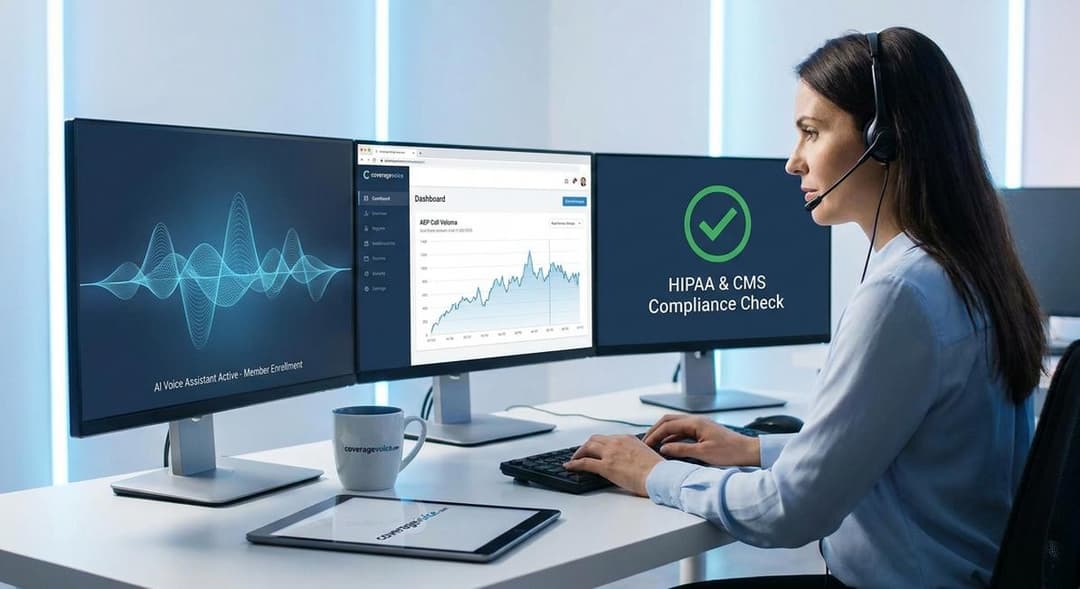
Any AI voice agent handling Medicare communications must maintain strict adherence to HIPAA privacy rules and CMS marketing and communication guidelines. The best solutions implement encryption at rest and in transit, maintain comprehensive audit trails, and provide documentation that supports compliance verification during audits.
Healthcare organizations operating Medicare call centers require voice AI platforms that understand scope of appointment (SOA) requirements, proper consent documentation, and prohibited marketing practices. The technology must prevent compliance violations automatically rather than relying solely on agent training or post-call quality assurance.
Natural Conversational Intelligence and Medicare-Specific Knowledge
The best AI voice agent platforms demonstrate sophisticated natural language understanding that goes beyond scripted responses. They comprehend Medicare-specific terminology, plan types, enrollment periods, and eligibility criteria without requiring beneficiaries to use exact phrases or navigate complex menu systems.
Leading solutions leverage large language models trained on Medicare conversations, enabling them to handle questions about Medicare Advantage, Medicare Supplement plans, Part D prescription coverage, and dual-eligible special needs plans. This contextual understanding allows the AI to guide conversations naturally while gathering qualification information and scheduling appointments appropriately.
Seamless Integration with Existing Medicare Technology Stacks
Medicare organizations typically operate with complex technology ecosystems including CRM systems, quoting engines, enrollment platforms, and telephony infrastructure. The best AI voice agent solutions provide pre-built integrations or robust APIs that connect with platforms like Salesforce, HubSpot, Medicare-specific CRMs, and carrier enrollment systems.
Organizations implementing enrollment automation require voice AI that can pull beneficiary information in real-time, update lead statuses, trigger workflows, and pass qualified prospects to human agents with complete context. Integration capabilities directly impact time-to-value and operational efficiency.
Essential Features of the Best AI Voice Agent Platforms
When evaluating AI voice agent solutions for Medicare operations, specific features separate truly effective platforms from basic automation tools. Understanding these capabilities helps organizations make informed decisions that align with their operational priorities.
24/7 Availability and Unlimited Scalability
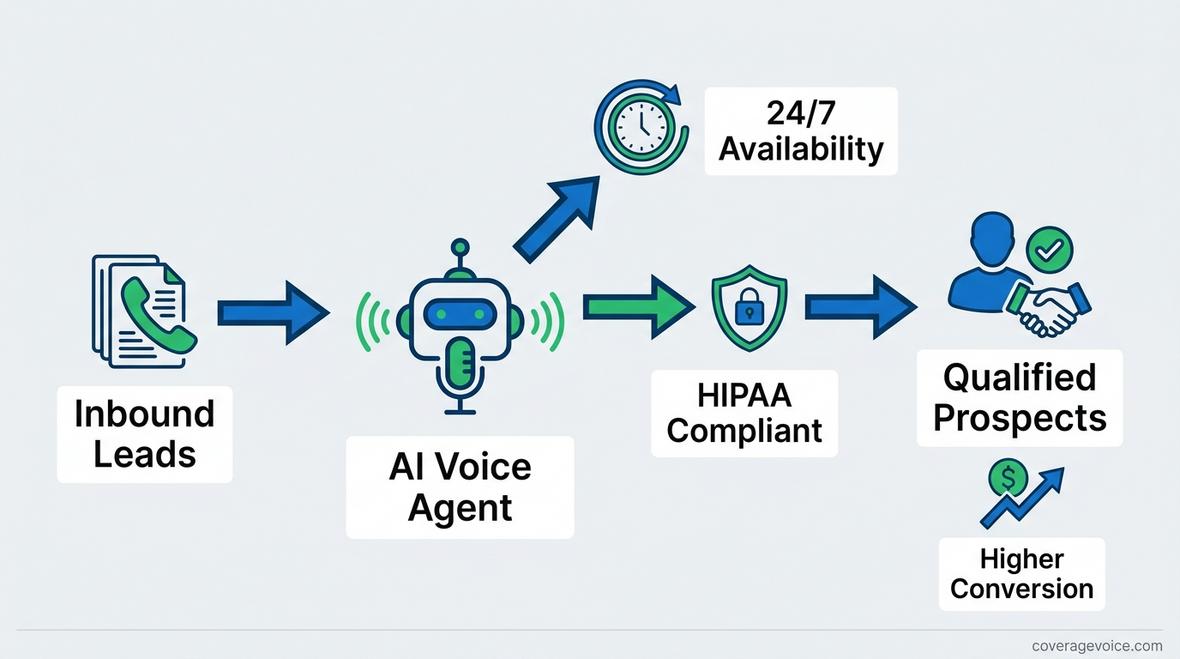
Medicare beneficiaries don't limit their questions to business hours, and enrollment periods create dramatic spikes in call volume. The best AI voice agent platforms provide round-the-clock availability without staffing constraints, handling hundreds or thousands of simultaneous conversations during peak demand.
This capability is particularly valuable for organizations offering after-hour AI agent services, ensuring no lead goes uncontacted and no member question remains unanswered regardless of when they reach out. Research indicates that organizations providing 24/7 response capabilities see 40-60% higher lead conversion rates compared to business-hours-only operations.
Intelligent Lead Qualification and Appointment Setting
The most valuable AI voice agents don't just answer questions they actively qualify leads using Medicare-specific criteria including age, current coverage, enrollment eligibility, and plan preferences. Through natural conversation, the best systems gather information about health conditions, prescription needs, preferred doctors, and budget considerations that inform plan recommendations.
Organizations using pre-screening capabilities report 3-5x improvements in agent productivity by ensuring human experts speak only with qualified, interested prospects. The AI handles initial outreach, qualification, and appointment scheduling, delivering warm transfers or confirmed appointments to the sales team.
Omnichannel Coordination Across Communication Channels
While voice remains the primary channel for Medicare enrollment, the best AI voice agent platforms coordinate across multiple touchpoints including SMS, email, and web chat. This omnichannel client intake approach ensures consistent experiences regardless of how beneficiaries choose to engage.
Advanced platforms remember conversation history across channels, allowing beneficiaries to start a conversation via phone, receive appointment confirmations via SMS, and complete paperwork through email links all within a unified experience that reduces friction and improves enrollment completion rates.
Proactive Outbound Dialing and Follow-Up Automation
Beyond inbound call handling, leading AI voice agent platforms include outbound AI dialer capabilities that enable proactive member engagement. These systems can reactivate dormant leads, conduct renewal outreach, perform satisfaction surveys, and execute compliance-required communications at scale.
Organizations implementing lead reactivation campaigns using AI voice technology report 20-35% reengagement rates from leads previously considered dead, recovering substantial value from existing marketing investments without additional acquisition costs.
Medicare-Specific Use Cases Where the Best AI Voice Agents Excel
The value of AI voice agents becomes most apparent when examining specific Medicare operational challenges. The best platforms deliver measurable improvements across multiple high-impact use cases.
Annual Enrollment Period Volume Management
The AEP creates overwhelming call volume that traditional staffing models struggle to accommodate. Organizations implementing AEP-OEP automation using AI voice agents can handle 10-50x more conversations simultaneously compared to human-only operations, eliminating abandoned calls and ensuring every inquiry receives immediate attention.
During the 2025 AEP, early adopters of Medicare voice AI reported 75-85% reductions in average wait times and 40-60% improvements in lead-to-enrollment conversion rates compared to previous years. The technology enables organizations to capitalize on peak enrollment periods without unsustainable temporary staffing costs.
Dual-Eligible and LIS Beneficiary Outreach
Reaching dual-eligible and Low-Income Subsidy (LIS) beneficiaries requires specialized outreach that addresses unique eligibility criteria and benefits. The best AI voice agent platforms include programming specific to dual-eligible LIS outreach, using appropriate language, emphasizing relevant benefits like $0 premium plans, and navigating complex eligibility verification.
These specialized capabilities enable organizations to serve underserved populations more effectively while maintaining compliance with heightened CMS scrutiny around marketing to vulnerable populations.
Member Retention and Renewal Automation
Acquiring new Medicare members costs 5-7 times more than retaining existing ones, making retention a critical priority. AI voice agents excel at member retention and renewals through proactive engagement, satisfaction monitoring, and early identification of at-risk members.
Leading organizations deploy voice AI for new member welcome calls, quarterly check-ins, benefit utilization reminders, and renewal conversations that prevent disenrollment. This consistent engagement improves member lifetime value while reducing the costly churn that impacts plan profitability and Star Ratings.
Immediate PPC and Marketing Lead Follow-Up
Medicare leads decay rapidly, with conversion probability dropping 80% or more within the first hour after inquiry. The best AI voice agent platforms provide instant PPC ad follow-up, contacting leads within seconds of form submission or call abandonment.
This immediate response dramatically improves conversion rates while reducing cost-per-acquisition from paid marketing channels. Organizations report 3-5x ROI improvements on digital advertising when combining campaigns with instant AI voice follow-up compared to traditional 24-48 hour human callback approaches.
Implementation Considerations for Medicare Organizations
Successfully deploying the best AI voice agent requires careful planning around integration, customization, and change management. Organizations that approach implementation strategically achieve faster time-to-value and higher adoption rates.
Integration with Existing Systems and Workflows
Effective AI voice agent implementation begins with mapping existing workflows and identifying integration requirements. Most Medicare organizations need connections between voice AI and CRM systems, telephony infrastructure, quoting tools, and enrollment platforms. Evaluating platforms based on their integrations capabilities prevents costly custom development and accelerates deployment timelines.
Leading implementations follow a phased approach: starting with basic lead capture and qualification, then adding appointment scheduling, and finally implementing advanced features like outbound campaigns and member retention workflows. This iterative methodology allows teams to learn the technology while delivering incremental value.
Compliance Configuration and Ongoing Monitoring
Configuring AI voice agents for Medicare requires attention to CMS marketing rules, state-specific regulations, and HIPAA requirements. Organizations should work with platforms that provide Medicare marketing compliance templates and regular updates reflecting regulatory changes.
Ongoing compliance monitoring should include random call sampling, keyword flagging for prohibited terms, and documentation verification. The best implementations establish compliance checkpoints before expanding usage, ensuring the technology enhances rather than compromises regulatory adherence.
Measuring ROI and Performance Optimization
According to Forrester Research: Customer Service Automation ROI Analysis, organizations implementing AI-driven customer service in regulated industries typically achieve 40-60% cost-per-contact reductions and 25-40% improvements in first-call resolution rates. For Medicare operations, key performance indicators should include cost per qualified lead, appointment set rate, enrollment conversion rate, member satisfaction scores, and compliance incident rates.
The most successful organizations establish baseline metrics before implementation, then track weekly performance across these dimensions. This data-driven approach enables continuous optimization of conversation flows, qualification criteria, and escalation protocols.
Cost Analysis and ROI Expectations for Medicare Voice AI
Understanding the financial implications of AI voice agent adoption helps Medicare organizations make informed investment decisions. While implementation approaches vary, consistent patterns emerge around costs and returns.
Implementation and Operational Costs
AI voice agent platforms typically offer subscription-based pricing models with costs varying based on conversation volume, feature sets, and integration complexity. Entry-level implementations for small Medicare agencies might start at $500-2,000 monthly, while enterprise deployments for large FMOs or health plans can range from $10,000-50,000+ monthly depending on scale.
Organizations evaluating pricing should consider total cost of ownership including platform fees, integration development, ongoing customization, and internal resources for management. Comparing these costs against current call center expenses typically $15-45 per handled call for Medicare operations provides context for ROI calculations.
Quantifiable Benefits Across Medicare Operations
Research from Capgemini: AI Voice Agent ROI and Implementation Benchmarks demonstrates that enterprise deployments of voice AI typically achieve 50-70% labor cost savings, 40-60% reductions in member acquisition costs, and 30-50% improvements in conversion rates within 6-12 months of implementation.
For Medicare organizations, specific benefits include: reduced cost per enrollment ($150-400 reduction per completed enrollment), improved lead response time (from hours to seconds), increased agent productivity (3-5x more qualified conversations per agent), extended service hours (24/7 availability without overtime costs), and better marketing ROI (40-60% improvement in paid advertising conversion rates).
Case studies from early adopters show that medium-sized Medicare FMOs handling 10,000+ annual enrollments typically achieve full ROI within 3-6 months of implementation, with ongoing savings of $500,000-2,000,000 annually compared to traditional call center models.
How to Select the Best AI Voice Agent for Your Medicare Organization
With numerous AI voice platforms available, Medicare organizations need systematic evaluation criteria that prioritize capabilities most relevant to healthcare enrollment and member engagement.
Medicare Industry Specialization and Healthcare Experience
Generic conversational AI platforms require extensive customization to handle Medicare-specific conversations effectively. The best AI voice agent for Medicare operations comes pre-configured with healthcare terminology, enrollment workflows, and compliance guardrails specific to the industry.
Organizations should prioritize platforms built specifically for Medicare, such as those serving Medicare brokers and FMOs, marketing agencies, and health plans. These specialized solutions deliver faster implementation, better out-of-box performance, and lower customization costs.
Proven Results and Healthcare References
Evaluating AI voice platforms should include reviewing case studies and speaking with existing Medicare customers. Organizations that have documented results such as those detailed in resources like Medicare Voice AI Replaces 45 Agents or Medicare Voice AI Cuts Resolution 30x provide confidence in the platform's ability to deliver promised outcomes.
Reference conversations should explore implementation timelines, integration challenges, ongoing support quality, compliance confidence, and quantified business results. Organizations with similar size, structure, and use cases provide the most relevant validation.
Vendor Viability and Long-Term Partnership Potential
AI voice technology continues evolving rapidly, making vendor stability and innovation roadmap important selection considerations. Organizations should evaluate the platform provider's financial backing, customer base growth, product development velocity, and commitment to the Medicare market specifically.
The best implementations result from true partnerships where the vendor understands Medicare operational challenges and continuously enhances the platform to address emerging needs. Evaluating vendor responsiveness, support quality, and willingness to customize for Medicare-specific requirements helps identify partners positioned for long-term success.
Future Trends in Medicare AI Voice Technology
The AI voice agent landscape continues advancing rapidly, with several emerging capabilities poised to further transform Medicare enrollment and member engagement operations.
Predictive Analytics and Proactive Member Engagement
Next-generation AI voice platforms are incorporating predictive analytics that identify members at risk of disenrollment, anticipate medication adherence issues, and flag social determinants of health concerns. These insights enable proactive outreach that improves retention, enhances Star Ratings, and supports value-based care objectives.
Organizations implementing payers MA plans member engagement strategies increasingly rely on AI-driven insights to prioritize outreach, personalize conversations, and coordinate across care teams shifting from reactive support to proactive population health management.
Multimodal AI Combining Voice, Vision, and Document Processing
Emerging AI platforms are expanding beyond voice to incorporate visual understanding and document processing capabilities. For Medicare operations, this evolution enables AI agents to guide beneficiaries through form completion via screen sharing, extract information from uploaded documents, and verify identity through visual confirmation all within conversational interactions.
These multimodal capabilities streamline complex processes like Medicare enrollment, reducing completion time and error rates while maintaining the natural conversation flow that beneficiaries prefer over purely digital self-service.
Advanced Emotion Detection and Empathetic AI
The best AI voice agent platforms are incorporating sophisticated emotion detection that recognizes frustration, confusion, or satisfaction in real-time. This emotional intelligence enables adaptive responses that provide additional explanation when beneficiaries seem confused, escalate to human agents when frustration is detected, and celebrate successful enrollment milestones appropriately.
For Medicare populations that skew older and may have varying comfort levels with technology, this empathetic AI significantly improves experience quality and conversion outcomes compared to purely transactional automation.
Frequently Asked Questions About Medicare AI Voice Agents
Are AI voice agents truly HIPAA compliant for Medicare operations?
Yes, the best AI voice agent platforms designed for healthcare implement comprehensive HIPAA safeguards including end-to-end encryption, strict access controls, business associate agreements, and audit logging. Organizations should verify that vendors provide HIPAA compliance documentation and conduct regular security assessments. Platforms specializing in HIPAA compliant AI voice automation maintain certifications and undergo third-party audits to validate their security posture.
Will AI voice agents completely replace human Medicare agents?
No, the best implementations use AI voice agents to augment rather than replace human experts. AI handles high-volume, repetitive tasks like lead qualification, appointment scheduling, and routine inquiries, while human agents focus on complex enrollment scenarios, relationship building, and situations requiring empathy and judgment. This hybrid approach maximizes efficiency while maintaining the personal touch that drives Medicare enrollment success. Organizations can learn more about this balance through resources on AI agents vs live agents for Medicare.
How long does it take to implement an AI voice agent for Medicare operations?
Implementation timelines vary based on complexity, but most Medicare organizations can deploy basic AI voice agent functionality within 2-6 weeks. This includes platform configuration, integration with existing CRM systems, conversation flow development, and compliance review. More sophisticated implementations incorporating multiple use cases, extensive integrations, and custom workflows may require 8-12 weeks. Platforms with pre-built Medicare templates and turnkey integrations significantly reduce time-to-value.
Do Medicare beneficiaries accept speaking with AI voice agents?
When implemented well, Medicare beneficiaries often cannot distinguish sophisticated AI voice agents from human representatives and satisfaction scores typically match or exceed human-only operations. The key is ensuring the AI provides accurate information, responds naturally to questions, and seamlessly transfers to human agents when appropriate. Transparency about AI usage varies by organization, but studies show that beneficiaries primarily care about getting accurate answers quickly rather than whether they're speaking with AI or humans.
What's the cost difference between AI voice agents and traditional call centers?
AI voice agents typically cost 60-80% less per conversation than traditional call center operations. While human-handled Medicare calls cost $15-45 each considering labor, training, management, and infrastructure, AI-handled conversations cost $2-8 each depending on platform and volume. For organizations handling thousands of calls during AEP, this cost differential represents hundreds of thousands in potential savings while simultaneously improving response times and availability.
Conclusion
Selecting the best AI voice agent for Medicare operations requires balancing technological sophistication with industry-specific requirements around compliance, member experience, and operational efficiency. The platforms that deliver greatest value combine natural conversational capabilities with deep Medicare knowledge, robust integrations, and proven results in healthcare environments.
As the AI voice agent market continues its rapid 39% annual growth trajectory, Medicare organizations that thoughtfully implement these technologies position themselves for sustainable competitive advantage. The key is moving beyond viewing AI as simple automation and instead recognizing it as a strategic capability that enables organizations to serve more beneficiaries, improve enrollment outcomes, and build lasting member relationships all while maintaining the compliance and quality standards essential to Medicare success.
Organizations ready to explore AI voice technology for their Medicare operations should begin with clear use case definition, thorough vendor evaluation using Medicare-specific criteria, and phased implementation approaches that deliver quick wins while building toward comprehensive transformation.
Ready to Transform Your Medicare Enrollment Process?
See how Coverage Voice AI can help you automate Medicare enrollment.