Best IVR Service Provider For Medicare Call Centers In 2026: A Comprehensive Guide

Why Choosing the Best IVR Service Provider Matters for Medicare Organizations
Interactive Voice Response (IVR) technology has evolved from a simple call routing tool into a sophisticated automation platform that can transform Medicare call center operations. For managers and directors at FMOs, health plans, and marketing agencies, selecting the best IVR service provider is a strategic decision that directly impacts operational costs, compliance, and member satisfaction especially during high-volume periods like the Annual Enrollment Period (AEP).
The stakes are particularly high in the Medicare sector. According to Forrester IVR Cost Reduction Data, AI-powered IVR systems correlate with a 30% operational cost reduction in healthcare call centers, with 50% deflection to self-service during high-volume AEP periods. Yet with dozens of vendors claiming to offer the 'best' solution, how do you identify the right partner for your specific needs?
This comprehensive guide examines what truly defines the best IVR service provider for Medicare organizations in 2026, explores market leaders, and provides a decision framework to help you select technology that aligns with your compliance requirements, operational goals, and budget constraints.
What Defines the Best IVR Service Provider in 2026?
The definition of 'best' varies significantly based on your organization's specific requirements. However, Medicare-focused operations share common critical needs that separate truly exceptional IVR providers from generic call center solutions.
HIPAA and CMS Compliance as Non-Negotiables
For Medicare organizations, compliance isn't a feature it's a foundation. The best IVR service provider must offer built-in HIPAA compliance with Business Associate Agreements (BAA), encrypted data transmission, and audit trails that satisfy CMS requirements. Generic IVR systems designed for retail or hospitality simply cannot address the regulatory complexity of Medicare operations.
Solutions like Medicare marketing compliance automation demonstrate how purpose-built platforms integrate compliance directly into the IVR workflow, rather than treating it as an afterthought. This includes automatic consent verification, TCPA-compliant calling protocols, and documentation that survives CMS audits.
High-Volume Scalability for AEP and OEP
Medicare call centers experience dramatic volume fluctuations. A provider handling 500 calls daily might suddenly face 5,000 during AEP. The best IVR service provider must scale instantly without degradation in performance or requiring extensive infrastructure changes.
Cloud-based architectures have become essential for this scalability. Organizations implementing AEP/OEP automation can handle volume spikes without adding proportional staff costs, maintaining service levels even during peak enrollment periods.
AI-Powered Natural Language Understanding
Traditional touch-tone IVR systems frustrate members and limit functionality. Modern Medicare beneficiaries expect conversational interactions. The best providers now incorporate advanced natural language processing (NLP) that understands member intent, handles complex Medicare-specific terminology, and routes calls intelligently based on context rather than simple menu selections.
This technological evolution is detailed in comprehensive resources on AI voice agents for Medicare enrollment, which explain how conversational AI transforms member experience while reducing operational burden.
Market Leaders: Comparing the Best IVR Service Providers
Understanding the competitive landscape helps contextualize your options. According to IVR Market Share Leaders 2025, the top IVR companies by revenue include Avaya Holdings Corp. with $540M (12.5% market share), Cisco at $510M (11.1%), and Genesys at $480M (10.2%), providing important market benchmarks for healthcare call center adoption in high-volume operations.
Enterprise Platforms: Avaya, Cisco, and Genesys
These established players offer robust, feature-rich platforms designed for large-scale operations. They excel in reliability, integration capabilities with existing enterprise systems, and comprehensive support infrastructure. However, their solutions are typically:
- Complex to implement: Deployment timelines often extend 6-12 months with significant IT resource requirements
- Expensive: Licensing models can exceed $100,000 annually before customization costs
- Generic: Healthcare-specific features require extensive customization
- Resource-intensive: Ongoing management demands dedicated technical staff
For large health plans with extensive IT departments and budgets, these platforms provide comprehensive capabilities. For mid-sized FMOs or marketing agencies, the total cost of ownership often proves prohibitive.
Healthcare-Specialized IVR Solutions
A newer category of providers focuses specifically on healthcare and Medicare operations. These platforms offer pre-configured workflows for common Medicare use cases, built-in compliance features, and faster deployment timelines.
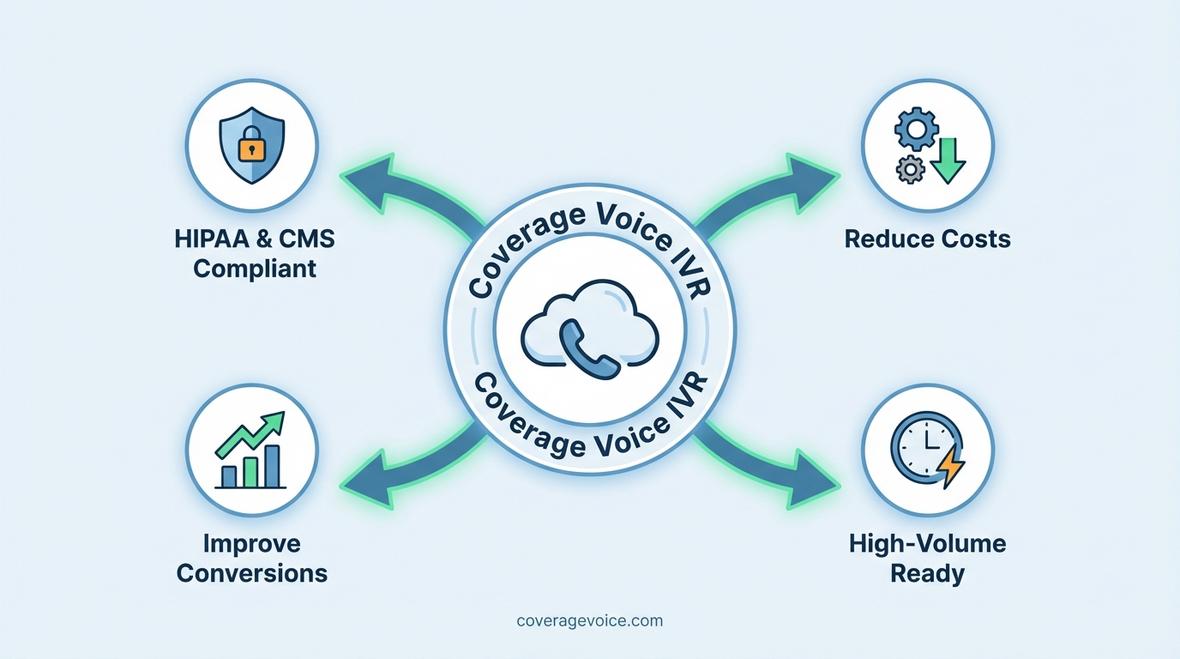
Coverage Voice represents this specialized approach, purpose-built for Medicare call centers with features specifically addressing enrollment automation, member retention, and compliance documentation. Organizations can compare specialized solutions through resources like CareKinesis vs Coverage Voice comparisons to understand functional differences.
Contact Center Platforms with IVR Components
Providers like Five9, Talkdesk, and RingCentral offer IVR as part of broader contact center suites. These platforms provide integrated omnichannel experiences combining voice, chat, and email. The trade-off typically involves:
- Less depth in IVR-specific functionality compared to specialized providers
- Broader contact center features that may exceed your immediate needs
- Subscription models that price based on total seat count rather than IVR usage
- Healthcare features that require third-party integrations
Key Features Every Best IVR Service Provider Must Offer for Medicare
When evaluating potential partners, specific functionality separates adequate solutions from truly exceptional ones in the Medicare context.
Intelligent Call Routing and Skills-Based Distribution
Basic IVR routes calls by department. The best IVR service provider routes by member intent, agent expertise, compliance requirements, and real-time availability. A member calling about a Medicare Advantage plan should reach an MA-certified agent, not a generic customer service representative.
Advanced routing considers factors like language preference, member risk stratification, and even predicted call complexity to optimize first-call resolution rates.
Self-Service Automation for Common Inquiries
Research consistently shows that 40-60% of Medicare call center inquiries involve routine information requests: benefit verification, coverage questions, formulary lookups, and provider network searches. The best providers enable complete self-service resolution for these interactions through conversational IVR.
Features like automated pre-screening allow members to verify eligibility and benefits without agent involvement, reducing wait times while freeing agents for complex enrollment assistance.
Integrated Appointment Scheduling
For brokers and FMOs, converting interested prospects into scheduled consultations is critical. IVR systems should integrate directly with agent calendars, allowing members to schedule enrollment appointments through self-service interfaces.
The appointment scheduling feature demonstrates how sophisticated IVR can handle complex workflows like checking real-time availability, sending confirmation messages, and managing rescheduling requests all without human intervention.
Proactive Outbound Campaign Management
The best IVR service providers don't just handle inbound calls they support outbound member engagement. Whether conducting wellness checks, renewal reminders, or re-engagement campaigns, outbound IVR capabilities extend your operational reach without proportional cost increases.
Solutions incorporating outbound AI dialer technology allow Medicare organizations to maintain consistent member touchpoints throughout the year, not just during enrollment periods, improving retention and satisfaction scores.
Implementation Considerations: Beyond the Technology
Selecting the best IVR service provider involves more than comparing feature lists. Implementation success depends on several practical factors.
Integration with Existing Systems
Your IVR must connect seamlessly with existing CRM platforms, enrollment systems, and telephony infrastructure. Evaluate providers based on:
- Pre-built integrations: Does the provider offer native connections to your current systems?
- API flexibility: Can custom integrations be developed if needed?
- Data synchronization: How does member information flow between systems?
- Implementation support: What technical resources does the vendor provide?
Organizations using Medicare-specific CRMs should review integration capabilities to ensure compatibility before committing to a provider.
Deployment Timeline and Resource Requirements
If you're evaluating solutions in Q2 for AEP implementation, deployment speed becomes critical. Ask potential providers:
- What is the typical implementation timeline from contract to production?
- What internal resources are required (IT staff, subject matter experts, testing personnel)?
- Can the system be deployed incrementally or does it require full cutover?
- What training is required for administrators and agents?
Cloud-based, Medicare-specialized platforms typically deploy in 4-8 weeks versus 6-12 months for enterprise solutions a significant consideration for time-sensitive implementations.
Total Cost of Ownership Analysis
Licensing fees represent only one component of true IVR costs. Comprehensive TCO analysis should include:
- Implementation costs: Professional services, customization, integration development
- Ongoing licensing: Per-user, per-minute, or subscription models
- Maintenance and support: Annual support contracts and upgrade fees
- Internal resource costs: IT staff time for management and troubleshooting
- Opportunity costs: Revenue impact during extended implementation periods
Many organizations find that lower-cost enterprise platforms actually carry higher TCO once implementation and maintenance costs are factored in. Specialized Medicare solutions often provide better total value despite potentially higher per-unit licensing costs.
Measuring Success: KPIs for IVR Performance
The best IVR service provider should help you track and improve specific metrics that matter for Medicare operations.
Operational Efficiency Metrics
Track these core indicators to measure IVR impact on operational costs:
- Call containment rate: Percentage of calls fully resolved through IVR without agent transfer
- Average handle time: Duration reduction for calls that do transfer to agents
- First-call resolution: Percentage of member needs resolved in single interaction
- Agent utilization: How IVR deflection affects agent productivity and capacity
Organizations implementing comprehensive Medicare call center automation typically see 30-40% improvements in these metrics within the first enrollment period.
Member Experience Metrics
Operational efficiency means nothing if member satisfaction declines. Monitor:
- Net Promoter Score (NPS): Member willingness to recommend your organization
- Customer Satisfaction (CSAT): Post-interaction satisfaction ratings
- Self-service adoption rate: Percentage of members successfully using IVR features
- Abandonment rate: Calls terminated before completion or agent connection
Compliance and Business Metrics
For Medicare organizations, regulatory adherence and enrollment outcomes matter as much as operational metrics:
- Compliance documentation rate: Percentage of interactions with complete audit trails
- Conversion rate: Prospects advancing from inquiry to enrollment
- Enrollment completion time: Days from initial contact to submitted application
- Member retention rate: Annual renewal percentages by acquisition channel
The Future of IVR Technology in Medicare
Understanding where IVR technology is heading helps ensure your provider selection remains relevant beyond immediate needs.
Conversational AI and Generative Models
The next generation of IVR leverages large language models to conduct truly natural conversations. Rather than following rigid scripts, these systems understand context, handle interruptions, and adapt responses based on member sentiment and comprehension.
This evolution is explored in depth through resources on voice AI for healthcare transformation, which detail how generative AI is reshaping member engagement.
Predictive Analytics and Member Journey Orchestration
The best IVR service providers are integrating predictive analytics to anticipate member needs before they call. By analyzing historical interaction patterns, enrollment status, and demographic factors, systems can proactively initiate outreach or customize IVR experiences based on predicted intent.
This capability becomes particularly valuable for retention, where identifying at-risk members and triggering appropriate interventions can significantly reduce disenrollment rates.
Omnichannel Consistency
Members increasingly expect seamless experiences across channels starting a question via IVR, continuing through chat, and completing via agent call without repeating information. The best providers now offer true omnichannel orchestration where member context persists across all touchpoints.
Making Your Decision: A Framework for Selecting the Best IVR Service Provider
With numerous options and complex considerations, a structured evaluation framework helps ensure you select the provider that truly fits your needs.
Phase 1: Requirements Assessment
Before engaging vendors, document your specific needs:
- Current call volumes and projected growth
- Peak period requirements (AEP/OEP capacity needs)
- Existing technology infrastructure and integration requirements
- Compliance and regulatory constraints
- Budget parameters (implementation and ongoing)
- Timeline constraints and deployment urgency
Phase 2: Vendor Evaluation
Develop a scoring matrix evaluating providers across categories:
- Functional fit: Does the platform address your specific Medicare use cases?
- Compliance capabilities: Are HIPAA and CMS requirements natively supported?
- Implementation complexity: Can you deploy within your timeline with available resources?
- Scalability: Does the architecture support your growth projections?
- Total cost of ownership: What are complete 3-year costs including implementation?
- Vendor stability: Is the provider financially stable with a track record in healthcare?
Phase 3: Pilot and Validation
Never select an IVR provider without conducting a limited pilot. Test with real call scenarios, actual members (if possible), and representative volume. Measure the KPIs that matter most to your organization during the pilot period.
This validation phase often reveals integration challenges, user experience issues, or performance limitations not apparent during sales presentations.
Conclusion
Selecting the best IVR service provider for your Medicare organization requires balancing technical capabilities, compliance requirements, implementation complexity, and total cost considerations. While enterprise platforms from market leaders like Avaya, Cisco, and Genesys offer comprehensive functionality, Medicare-specialized solutions often provide better value through purpose-built features, faster deployment, and lower total cost of ownership. The ideal provider combines AI-powered natural language understanding, HIPAA-compliant architecture, high-volume scalability, and seamless integration with your existing systems. By following a structured evaluation framework assessing requirements, scoring vendors objectively, and validating through pilots you can confidently select technology that transforms operational efficiency while enhancing member experience throughout the enrollment lifecycle.
Frequently Asked Questions
What is the average cost of implementing an IVR system for Medicare call centers?
Implementation costs vary significantly based on platform complexity and organizational size. Enterprise solutions typically range from $100,000-$500,000 for initial deployment, while specialized Medicare platforms may range from $25,000-$100,000. Ongoing costs depend on usage models (per-minute, per-user, or flat subscription), generally ranging from $2,000-$20,000 monthly for mid-sized operations.
How long does IVR implementation typically take?
Implementation timelines range from 4 weeks for cloud-based Medicare-specialized platforms to 6-12 months for complex enterprise solutions requiring extensive customization and integration. Organizations with AEP deadlines should begin evaluation at least 6 months prior to target deployment.
Can IVR systems integrate with existing Medicare CRM platforms?
Modern IVR providers offer integration capabilities through APIs, pre-built connectors, or custom development. Medicare-specialized platforms typically include native integrations with common Medicare CRMs, while enterprise solutions may require custom integration development. Always validate integration capabilities during vendor evaluation.
What call containment rates should I expect from a quality IVR system?
Industry benchmarks suggest 30-50% call containment rates for healthcare IVR systems, meaning 30-50% of calls are fully resolved without agent transfer. Medicare-specialized systems with conversational AI capabilities often achieve 40-60% containment for routine inquiries like benefit verification and provider searches.
How do I ensure my IVR system remains HIPAA compliant?
HIPAA compliance requires selecting a provider that offers Business Associate Agreements, encrypted data transmission and storage, comprehensive audit logging, and regular security assessments. Verify that the provider has healthcare clients and can demonstrate compliance documentation. Medicare-specialized providers typically build compliance into core architecture rather than treating it as an add-on feature.
Ready to Transform Your Medicare Enrollment Process?
See how Coverage Voice AI can help you automate Medicare enrollment.