Is Read.AI HIPAA Compliant? What Medicare Organizations Need To Know In 2026

Understanding HIPAA Compliance for AI Tools in Healthcare
As Medicare organizations increasingly adopt artificial intelligence to streamline operations, the question 'is Read.AI HIPAA compliant' has become critical for decision-makers managing sensitive health information. HIPAA (Health Insurance Portability and Accountability Act) compliance isn't optional for organizations handling protected health information (PHI)—it's a legal requirement that carries significant penalties for violations.
The stakes are particularly high in the Medicare sector, where call centers, Field Marketing Organizations (FMOs), and health plans process thousands of member conversations daily. According to the IBM Cost of a Data Breach Report 2025 healthcare stats, the average cost of a healthcare data breach reached $10.93 million in 2025, with AI-driven compliance tools reducing incident rates by 35% through automated monitoring. This statistic underscores why Medicare professionals must carefully evaluate the compliance posture of any AI meeting assistant before implementation.
Read.AI markets itself as an AI-powered meeting assistant that records, transcribes, and summarizes conversations across platforms like Zoom, Google Meet, and Microsoft Teams. For Medicare brokers, health plan call centers, and marketing agencies handling enrollment calls, benefits discussions, and member outreach, the compliance question isn't just about features it's about regulatory risk, member trust, and operational continuity.
What Makes an AI Tool HIPAA Compliant?
Before examining whether Read.AI meets HIPAA standards, it's essential to understand what HIPAA compliance actually requires for AI tools used in healthcare settings.
Core HIPAA Requirements for AI Vendors
HIPAA compliance for AI meeting assistants involves several non-negotiable elements:
- Business Associate Agreement (BAA): Any vendor that processes, stores, or transmits PHI must sign a BAA acknowledging their compliance responsibilities and liability for breaches.
- Data Encryption: PHI must be encrypted both in transit (during transmission) and at rest (when stored), using industry-standard encryption protocols.
- Access Controls: Only authorized personnel should access PHI, with role-based permissions, multi-factor authentication, and audit logs tracking all access.
- Data Minimization: Systems should collect only the minimum necessary PHI required for the intended purpose.
- Audit Trails: Comprehensive logging of all PHI access, modifications, and transmissions to enable breach investigation and compliance verification.
- Breach Notification: Documented procedures for identifying, reporting, and mitigating data breaches within legally required timeframes.
For Medicare organizations specifically, CMS (Centers for Medicare & Medicaid Services) adds additional layers of oversight through marketing and communication guidelines that govern how member information can be recorded, stored, and used.
Special Considerations for Meeting Recording AI
Meeting assistants like Read.AI present unique compliance challenges because they automatically join virtual meetings, record audio/video, capture screen shares, and generate transcripts all of which may contain PHI when discussing member benefits, health conditions, or enrollment details.
Key compliance concerns include:
- Whether participants are properly notified before recording begins
- How long recordings and transcripts are retained
- Where data is stored geographically (HIPAA has specific requirements about data sovereignty)
- Whether AI models are trained on customer data (which would constitute an unauthorized use of PHI)
- How data is transmitted to third-party AI providers like OpenAI or Google
These factors make evaluating 'is Read.AI HIPAA compliant' more complex than simply checking for encryption or access controls.
Read.AI HIPAA Compliance Status: What We Know
As of early 2026, Read.AI's public documentation provides limited specific information about HIPAA compliance. Here's what Medicare organizations need to understand about Read.AI's compliance posture:
BAA Availability and Limitations
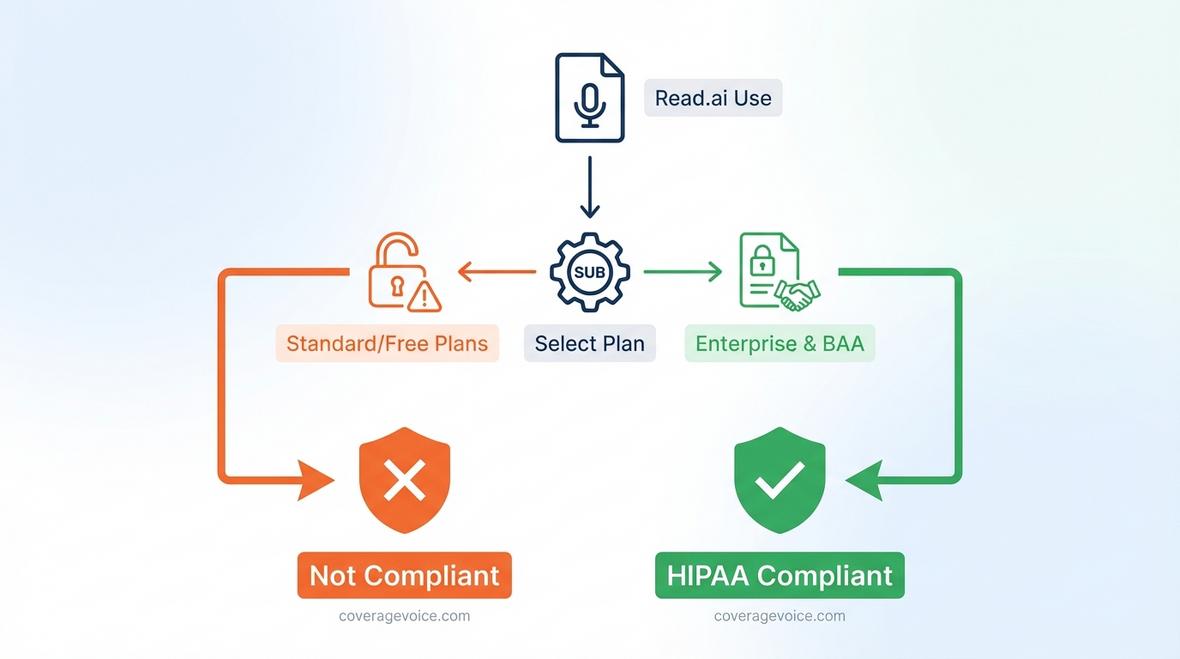
Read.AI does offer Business Associate Agreements to enterprise customers, but this feature is typically restricted to their highest-tier plans. For most Medicare brokers, small FMOs, or individual agents using standard subscription plans, a BAA may not be available or may require custom enterprise pricing.
This tiered approach to compliance creates a significant challenge: organizations handling PHI cannot legally use Read.AI without a signed BAA, regardless of how useful the tool might be. The absence of BAA availability at lower price points effectively disqualifies Read.AI for many small-to-medium Medicare organizations operating on tight budgets during AEP (Annual Enrollment Period).
Data Storage and Processing Concerns
Read.AI processes meeting data through cloud infrastructure, and understanding where this data resides is critical for HIPAA compliance. Questions Medicare organizations should ask include:
- Are recordings stored on HIPAA-compliant servers with appropriate physical and logical safeguards?
- Does Read.AI use sub-processors (like AWS or Google Cloud) that are themselves HIPAA-compliant with proper BAAs in place?
- How long are recordings and transcripts retained, and can customers configure retention policies to meet their compliance requirements?
- Can customers request complete data deletion, and is this deletion verifiable?
Without transparent answers to these questions readily available in Read.AI's public documentation, Medicare compliance officers face difficulties conducting proper risk assessments.
AI Model Training and PHI Exposure
A critical but often overlooked aspect of HIPAA compliance for AI meeting tools is whether customer data is used to train or improve AI models. If Read.AI uses meeting transcripts containing PHI to enhance its natural language processing capabilities, this could constitute an unauthorized disclosure of PHI.
Medicare organizations must explicitly confirm with vendors that:
- No PHI is used for model training without explicit consent
- AI processing occurs in isolated environments that prevent cross-customer data contamination
- Any third-party AI providers (like OpenAI's GPT models) are HIPAA-compliant and covered under appropriate BAAs
The lack of detailed public documentation on these points makes it difficult to conclusively answer 'is Read.AI HIPAA compliant' without direct vendor engagement and legal review.
Compliance Gaps Medicare Organizations Should Consider
Even when vendors offer BAAs, Medicare organizations must evaluate whether the tool's architecture and workflows align with HIPAA's spirit and CMS's additional requirements.
Participant Consent and Notification
HIPAA requires that individuals be informed when their health information is being collected and how it will be used. When Read.AI automatically joins meetings and begins recording, several compliance questions arise:
- Are all participants adequately notified before PHI is discussed?
- Do Medicare beneficiaries understand their information is being recorded by an AI system?
- Can participants opt out of recording while still participating in the call?
For Medicare call centers conducting enrollment or benefits verification calls, these consent requirements are not optional. CMS marketing guidelines require explicit disclosure of recording practices, and failure to obtain proper consent can result in both HIPAA violations and CMS sanctions.
Access Controls and Role Limitations
Medicare organizations often have complex team structures with varying levels of access to member information. Health plan employees, contracted agents, marketing agency staff, and FMO personnel all require different access levels based on their business need to know.
When evaluating whether Read.AI is HIPAA compliant for your organization, consider:
- Can you restrict which team members see recordings of calls containing PHI?
- Does Read.AI support granular role-based access controls aligned with your compliance policies?
- Can you prevent certain meetings from being recorded or transcribed when sensitive information will be discussed?
General-purpose meeting assistants often lack the granular controls necessary for healthcare-specific compliance, creating gaps that organizations must address through policy, training, or additional technology layers.
Integration with Existing Compliance Infrastructure
Medicare organizations typically have established compliance workflows, including:
- Quality assurance reviews of agent calls
- Automated PHI detection and redaction systems
- Compliance monitoring dashboards
- Incident response procedures
The question 'is Read.AI HIPAA compliant' must extend to whether it integrates with these existing systems. If Read.AI operates as a siloed tool without API connectivity to your compliance infrastructure, it creates visibility gaps that increase risk.
Organizations implementing Medicare marketing compliance solutions need AI tools that enhance rather than complicate their compliance posture.
HIPAA-Compliant Alternatives for Medicare Organizations
Given the complexity and potential limitations of Read.AI for Medicare use cases, it's worth exploring purpose-built alternatives designed specifically for healthcare compliance.
CoverageVoice: A Medicare-Focused Solution
Unlike general-purpose meeting assistants, CoverageVoice is built specifically for Medicare and health insurance workflows with HIPAA compliance integrated from the ground up.
Key differentiators include:
- Standard BAAs: Business Associate Agreements are available across all plan tiers, not just enterprise customers, making compliance accessible for organizations of all sizes.
- Healthcare-Specific Architecture: Purpose-built for Medicare enrollment, member engagement, and benefits verification with CMS compliance controls embedded in the platform.
- Granular Consent Management: Automated consent capture and documentation aligned with both HIPAA and CMS marketing guidelines.
- PHI Detection and Redaction: AI-powered identification of sensitive information with automatic redaction options to minimize PHI exposure.
- Audit-Ready Logging: Comprehensive audit trails documenting all data access, modifications, and transmissions to support compliance investigations.
For Medicare brokers and FMOs handling high volumes of enrollment calls during AEP, having a compliance-first platform eliminates the need to retrofit general tools for healthcare use.
Feature Comparison from a Compliance Perspective
When comparing Read.AI to healthcare-specific alternatives like CoverageVoice, consider these compliance dimensions:
| Compliance Feature | Read.AI | CoverageVoice |
|---|---|---|
| BAA Availability | Enterprise plans only | All plan tiers |
| Healthcare-Specific Design | General purpose | Medicare-optimized |
| CMS Guideline Alignment | Requires custom configuration | Built-in compliance controls |
| PHI Redaction | Manual or third-party required | Automated detection and redaction |
| Consent Documentation | Basic recording notice | HIPAA and CMS-compliant consent workflows |
| Compliance Audit Support | Standard logging | Healthcare-specific audit trails |
This comparison highlights why 'is Read.AI HIPAA compliant' is the wrong question the better question is whether Read.AI is optimally compliant for Medicare-specific workflows.
Implementation Best Practices for Compliant AI Meeting Tools
Whether you choose Read.AI (with appropriate enterprise safeguards) or a Medicare-specific solution like CoverageVoice, implementing AI meeting tools in a HIPAA-compliant manner requires careful planning.
Pre-Deployment Compliance Checklist
Before rolling out any AI meeting assistant to teams handling PHI:
- Conduct Vendor Risk Assessment: Review the vendor's security documentation, compliance certifications, and breach history.
- Negotiate and Execute BAA: Ensure the Business Associate Agreement clearly defines data handling responsibilities, breach notification procedures, and liability allocation.
- Map Data Flows: Document exactly where PHI travels from initial capture through storage, processing, and eventual deletion.
- Configure Privacy Settings: Disable any features that share data with third parties not covered under your BAA.
- Establish Access Policies: Define which roles can access recordings, transcripts, and AI-generated summaries containing PHI.
- Create User Training: Educate staff on proper use, consent requirements, and incident reporting procedures.
- Test Breach Response: Conduct tabletop exercises simulating data breaches to verify your incident response procedures work with the new tool.
Ongoing Compliance Monitoring
HIPAA compliance isn't a one-time checkbox it requires continuous monitoring and adaptation. For AI meeting tools, this includes:
- Regular audits of access logs to identify unusual patterns or unauthorized access
- Periodic review of vendor security certifications and compliance status
- Testing of data deletion procedures to ensure PHI can be completely removed when required
- Updates to privacy policies and consent forms as tool capabilities evolve
- Staff retraining when features change or new compliance risks emerge
Organizations using AEP and OEP automation tools must be particularly vigilant during high-volume enrollment periods when compliance shortcuts become tempting.
Cost of Compliance vs. Cost of Non-Compliance
When evaluating 'is Read.AI HIPAA compliant' for your organization, the financial equation extends beyond subscription pricing.
Direct Costs of HIPAA Violations
HIPAA violations carry substantial financial penalties:
- Tier 1 (Unknowing): $100-$50,000 per violation
- Tier 2 (Reasonable Cause): $1,000-$50,000 per violation
- Tier 3 (Willful Neglect, Corrected): $10,000-$50,000 per violation
- Tier 4 (Willful Neglect, Not Corrected): $50,000 per violation
Annual maximums can reach $1.5 million per violation category. For a Medicare FMO processing thousands of enrollment calls annually, even a single breach affecting multiple members could result in catastrophic penalties.
Indirect Costs: Reputation and Operations
Beyond direct fines, HIPAA breaches carry hidden costs:
- Member Trust Erosion: Medicare beneficiaries who learn their health information was mishandled are unlikely to renew or refer others.
- CMS Sanctions: Health plans and FMOs may face additional penalties from CMS, including enrollment suspensions during critical periods.
- Legal Fees: Breach investigation, notification, and potential lawsuits generate substantial legal expenses.
- Operational Disruption: Breach response diverts staff from revenue-generating activities like enrollment and member services.
These indirect costs often exceed direct penalties, making proactive compliance investment far more cost-effective than reactive breach management.
ROI of Purpose-Built Compliant AI Solutions
While healthcare-specific AI tools like CoverageVoice may have higher upfront costs than general tools like Read.AI, their compliance-first architecture delivers measurable ROI:
- Reduced Compliance Staff Time: Automated consent management and PHI detection eliminate manual compliance reviews.
- Lower Breach Risk: Purpose-built controls reduce the probability of costly violations.
- Faster Deployment: Pre-configured compliance features accelerate time-to-value compared to customizing general tools.
- Audit Efficiency: Healthcare-specific audit trails simplify regulatory examinations and reduce preparation costs.
For organizations handling enrollment automation, these efficiencies translate directly to cost savings and competitive advantage.
Critical Questions to Ask AI Meeting Tool Vendors
When evaluating any AI meeting assistant for Medicare use including assessing 'is Read.AI HIPAA compliant'—ask vendors these specific questions:
BAA and Data Handling
- Do you provide a Business Associate Agreement, and at what plan tier is it available?
- Where is customer data stored geographically, and what certifications does your infrastructure hold (SOC 2, HITRUST, etc.)?
- Do you use sub-processors for any data handling, and are they all covered under appropriate BAAs?
- What is your data retention policy, and can customers configure retention periods to meet their compliance requirements?
- How is data deletion handled, and can you provide verification of complete removal?
AI Processing and Model Training
- Is customer data (including transcripts and recordings) used to train or improve your AI models?
- What third-party AI providers do you use, and are they HIPAA-compliant with appropriate safeguards?
- How do you prevent cross-contamination of customer data in multi-tenant environments?
- Can customers opt out of any AI processing that isn't essential to core functionality?
Security and Access Controls
- What encryption standards do you use for data in transit and at rest?
- Do you support role-based access controls with granular permission settings?
- What authentication methods are available (multi-factor, SSO, etc.)?
- How are audit logs maintained, and can they be exported for compliance review?
- What is your breach notification procedure and timeline?
Compliance Support and Documentation
- Do you provide compliance documentation (security whitepaper, penetration test results, etc.)?
- Can you support our audit process with evidence of your compliance controls?
- What compliance training do you provide for administrators and end users?
- Do you have healthcare customers who can serve as references for your compliance capabilities?
Vendors unable or unwilling to answer these questions transparently should be carefully reconsidered, regardless of their feature set or pricing.
The Future of AI and Compliance in Medicare
As AI becomes increasingly central to Medicare operations, regulatory frameworks are evolving to address new risks and opportunities.
Emerging Regulatory Trends
Several regulatory developments will shape how Medicare organizations evaluate AI compliance:
- CMS AI Guidance: The Centers for Medicare & Medicaid Services is developing specific guidance on AI use in member communications and enrollment processes.
- State Privacy Laws: California's CCPA, Virginia's CDPA, and similar state regulations add compliance layers beyond HIPAA.
- AI Transparency Requirements: Emerging regulations may require disclosure when AI systems are processing member information or making decisions.
- Algorithm Accountability: Future frameworks may require audit rights to examine AI decision-making processes for bias or discrimination.
Medicare organizations investing in AI today should choose vendors committed to evolving with regulatory landscapes rather than those offering minimal compliance at fixed points in time.
Building a Compliance-First AI Culture
Technology alone cannot ensure HIPAA compliance organizational culture matters equally. Leading Medicare organizations are:
- Appointing AI Ethics Officers to oversee responsible AI deployment
- Creating cross-functional compliance teams bringing together IT, legal, operations, and clinical perspectives
- Implementing 'compliance by design' principles where regulatory requirements shape technology selection from the start
- Investing in ongoing education to help staff understand both the capabilities and limitations of AI in healthcare contexts
For marketing agencies serving Medicare clients, demonstrating this compliance-first culture becomes a competitive differentiator.
Making the Right Choice for Your Organization
So, is Read.AI HIPAA compliant? The answer is nuanced: Read.AI can be HIPAA-compliant when configured correctly with appropriate BAAs and enterprise safeguards, but it's not optimally designed for Medicare-specific workflows and may require significant customization and higher-tier pricing to meet healthcare requirements.
For Medicare organizations evaluating AI meeting tools, the decision framework should include:
- Compliance Readiness: Does the tool offer BAAs at your price point, or will compliance require enterprise upgrades?
- Healthcare Specificity: Is the tool built for general business use or specifically for healthcare/Medicare workflows?
- Integration Capability: Can it connect with your existing compliance, CRM, and quality assurance systems?
- Scalability: Will it support your growth through high-volume periods like AEP without compromising compliance?
- Vendor Partnership: Is the vendor committed to evolving with healthcare regulations, or will you be responsible for maintaining compliance as rules change?
Purpose-built solutions like CoverageVoice address these requirements from the foundation up, offering Medicare organizations a compliance-first path to AI adoption without the customization burden required with general-purpose tools.
Frequently Asked Questions
Is a Business Associate Agreement required to use AI tools with Medicare data?
Yes, any tool that processes, stores, or transmits protected health information (PHI) requires a signed Business Associate Agreement under HIPAA. This includes AI meeting assistants that record or transcribe calls discussing member health information, benefits, or enrollment details. Using such tools without a BAA constitutes a HIPAA violation regardless of other security measures in place.
Can I use general-purpose AI meeting tools for Medicare enrollment calls?
General-purpose tools can be used for Medicare workflows if they offer HIPAA-compliant configurations with appropriate BAAs. However, they typically require significant customization to meet CMS marketing guidelines, consent requirements, and healthcare-specific access controls. Purpose-built Medicare solutions often provide better compliance outcomes with lower implementation effort and risk.
What should small Medicare agencies know about Read.AI compliance?
Small Medicare agencies should verify whether Read.AI offers Business Associate Agreements at accessible price points. Many AI vendors restrict BAAs to enterprise tiers that may be cost-prohibitive for smaller organizations. Additionally, small agencies may lack the compliance expertise to properly configure general tools for healthcare use, making purpose-built Medicare solutions more practical.
What are the biggest compliance red flags when evaluating AI meeting tools?
Key warning signs include: vendors unwilling to sign BAAs, lack of transparency about data storage locations, use of customer data for AI model training without explicit consent, inability to provide compliance documentation, absence of healthcare customer references, and pricing models that make compliance features inaccessible to smaller organizations.
How can I switch from Read.AI to a more compliant solution?
Transitioning to a healthcare-specific solution involves: conducting a new vendor assessment, negotiating and executing a BAA with the new provider, migrating historical data (if necessary and compliant), configuring access controls and privacy settings, training staff on the new platform, and documenting the transition for compliance records. Organizations should maintain both systems briefly during transition to ensure business continuity while validating the new platform's functionality.
Conclusion
The question 'is Read.AI HIPAA compliant' reveals a broader challenge facing Medicare organizations: balancing innovation with regulatory adherence. While Read.AI can achieve HIPAA compliance with proper configuration and enterprise agreements, Medicare-specific alternatives like CoverageVoice offer purpose-built compliance frameworks that reduce implementation complexity and ongoing risk. As healthcare AI regulation evolves, organizations that prioritize compliance-first solutions will be better positioned to scale operations, protect member trust, and avoid costly violations. The right choice depends on your organization's size, technical capabilities, and commitment to maintaining regulatory alignment as both technology and rules continue advancing.
Ready to Transform Your Medicare Enrollment Process?
See how Coverage Voice AI can help you automate Medicare enrollment.