Leap AI Vs Coverage Voice: Complete Comparison Guide For Medicare & Healthcare Automation In 2026
Introduction: Understanding Leap AI in the Healthcare AI Landscape
As healthcare organizations seek to automate enrollment, member engagement, and customer service operations in 2026, many are evaluating various AI voice automation platforms. One platform that has garnered attention is Leap AI, which positions itself as a solution for healthcare communication automation. However, when compared to specialized Medicare-focused platforms like Coverage Voice, significant differences emerge in capabilities, compliance features, and industry-specific functionality.
This comprehensive guide examines Leap AI in detail, comparing its features, limitations, and use cases against purpose-built Medicare automation solutions. Whether you're a Medicare broker, health plan, or healthcare organization, understanding these distinctions is critical for making the right technology investment in an increasingly competitive marketplace.
What Is Leap AI? Platform Overview and Core Capabilities
Leap AI is an artificial intelligence platform designed to facilitate conversational automation across various industries. The platform offers voice and text-based AI agents that can handle customer interactions, appointment scheduling, and basic information gathering. Like many general-purpose AI solutions, Leap AI utilizes natural language processing (NLP) and machine learning to simulate human-like conversations.
Primary Features of Leap AI
The core functionality of Leap AI typically includes:
- Conversational AI agents for basic customer interactions
- Appointment scheduling capabilities across generic calendaring systems
- Lead qualification using pre-built conversation flows
- Multi-channel support including phone and web chat
- Basic analytics dashboards tracking conversation metrics
While these features provide value for general business applications, they lack the specialized compliance frameworks, Medicare-specific workflows, and healthcare industry expertise required for regulated health insurance operations.
Critical Limitations of Leap AI for Medicare Operations
When evaluating Leap AI for Medicare enrollment, member engagement, or health plan operations, several significant limitations become apparent. These constraints can create compliance risks, operational inefficiencies, and missed revenue opportunities.
Medicare Compliance and Regulatory Gaps
Medicare operations are governed by strict CMS regulations, including Scope of Appointment (SOA) requirements, TCPA compliance, and documentation standards. Leap AI, as a general-purpose platform, does not include:
- Pre-built SOA collection workflows that meet CMS requirements
- Automated consent management specific to Medicare marketing regulations
- Call recording retention policies aligned with health plan compliance needs
- Star Ratings optimization features that impact plan quality measures
These compliance gaps create significant risk for Medicare brokers, FMOs, and health plans that must adhere to federal regulations or face substantial penalties.
Lack of Medicare-Specific Functionality
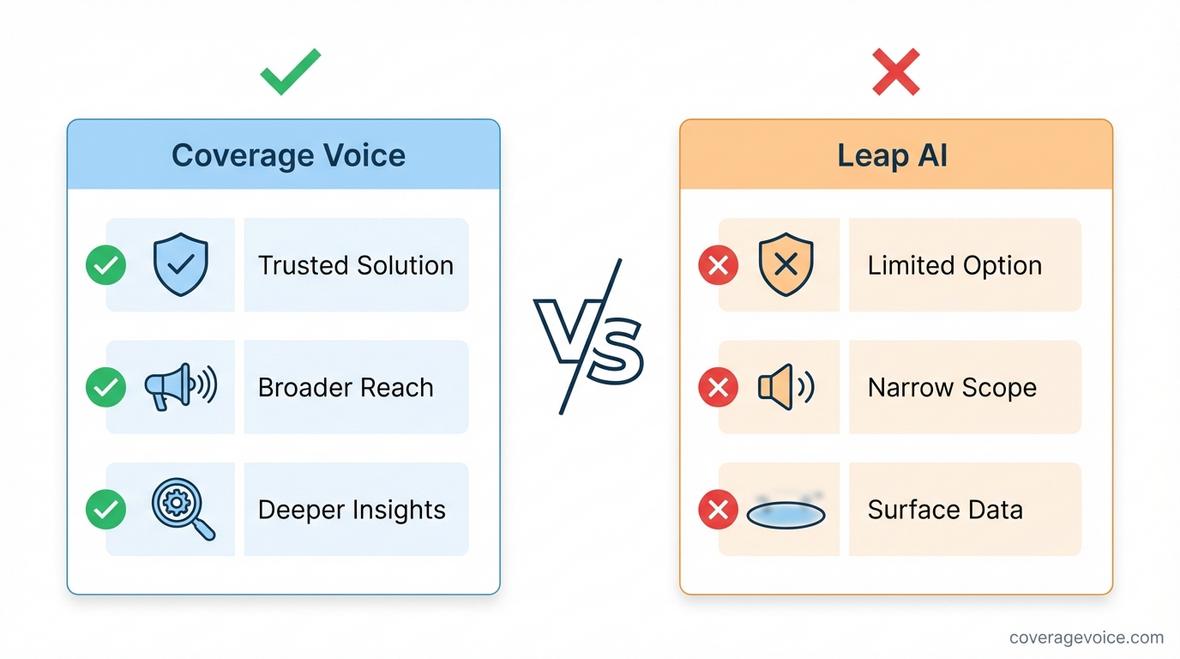
Beyond compliance, Leap AI lacks the specialized workflows that Medicare operations require daily. Unlike purpose-built platforms like Coverage Voice, Leap AI does not offer:
- Dual-eligible prospect identification and outreach automation
- AEP/OEP campaign orchestration with enrollment period tracking
- Plan comparison assistance integrated with carrier benefit data
- Medicare Advantage enrollment automation with carrier connectivity
- Member retention workflows triggered by disenrollment risk signals
This absence of industry-specific functionality means organizations using Leap AI must build custom workflows, integrate multiple systems, and maintain complex technical infrastructure all of which increase costs and time-to-value.
Coverage Voice: The Purpose-Built Alternative to Leap AI
While Leap AI serves as a general conversational AI platform, Coverage Voice was engineered specifically for Medicare enrollment, member engagement, and health plan operations. This specialization delivers measurable advantages in compliance, conversion rates, and operational efficiency.
Medicare-Native Architecture and Compliance
Coverage Voice incorporates Medicare compliance into its core architecture, not as an afterthought. The platform includes:
- Automated SOA collection that meets CMS documentation requirements
- TCPA-compliant consent workflows with multi-channel verification
- Star Ratings enhancement features including CAHPS survey optimization
- Audit-ready call recordings with compliant retention policies
Organizations using Medicare marketing compliance features report reduced regulatory risk and faster CMS audit responses compared to generic platforms like Leap AI.
Advanced Enrollment and Conversion Features
Coverage Voice delivers conversion-optimized workflows that Leap AI cannot match. These include:
- Enrollment automation with carrier integration and real-time verification
- Intelligent lead qualification using Medicare-specific eligibility criteria
- Appointment scheduling synchronized with agent calendars and CRM systems
- Dual-eligible outreach targeting LIS and Medicaid-eligible prospects
- AEP/OEP automation with campaign orchestration and follow-up sequences
According to case studies, organizations implementing Coverage Voice have experienced dramatic operational improvements. One Medicare voice AI deployment replaced 45 agents while improving response times and member satisfaction scores.
Industry-Specific Use Cases: Where Leap AI Falls Short
Different healthcare stakeholders have unique operational requirements that general platforms like Leap AI struggle to address. Coverage Voice, by contrast, offers tailored solutions for each industry segment.
Medicare Brokers and FMOs
For Medicare brokers and FMOs, peak enrollment periods demand scalable automation that maintains compliance while maximizing conversions. Leap AI's generic workflows cannot handle:
- Multi-carrier enrollment processing with carrier-specific data requirements
- Agent assignment logic based on territory, language, or specialization
- Commission tracking integration with back-office systems
- Compliance documentation specific to Medicare marketing rules
Coverage Voice addresses these needs with purpose-built features that understand broker workflows, commission structures, and compliance obligations capabilities that would require extensive customization on Leap AI.
Health Plans and Medicare Advantage Payers
Medicare Advantage plans face unique challenges around member retention, Star Ratings, and care management. Health systems and ACOs require AI solutions that integrate with population health initiatives and quality reporting.
Leap AI cannot deliver:
- Medication adherence outreach tied to quality measures
- CAHPS survey coordination to improve member experience scores
- Rapid disenrollment prevention with risk-based intervention triggers
- Care gap closure campaigns supporting HEDIS and Star Ratings
Coverage Voice integrates these capabilities natively, supporting payers and MA plans with member engagement workflows that directly impact financial performance and regulatory ratings.
Medicare Call Centers and BPOs
For Medicare call centers and TPAs, operational efficiency and compliance are paramount. According to research from Markets and Markets, AI for customer service is transforming contact center operations across industries, with healthcare leading adoption due to regulatory complexity and volume demands.
Leap AI's limitations become particularly evident in call center environments:
- No Medicare-specific escalation protocols for complex benefit questions
- Limited integration with healthcare CRMs like Connecture or Benefitalign
- Generic quality monitoring without Medicare compliance checkpoints
- Basic reporting that doesn't align with Medicare operational KPIs
Coverage Voice, by contrast, offers voice AI specifically designed for Medicare call centers, with features like intelligent routing, compliance monitoring, and real-time supervisor dashboards.
Total Cost of Ownership: Leap AI vs. Coverage Voice
While Leap AI may appear cost-competitive on a per-seat or per-conversation basis, total cost of ownership tells a different story when accounting for customization, integration, and compliance requirements.
Hidden Costs of Implementing Leap AI for Medicare
Organizations attempting to use Leap AI for Medicare operations typically encounter:
- Custom development costs to build Medicare-specific workflows ($50,000-$150,000+)
- Ongoing integration expenses to connect with carrier systems and CRMs
- Compliance consulting fees to ensure regulatory adherence
- Extended implementation timelines (6-12 months vs. 4-6 weeks for Coverage Voice)
- Higher error rates leading to enrollment issues and member complaints
Coverage Voice: Predictable ROI and Faster Time-to-Value
Coverage Voice delivers measurable return on investment through:
- Pre-built Medicare workflows that eliminate custom development
- Native carrier integrations reducing technical overhead
- Compliance built-in eliminating consulting and legal review costs
- Rapid deployment generating value within weeks, not months
Organizations can estimate their specific return using the Medicare voice AI ROI calculator, which accounts for agent replacement, conversion improvement, and compliance risk reduction.
Technical Capabilities Comparison
Integration Ecosystem and Data Connectivity
Modern healthcare operations require seamless data flow between multiple systems. Coverage Voice offers pre-built integrations with leading Medicare technology platforms, including:
- CRM systems: Salesforce Health Cloud, Connecture, SilverCloud, Benefitalign
- Carrier connections: Direct enrollment APIs with major Medicare Advantage carriers
- Analytics platforms: SFTP exports, webhook notifications, and real-time dashboards
- Telephony providers: Native carrier integration and SIP trunking support
Leap AI, by contrast, requires custom API development for most healthcare-specific integrations, adding time and cost to deployment.
Conversational Intelligence and Natural Language Understanding
Both platforms utilize advanced NLP, but Coverage Voice incorporates Medicare-specific training data that dramatically improves accuracy for healthcare conversations. This specialization enables:
- Benefit explanation accuracy with terminology specific to Medicare Advantage, Medigap, and Part D
- Eligibility determination understanding age, disability, ESRD, and special enrollment periods
- Plan comparison logic navigating formularies, provider networks, and cost structures
- Compliance-aware responses avoiding prohibited marketing language automatically
This domain expertise cannot be easily replicated on general platforms like Leap AI without extensive custom training a process that typically requires months of iteration and significant data science resources.
Implementation and Ongoing Support Comparison
Deployment Timeline and Complexity
Implementing Leap AI for Medicare operations typically follows this timeline:
- Weeks 1-4: Requirements gathering and workflow design
- Weeks 5-12: Custom development of Medicare-specific features
- Weeks 13-20: Integration with existing systems and testing
- Weeks 21-24: Compliance review and regulatory validation
- Week 25+: Pilot deployment and iteration
Coverage Voice, with its Medicare-native architecture, compresses this timeline dramatically:
- Week 1: Kickoff and configuration of pre-built Medicare workflows
- Weeks 2-3: CRM integration and data migration
- Week 4: Agent training and pilot launch
- Weeks 5-6: Optimization and full-scale deployment
This accelerated timeline means organizations begin generating ROI in weeks rather than months.
Ongoing Optimization and Account Management
Coverage Voice provides dedicated Medicare industry expertise through:
- Healthcare-specialized account managers who understand Medicare operations
- Regular compliance updates as CMS regulations evolve
- Performance optimization recommendations based on Medicare benchmarks
- Seasonal campaign support for AEP/OEP planning and execution
Leap AI, as a horizontal platform, typically provides generic customer success support without Medicare domain expertise requiring organizations to develop this knowledge internally.
Medicare Regulatory Landscape and Platform Requirements
CMS Marketing and Enrollment Compliance
Medicare operations are subject to extensive federal oversight through the Centers for Medicare & Medicaid Services (CMS). Key regulatory requirements include:
- Scope of Appointment (SOA): Required documentation before discussing specific plans
- TCPA compliance: Consent requirements for automated calling and texting
- Marketing material approval: All member-facing content must be CMS-approved
- Enrollment documentation: Specific data elements required for valid enrollments
- Star Ratings impact: Member experience affects plan quality ratings and revenue
Coverage Voice incorporates these requirements into every workflow, ensuring compliant operations by default. Organizations can learn more about Medicare SOA automation and how purpose-built platforms maintain compliance automatically.
HIPAA and Healthcare Data Security
Healthcare AI platforms must meet stringent data security requirements, including HIPAA technical safeguards for Protected Health Information (PHI). While Leap AI may offer basic security certifications, Coverage Voice provides healthcare-specific protections:
- HIPAA-compliant infrastructure with Business Associate Agreements (BAAs)
- PHI encryption at rest and in transit using healthcare-grade protocols
- Audit logging meeting healthcare regulatory requirements
- Access controls supporting role-based permissions for healthcare teams
Industry Trends: The Future of Medicare AI Automation
Medicare AI Market Growth and Adoption
The Medicare market is experiencing rapid AI adoption driven by demographic shifts and operational pressures. Key trends include:
- Baby Boomer enrollment surge: 10,000 Americans turning 65 daily through 2030
- Medicare Advantage growth: MA enrollment exceeding 50% of eligible beneficiaries
- Operational cost pressures: Plans seeking efficiency amid margin compression
- Regulatory complexity: Increasing compliance requirements driving automation needs
Organizations that select specialized platforms like Coverage Voice position themselves to capitalize on these trends, while those using generic tools like Leap AI risk competitive disadvantage.
Competitive Landscape and Alternative Solutions
Beyond Leap AI and Coverage Voice, the Medicare AI landscape includes several other platforms. Organizations often compare solutions like CareCycle and Rivvi when evaluating alternatives.
Key differentiators when comparing platforms include:
- Medicare specialization depth: Purpose-built vs. general-purpose architecture
- Compliance coverage: Built-in regulatory features vs. custom development required
- Integration ecosystem: Pre-built healthcare connections vs. generic APIs
- Implementation speed: Weeks vs. months to deployment
- Industry expertise: Healthcare-focused support vs. generic customer success
Decision Framework: Choosing the Right Platform
Key Evaluation Criteria for Medicare AI Platforms
When evaluating Leap AI versus Coverage Voice or other Medicare automation platforms, consider these critical factors:
- Regulatory compliance: Does the platform include Medicare-specific compliance features, or will you need custom development?
- Industry functionality: Are Medicare workflows pre-built, or must they be configured from scratch?
- Integration requirements: Does the platform connect natively with your existing Medicare tech stack?
- Implementation timeline: How quickly can you deploy and begin generating ROI?
- Total cost of ownership: What are the all-in costs including customization, integration, and ongoing support?
- Vendor expertise: Does the provider understand Medicare operations and regulations?
Matching Platform to Use Case
Different organizations have different AI automation priorities:
For Medicare Brokers and FMOs: Prioritize lead reactivation, appointment scheduling, and enrollment automation with multi-carrier support.
For Health Plans: Focus on member retention, Star Ratings optimization, and care management outreach.
For Call Centers: Emphasize volume handling, after-hours coverage, and compliance monitoring.
For Marketing Agencies: Select platforms supporting marketing agencies with campaign execution, lead qualification, and client reporting.
Coverage Voice offers specialized solutions for each use case, while Leap AI requires significant customization to address Medicare-specific requirements.
Implementation Best Practices
Change Management and Team Adoption
Successful AI implementation requires more than technology it demands organizational change management. Best practices include:
- Executive sponsorship: Secure leadership commitment to drive adoption
- Agent involvement: Include frontline staff in workflow design and testing
- Phased rollout: Start with pilot programs before full-scale deployment
- Performance metrics: Establish clear KPIs to measure success
- Continuous optimization: Regular review and refinement of AI performance
Data Quality and System Readiness
AI effectiveness depends on data quality and system integration. Before implementation, ensure:
- Clean CRM data: Accurate contact information and prospect status
- System connectivity: APIs and integrations tested and functional
- Compliance documentation: Consent records and SOA forms organized
- Call scripts: Approved messaging and compliance language prepared
Frequently Asked Questions About Leap AI and Medicare Voice AI
What is Leap AI used for?
Leap AI is a general-purpose conversational AI platform designed for customer service automation across various industries. It offers basic appointment scheduling, lead qualification, and customer interaction capabilities, but lacks specialized features for Medicare operations, compliance, or healthcare-specific workflows.
Is Leap AI compliant with Medicare regulations?
Leap AI does not include Medicare-specific compliance features such as automated SOA collection, CMS-approved marketing language, or TCPA consent workflows. Organizations using Leap AI for Medicare must develop custom compliance frameworks, adding significant cost and complexity compared to purpose-built platforms like Coverage Voice.
How does Leap AI pricing compare to Coverage Voice?
While Leap AI may have competitive base pricing, total cost of ownership for Medicare operations is typically higher due to custom development, integration expenses, compliance consulting, and extended implementation timelines. Coverage Voice delivers faster ROI through pre-built Medicare workflows and rapid deployment.
Can Leap AI integrate with Medicare carrier systems?
Leap AI requires custom API development to connect with Medicare carrier enrollment systems, CRMs like Connecture, and healthcare-specific platforms. Coverage Voice offers pre-built integrations with major Medicare technology providers, reducing implementation time and technical complexity.
What is the best alternative to Leap AI for Medicare operations?
Coverage Voice is the leading Leap AI alternative for Medicare brokers, health plans, and call centers. With Medicare-native architecture, built-in compliance, and industry-specific workflows, Coverage Voice delivers superior results for enrollment automation, member engagement, and regulatory adherence.
How long does it take to implement Leap AI for Medicare?
Implementing Leap AI for Medicare typically requires 6-12 months due to custom development, integration work, and compliance validation. Coverage Voice can be deployed in 4-6 weeks with its pre-built Medicare workflows and native healthcare integrations.
Can Leap AI help improve Medicare Star Ratings?
Leap AI does not include Star Ratings optimization features such as CAHPS survey coordination, medication adherence outreach, or care gap closure campaigns. Coverage Voice incorporates these capabilities natively, supporting health plans in improving quality measures and member experience scores.
Conclusion
While Leap AI serves as a capable general-purpose conversational AI platform, it falls short of the specialized requirements that Medicare operations demand. Organizations seeking to automate enrollment, enhance member engagement, or improve call center efficiency need purpose-built solutions that understand Medicare compliance, incorporate industry-specific workflows, and integrate seamlessly with healthcare technology ecosystems.
Coverage Voice delivers these capabilities through Medicare-native architecture, pre-built compliance features, and deep industry expertise. With faster implementation timelines, lower total cost of ownership, and superior results in conversion rates and member satisfaction, Coverage Voice represents the optimal choice for Medicare brokers, health plans, and healthcare organizations.
Organizations evaluating leap ai alternatives should prioritize platforms that reduce compliance risk, accelerate time-to-value, and deliver measurable ROI through specialized Medicare functionality. To explore how Coverage Voice can transform your Medicare operations, visit Coverage Voice pricing or schedule a demonstration to see the platform in action.
Ready to Transform Your Medicare Enrollment Process?
See how Coverage Voice AI can help you automate Medicare enrollment.