Medicare AI Voice Agent For Brokers: Complete 2026 Guide To Intelligent Automation

Introduction
The Medicare insurance landscape is undergoing a profound transformation. As enrollment pressures intensify and regulatory requirements become more stringent, brokers and Field Marketing Organizations (FMOs) are turning to advanced technology to maintain competitive advantage. The Medicare AI voice agent for brokers has emerged as a game-changing solution that addresses the industry's most pressing challenges: lead qualification, compliance adherence, operational efficiency, and member engagement.
With MA insurers spending $6.9 billion on agent commissions in 2023, the financial stakes have never been higher. Simultaneously, the federal government is signaling a major shift toward AI adoption, with CMS issuing an RFI for AI tools including real-time conversational AI voice advisors for 1-800-MEDICARE call centers. This convergence of economic pressure and technological opportunity makes 2026 the ideal time for Medicare brokers to embrace AI voice automation.
This comprehensive guide explores how Medicare AI voice agents transform broker operations, the specific features that drive ROI, compliance considerations, implementation strategies, and real-world performance metrics that demonstrate tangible business impact.
Understanding Medicare AI Voice Agents for Brokers
A Medicare AI voice agent for brokers is a sophisticated conversational AI system designed specifically for the Medicare insurance ecosystem. Unlike generic chatbots or basic IVR systems, these specialized agents understand Medicare terminology, regulatory requirements, and the unique workflow challenges faced by brokers during high-volume periods like the Annual Enrollment Period (AEP).
Core Capabilities of Medicare AI Voice Agents
Modern Medicare AI voice agents deliver a comprehensive suite of capabilities that address every stage of the broker workflow:
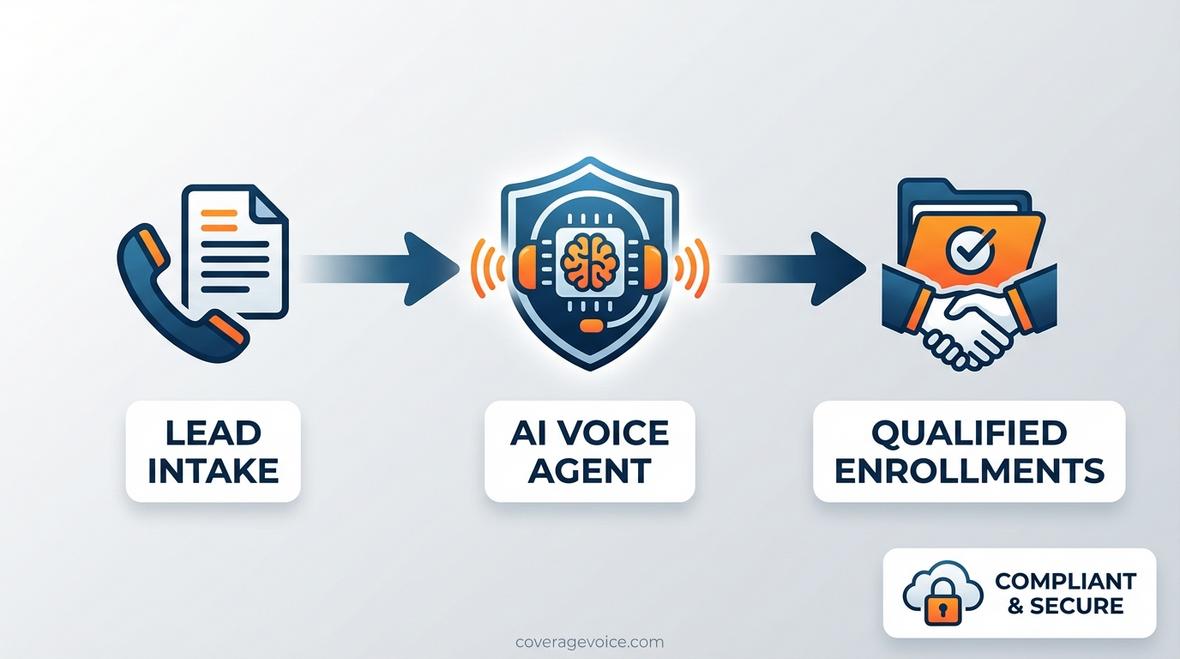
- Intelligent Lead Intake: The system captures inbound inquiries 24/7, extracting critical information such as age, location, current coverage, and specific health needs without human intervention.
- Pre-Qualification Screening: AI agents conduct thorough eligibility assessments, identifying Medicare eligibility status, Special Enrollment Period (SEP) qualifications, and budget constraints before routing to human agents.
- Appointment Scheduling: Automated calendar integration ensures qualified leads are immediately scheduled with appropriate brokers based on availability, specialization, and geographic territory.
- Compliance Automation: Every conversation is recorded, transcribed, and analyzed for CMS and HIPAA compliance, with automatic flagging of potential violations.
- Multi-Language Support: Leading platforms support English, Spanish, and other languages critical for reaching diverse Medicare populations.
Technical Architecture
The most effective Medicare AI voice agents combine multiple advanced technologies:
- Natural Language Processing (NLP): Understands Medicare-specific terminology, acronyms (MA, MAPD, SNP), and colloquial expressions used by beneficiaries.
- Speech Recognition: Accurately transcribes conversations even with background noise, accents, or age-related speech patterns common among Medicare beneficiaries.
- Intent Classification: Identifies caller intent (new enrollment, plan comparison, renewal, complaint) and routes appropriately.
- CRM Integration: Seamlessly connects with platforms like Salesforce, HubSpot, and Medicare-specific systems to maintain unified data records.
- Real-Time Analytics: Provides immediate visibility into call volume, conversion rates, and agent performance metrics.
The Business Case: Why Brokers Need AI Voice Agents in 2026
The economic and operational arguments for adopting a Medicare AI voice agent for brokers are compelling across multiple dimensions.
Dramatic Cost Reduction
Traditional call center operations carry substantial fixed and variable costs. Human agents require salaries, benefits, training, supervision, and physical infrastructure. During peak AEP periods, brokers face the dilemma of either maintaining excess capacity year-round or scrambling to hire and train temporary staff who lack Medicare expertise.
AI voice agents fundamentally change this economic equation. Organizations implementing Medicare voice AI have successfully replaced 45 agents while maintaining or improving service quality. The cost per interaction drops dramatically from $5-15 per human-handled call to pennies per AI interaction.
Conversion Rate Improvement
Speed-to-contact is the single most important factor in Medicare lead conversion. Research consistently shows that leads contacted within five minutes convert at 10-20 times the rate of leads contacted after an hour. Human agents, constrained by working hours and call volume, cannot achieve this response velocity.
Medicare AI voice agents respond instantly, 24/7/365, ensuring no lead goes cold. They conduct consistent, thorough qualification conversations that identify high-intent prospects and schedule appointments immediately. Organizations report conversion rate improvements of 30-50% after implementing AI voice technology.
Scalability During AEP
The Annual Enrollment Period creates extreme operational stress for Medicare brokers. Call volume can increase 300-500% over baseline, overwhelming even well-staffed operations. The traditional response hiring temporary agents introduces quality control challenges, training bottlenecks, and compliance risks.
AEP automation through AI voice agents eliminates these constraints entirely. The system scales instantly to handle any call volume without degradation in service quality. Whether you receive 100 calls or 10,000 calls in a day, every caller receives immediate, consistent, compliant service.
Compliance Assurance
CMS regulations governing Medicare marketing and enrollment are complex and continuously evolving. Human agents, despite best efforts, make mistakes omitting required disclosures, making inappropriate comparisons between plans, or failing to properly document consent.
Every compliance violation carries substantial financial and reputational risk. CMS can impose sanctions ranging from corrective action plans to complete termination of marketing privileges. Medicare marketing compliance automation ensures that every conversation follows scripted, approved language, all required disclosures are made, and complete documentation is maintained for audit purposes.
Key Features Medicare Brokers Need in AI Voice Agents
Not all AI voice platforms are created equal. Medicare brokers require specific capabilities that address their unique operational and regulatory environment.
Medicare-Specific Knowledge Base
The system must possess deep understanding of Medicare program structure, including Original Medicare (Parts A and B), Medicare Advantage (Part C), prescription drug coverage (Part D), and Medigap supplemental insurance. It should accurately explain coverage options, compare plan features, and identify potential cost savings based on individual circumstances.
Advanced Eligibility Determination
The AI agent must skillfully navigate complex eligibility scenarios including: age-based eligibility (65+), disability-based eligibility (under 65), End-Stage Renal Disease (ESRD) exceptions, and Special Enrollment Period (SEP) qualifications such as loss of employer coverage, relocation, or dual-eligible status changes.
Intelligent Appointment Scheduling
Automated appointment scheduling goes beyond simple calendar integration. The system should match prospects with brokers based on specialization (Medicare Advantage vs. Medicare Supplement), language requirements, geographic territory, and current capacity. It should send automated reminders and handle rescheduling requests without human intervention.
Sophisticated Lead Qualification
Pre-screening and lead qualification capabilities separate high-value prospects from tire-kickers. The system should assess budget, urgency, current coverage satisfaction, health conditions requiring specialized plans, and prescription drug needs. It should assign lead scores that help brokers prioritize follow-up efforts.
Outbound Calling Capabilities
While inbound call handling is critical, proactive outreach drives revenue growth. Outbound AI dialer technology enables brokers to conduct large-scale campaigns for lead reactivation, renewal reminders, annual wellness visit scheduling, and plan change notifications during Open Enrollment Periods.
Omnichannel Integration
Today's Medicare beneficiaries engage through multiple channels phone, web forms, SMS, email, and social media. Omnichannel client intake ensures seamless experience regardless of initial contact method, with the AI agent maintaining context across channel transitions.
Implementation Strategy for Medicare Brokers
Successfully deploying a Medicare AI voice agent for brokers requires thoughtful planning and phased execution.
Assessment and Planning
Begin with comprehensive analysis of current operations: call volume patterns, peak demand periods, average handling time, conversion rates by lead source, and common call types. Identify the highest-value use cases where AI can deliver immediate impact typically after-hours coverage, initial lead qualification, and appointment scheduling.
Platform Selection
Evaluate potential vendors based on Medicare-specific capabilities, compliance features, integration options, scalability, and total cost of ownership. Request demonstrations using your actual scripts and scenarios. Review case studies from similar organizations and speak with reference customers.
For brokers and FMOs seeking purpose-built solutions, specialized platforms for Medicare brokers and FMOs offer pre-configured workflows, Medicare-specific language models, and compliance frameworks that dramatically accelerate deployment.
Pilot Deployment
Launch with a limited scope pilot perhaps after-hours coverage or a specific lead source. This approach minimizes risk while generating real-world performance data. Monitor key metrics closely: call completion rate, qualification accuracy, appointment show rate, and beneficiary satisfaction.
Human Agent Training
Your human agents require training on the new workflow. They'll transition from handling initial inquiries to focusing exclusively on qualified, scheduled appointments. This requires different skills consultative selling, plan comparison expertise, and enrollment execution. Invest in training that prepares agents for this elevated role.
Continuous Optimization
AI systems improve through machine learning. Regularly review call recordings, analyze conversation patterns, and refine scripts based on performance data. Update the knowledge base as plan offerings change, new regulations take effect, or seasonal patterns emerge.
Compliance Considerations for Medicare AI Voice Agents
Regulatory compliance is non-negotiable in the Medicare space. Your AI voice agent must adhere to multiple regulatory frameworks simultaneously.
CMS Marketing Guidelines
The Centers for Medicare & Medicaid Services maintains strict rules governing how Medicare plans can be marketed. AI voice agents must: provide required disclaimers about agent scope of appointment, avoid making inappropriate plan comparisons, obtain and document proper consent before discussing specific plans, and accurately represent plan benefits without exaggeration.
TCPA Compliance
TCPA compliance for Medicare voice AI requires careful attention to consent management, do-not-call list integration, time-of-day restrictions, and proper identification of the calling party. Violations carry penalties of $500-1,500 per call, making compliance infrastructure essential.
HIPAA Security Requirements
Any system handling Protected Health Information (PHI) must implement appropriate administrative, physical, and technical safeguards. This includes encrypted data transmission, access controls, audit logging, and Business Associate Agreements (BAAs) with all vendors in the data chain.
State-Specific Regulations
Insurance regulations vary by state. Some jurisdictions impose additional requirements on AI systems, recording disclosure, or consent documentation. Your AI voice agent must be configurable to accommodate state-specific variations in script language and workflow.
ROI Metrics and Performance Benchmarks
Organizations evaluating a Medicare AI voice agent for brokers should track specific metrics that demonstrate business impact.
Cost Metrics
- Cost Per Lead Handled: Compare AI cost (typically $0.10-0.50) versus human agent cost ($5-15)
- Cost Per Qualified Lead: Factor in qualification accuracy to determine true cost efficiency
- Cost Per Enrollment: Ultimate measure of marketing efficiency
- Seasonal Staffing Costs: Savings from eliminating temporary AEP hiring
Operational Metrics
- Answer Rate: Percentage of calls answered (should approach 100% with AI)
- Average Speed to Answer: Time until call is connected (should be under 5 seconds)
- After-Hours Conversion: Leads captured outside business hours
- Appointment Show Rate: Percentage of scheduled appointments that occur
Quality Metrics
- Qualification Accuracy: Percentage of AI-qualified leads that convert
- Compliance Score: Adherence to required scripts and disclosures
- Beneficiary Satisfaction: Feedback scores from post-interaction surveys
- Human Escalation Rate: Percentage of calls requiring human takeover
Organizations implementing comprehensive Medicare AI voice solutions report dramatic improvements. For example, Medicare voice AI has reduced resolution time by 30 times in documented case studies, enabling brokers to handle exponentially more volume with existing resources.
Future Trends in Medicare AI Voice Technology
The Medicare AI voice agent landscape continues to evolve rapidly, with several emerging trends shaping the 2026 market.
Advanced Personalization
Next-generation systems will leverage historical data, demographic information, and behavioral patterns to deliver highly personalized conversations. The AI will adapt its communication style, pacing, and content based on individual beneficiary characteristics, improving engagement and conversion.
Predictive Analytics
AI systems will increasingly predict member behavior likelihood to disenroll, probability of plan satisfaction, risk of rapid disenrollment enabling proactive intervention. Member retention and renewal automation powered by predictive models will help brokers maintain their book of business more effectively.
Government Integration
Federal adoption signals mainstream acceptance. As CMS and other government agencies deploy conversational AI, interoperability standards will emerge, enabling seamless data exchange between broker systems, carrier platforms, and government databases.
Expanded Capabilities
Future Medicare AI voice agents will handle increasingly complex scenarios including benefits verification, prior authorization initiation, appeals assistance, and care coordination. AI agents for Medicare will evolve from purely transactional tools to comprehensive member engagement platforms.
Frequently Asked Questions
How accurate are Medicare AI voice agents compared to human agents?
Modern Medicare AI voice agents achieve 95%+ accuracy in lead qualification when properly configured with Medicare-specific knowledge. They eliminate human inconsistencies, never forget required disclosures, and maintain perfect compliance adherence. However, complex scenarios still benefit from human expertise, which is why the optimal model combines AI for initial handling with human escalation for complex cases.
What is the typical cost structure for Medicare AI voice agents?
Pricing models vary by vendor but typically include: monthly platform fees ($500-5,000 depending on features), per-minute usage charges ($0.05-0.15), and integration/setup fees. Enterprise pricing often provides better economics for high-volume operations. Total cost of ownership is typically 60-80% lower than equivalent human agent capacity.
How long does implementation take?
Pilot deployments can launch within 2-4 weeks with pre-configured Medicare solutions. Full production deployment typically requires 6-12 weeks to complete CRM integration, customize scripts, train the AI on your specific plans and processes, and conduct thorough testing. Organizations should begin planning 3-6 months before AEP to ensure readiness for peak season.
Do Medicare beneficiaries accept AI voice agents?
Initial skepticism exists among some beneficiaries, but acceptance rates are high when the AI performs well. Key success factors include: transparent disclosure that beneficiaries are speaking with AI, seamless escalation to humans when requested, natural conversational flow without robotic characteristics, and demonstrable value (immediate answers, 24/7 availability). Post-interaction surveys show satisfaction rates of 85-90% for well-designed Medicare AI voice agents.
What systems do Medicare AI voice agents integrate with?
Leading platforms offer pre-built integrations with major CRMs (Salesforce, HubSpot, Zoho), telephony providers (Twilio, RingCentral, Five9), Medicare-specific platforms (Agent Pipeline, Connecture, SureLC), calendar systems (Google Calendar, Outlook), and marketing automation tools (Marketo, Pardot). Custom API integrations enable connection to proprietary systems.
Conclusion
The Medicare AI voice agent for brokers represents a fundamental shift in how Medicare insurance is marketed, sold, and serviced. With billions spent annually on agent commissions and government agencies actively pursuing AI adoption, the technology has reached a maturity and acceptance level that makes 2026 the optimal time for implementation.
Brokers who embrace this technology gain decisive advantages: dramatic cost reduction, unlimited scalability during peak periods, perfect compliance adherence, and conversion rates that far exceed traditional models. The case studies, metrics, and government signals all point in the same direction AI voice automation is not a future possibility but a present necessity for competitive Medicare operations.
Organizations ready to explore Medicare AI voice solutions should begin with thorough assessment of their current operations, clear definition of success metrics, and selection of a platform purpose-built for the Medicare ecosystem. The investment pays dividends immediately through increased efficiency and extends long-term through improved member satisfaction, retention, and lifetime value. Get started today to transform your Medicare broker operations for the modern era.
Ready to Transform Your Medicare Enrollment Process?
See how Coverage Voice AI can help you automate Medicare enrollment.