Medicare AI Voice Agent: The Complete 2026 Guide To Intelligent Automation For Enrollment & Member Engagement

What is a Medicare AI Voice Agent?
A Medicare AI voice agent is an advanced conversational artificial intelligence system specifically designed to handle inbound and outbound voice interactions within the Medicare ecosystem. These intelligent agents leverage natural language processing (NLP), machine learning, and voice recognition technologies to autonomously manage member inquiries, screen leads, schedule appointments, facilitate enrollments, and provide post-enrollment support all while maintaining strict HIPAA and CMS compliance standards.
For Medicare brokers, FMOs, health plans, and call centers, the implementation of a Medicare AI voice agent represents a transformative shift from traditional human-only operations to a hybrid or fully automated approach. According to research published in NCBI, AI virtual assistants demonstrate superior accuracy on Medicare queries compared to average Medicare beneficiaries from two decades ago, with strong scoring reliability indicated by high kappa coefficients. This evidence underscores the technological maturity and readiness of AI systems to handle complex Medicare interactions.
During high-stakes periods like the Annual Enrollment Period (AEP) and Open Enrollment Period (OEP), Medicare organizations face unprecedented call volumes, compliance pressures, and operational costs. A Medicare AI voice agent addresses these challenges by providing 24/7 availability, instant response times, scalable capacity, and consistent compliance adherence capabilities that traditional staffing models struggle to deliver cost-effectively.
Why Medicare Organizations Need AI Voice Agents in 2026
The Medicare landscape in 2026 is characterized by increasing regulatory complexity, heightened member expectations, and intensifying competition among Medicare Advantage plans. Traditional call center operations face several critical challenges that Medicare AI voice agents are uniquely positioned to solve.
Escalating Operational Cost Pressures
Hiring, training, and retaining qualified Medicare call center agents requires substantial investment. Average per-agent costs including salary, benefits, training, and infrastructure can exceed $45,000 annually. During AEP, organizations typically need to increase staffing by 200-300% to handle call volume spikes, creating seasonal hiring challenges and inefficiencies. Medicare call centers using AI voice agents can reduce these variable costs significantly while maintaining service quality.
Compliance and Regulatory Requirements
CMS maintains strict guidelines governing Medicare marketing, enrollment, and member communications. Human agents, despite thorough training, can inadvertently make compliance errors that result in costly penalties or enrollment disqualifications. A Medicare AI voice agent operates within pre-programmed compliance parameters, ensuring every interaction adheres to current CMS regulations, Medicare marketing compliance standards, and HIPAA requirements. The CMS conversational AI assistants pledge program demonstrates regulatory recognition of AI's potential in healthcare communications when properly implemented.
Evolving Member Experience Expectations
Medicare beneficiaries increasingly expect immediate responses, personalized interactions, and convenient communication channels. Wait times exceeding five minutes can result in abandoned calls and lost enrollment opportunities. AI voice agents provide instant engagement, eliminating hold times and ensuring no prospect or member goes unattended, regardless of call volume or time of day.
Data-Driven Insights and Analytics
Unlike traditional call recordings that require manual review, Medicare AI voice agents automatically capture, transcribe, and analyze every interaction. This generates actionable intelligence on member concerns, enrollment barriers, competitive intelligence, and agent performance metrics that inform strategic decision-making and continuous improvement initiatives.
Key Capabilities of Medicare AI Voice Agents
Modern Medicare AI voice agents encompass a comprehensive suite of functionalities designed to address the entire member lifecycle, from initial lead qualification through enrollment and ongoing member engagement.
Intelligent Lead Qualification and Pre-Screening
AI voice agents can conduct sophisticated pre-screening conversations that assess Medicare eligibility, coverage needs, financial qualifications, and enrollment readiness. By asking targeted questions and analyzing responses in real-time, the system routes only qualified, enrollment-ready prospects to human agents, dramatically improving conversion rates and agent productivity.
Automated Appointment Scheduling and Management
The technology handles complex appointment scheduling tasks, including calendar coordination, confirmation calls, reminder sequences, and rescheduling requests. Integration with CRM systems ensures real-time availability checking and eliminates double-booking scenarios that frustrate both members and agents.
Enrollment Automation and Application Assistance
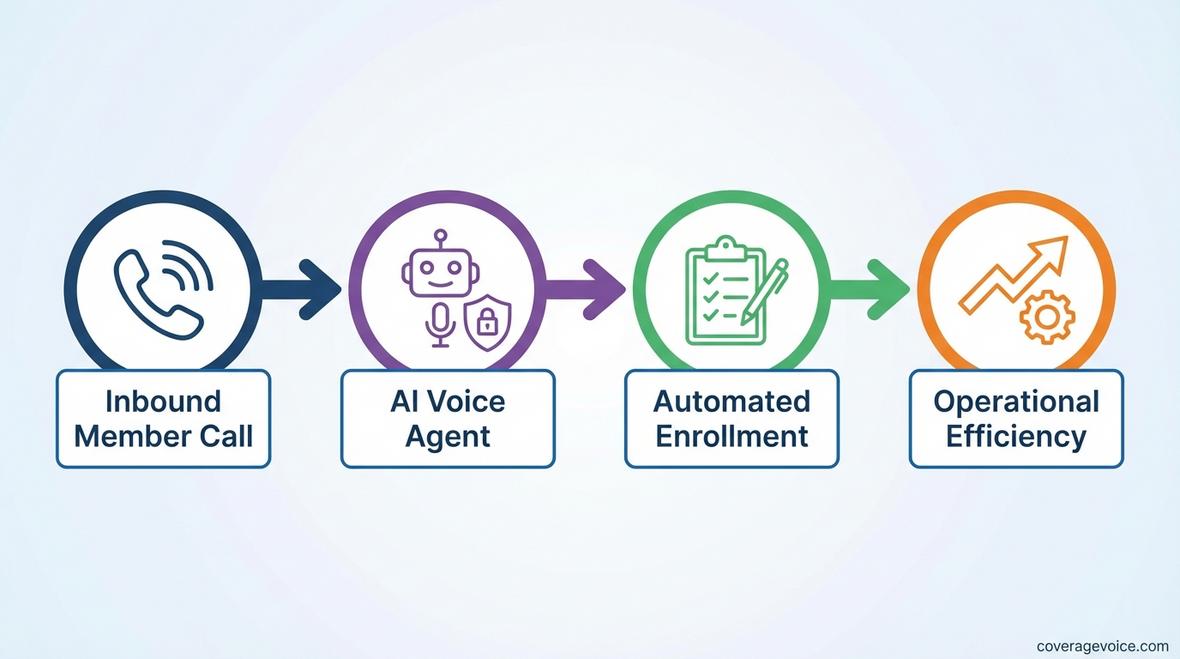
Advanced Medicare AI voice agents can guide members through the enrollment process, collecting required information, explaining plan benefits, addressing questions, and even initiating electronic enrollment submissions. Medicare enrollment automation capabilities reduce enrollment cycle times from days to minutes while maintaining accuracy and compliance.
Member Retention and Engagement
Post-enrollment, AI voice agents execute new member welcome calls, benefits education campaigns, utilization reminders, and retention outreach. Proactive engagement during critical windows helps reduce disenrollment rates and improves member satisfaction scores that impact Medicare Star Ratings.
After-Hours and Weekend Coverage
Medicare prospects often research coverage options outside traditional business hours. After-hour AI agents ensure your organization captures these inquiries immediately, providing information and scheduling follow-up conversations rather than losing opportunities to competitors with extended availability.
Medicare AI Voice Agent vs. Traditional Call Center Solutions
Understanding how Medicare AI voice agents compare to conventional staffing models helps organizations evaluate the business case for adoption.
Cost Efficiency Comparison
Traditional call centers operate with fixed staffing costs that create inefficiencies during low-volume periods and capacity constraints during peak seasons. AI voice agents provide elastic capacity that scales instantly based on demand, eliminating both underutilization waste and overflow call abandonment. Organizations implementing AI solutions typically report 40-60% reductions in per-interaction costs while simultaneously improving response times and availability.
Consistency and Quality Assurance
Human agent performance varies based on experience, training retention, fatigue, and individual capabilities. Medicare AI voice agents deliver consistent quality across every interaction, applying identical screening criteria, compliance protocols, and information accuracy regardless of call volume or timing. This standardization reduces quality assurance overhead and regulatory risk exposure.
Scalability and Flexibility
Scaling traditional call centers requires lengthy recruitment, training, and onboarding cycles that make rapid capacity adjustments impractical. AI voice agents can handle exponential call volume increases without additional deployment time or infrastructure investment, making them ideal for AEP/OEP automation where demand predictability is challenging.
Compliance Considerations for Medicare AI Voice Agents
Regulatory compliance represents both a critical requirement and a compelling advantage of Medicare AI voice agent implementation.
HIPAA Compliance Requirements
Any technology handling protected health information (PHI) must meet stringent HIPAA security and privacy standards. Enterprise-grade Medicare AI voice agents incorporate encryption, access controls, audit logging, and business associate agreements (BAAs) that ensure compliance. Organizations should verify that their chosen solution maintains appropriate certifications and documentation.
CMS Marketing and Communication Guidelines
CMS regulations govern Medicare marketing communications, including prohibited claims, required disclosures, scope of appointment documentation, and enrollment verification protocols. AI voice agents can be programmed with current regulatory requirements, automatically adapting scripts and workflows as regulations evolve. Research from Becker's Payer Issues notes that CMS has issued specific AI guidance for Medicare Advantage to prevent bias in coverage decisions, highlighting the regulatory attention to responsible AI deployment.
TCPA and Consent Management
The Telephone Consumer Protection Act requires explicit consent before automated calls to mobile phones. Medicare AI voice agents must integrate with consent management systems that track opt-ins, honor do-not-call lists, and maintain compliant calling practices. Proper implementation protects organizations from significant regulatory penalties.
Monitoring and Human Oversight
While AI automation delivers efficiency gains, CMS guidelines may require human oversight for certain decision points, particularly final enrollment submissions and coverage recommendations. Effective implementations balance automation with appropriate human intervention points that satisfy regulatory requirements while maximizing efficiency benefits.
Implementation Best Practices for Medicare AI Voice Agents
Successful Medicare AI voice agent deployment requires strategic planning, technical integration, and change management across the organization.
Define Clear Use Cases and Success Metrics
Organizations should identify specific workflows where AI voice agents deliver maximum impact such as lead qualification, appointment scheduling, or after-hours inquiry management rather than attempting wholesale replacement of all human interactions. Establishing baseline metrics for cost per interaction, conversion rates, and member satisfaction enables measurable ROI demonstration.
Integration with Existing Systems
Medicare AI voice agents must connect seamlessly with CRM platforms, telephony infrastructure, enrollment systems, and analytics tools. Integration capabilities should be evaluated during vendor selection to ensure data flows correctly between systems without manual intervention or data silos.
Training and Continuous Optimization
Initial implementation requires training the AI on Medicare-specific terminology, common member questions, plan details, and organizational processes. Ongoing optimization based on conversation analytics, member feedback, and performance metrics ensures the system improves over time and adapts to changing market conditions.
Hybrid Human-AI Approach
The most effective implementations leverage AI for initial engagement, qualification, and routine inquiries while routing complex situations, emotional conversations, or high-value prospects to experienced human agents. This hybrid model optimizes both cost efficiency and member experience quality.
Use Cases Across the Medicare Ecosystem
Different Medicare organization types benefit from AI voice agents in distinct ways aligned with their specific operational models and challenges.
Medicare Brokers and FMOs
Medicare brokers and FMOs face intense competition for qualified leads and operate with limited resources. AI voice agents enable immediate lead response, consistent follow-up, and efficient qualification that maximizes agent productivity. During AEP, when lead volumes spike dramatically, AI ensures no opportunity is missed due to capacity constraints.
Marketing Agencies Serving Medicare Clients
Marketing agencies generating Medicare leads for broker networks can enhance lead value by implementing AI-powered qualification and appointment setting. This value-add service differentiates agency offerings and improves client satisfaction through higher-quality, enrollment-ready appointments.
Health Plans and Medicare Advantage Call Centers
Medicare Advantage plans operating member service call centers use AI voice agents to handle routine inquiries about benefits, claims status, and provider networks, freeing human agents for complex problem resolution and relationship-building interactions. This improves both operational efficiency and member satisfaction scores that impact Star Ratings.
Dual Eligible and LIS Outreach Programs
Dual eligible and LIS outreach initiatives require high-volume contact strategies to identify and enroll eligible populations. AI voice agents can execute large-scale outreach campaigns, conduct eligibility screening, and schedule enrollment appointments more cost-effectively than traditional outbound calling teams.
ROI and Cost Analysis of Medicare AI Voice Agents
Financial justification for Medicare AI voice agent adoption typically focuses on three value drivers: direct cost reduction, revenue enhancement, and risk mitigation.
Direct Cost Savings
Organizations replacing human agents with AI for routine interactions typically achieve 50-70% cost reductions on those specific workflows. For a mid-sized FMO handling 10,000 calls monthly, this can translate to $15,000-$25,000 in monthly savings or $180,000-$300,000 annually. Implementation costs are typically recovered within 6-12 months.
Revenue Enhancement Through Improved Conversion
Immediate response to inbound inquiries and consistent follow-up dramatically improves conversion rates. Organizations report 20-35% increases in lead-to-enrollment conversion when implementing AI voice agents, directly impacting commission revenue and membership growth.
Risk Mitigation Value
Compliance violations can result in penalties ranging from thousands to millions of dollars, plus potential loss of selling privileges. The compliance consistency provided by AI voice agents reduces this exposure, though the value is harder to quantify until a violation is prevented.
Selecting the Right Medicare AI Voice Agent Solution
The Medicare AI voice agent market includes both general-purpose conversational AI platforms and specialized Medicare-focused solutions. Organizations should evaluate vendors across several critical dimensions.
Medicare-Specific Expertise and Compliance
Generic AI platforms require substantial customization to handle Medicare's unique regulatory requirements, terminology, and workflows. Purpose-built solutions like those offered by specialized vendors incorporate Medicare compliance, CMS guideline adherence, and industry-specific workflows out of the box, reducing implementation risk and time-to-value.
Voice Quality and Naturalness
Early AI voice systems suffered from robotic speech patterns that frustrated users. Modern solutions leverage advanced text-to-speech and natural language generation to create conversations that members perceive as natural and helpful. Organizations should test voice quality with representative users before committing to a platform.
Integration and Customization Capabilities
The ability to integrate with existing CRM, telephony, and enrollment systems determines how seamlessly AI fits into current workflows. API availability, pre-built connectors for common platforms, and customization flexibility should be thoroughly evaluated during vendor selection.
Analytics and Reporting
Comprehensive conversation analytics, performance dashboards, and compliance reporting capabilities enable continuous optimization and demonstrate ROI. Solutions should provide both real-time monitoring and historical trend analysis across key performance indicators.
Future Trends in Medicare AI Voice Technology
The Medicare AI voice agent market continues to evolve rapidly, with several emerging trends that will shape future capabilities and adoption patterns.
Multimodal Engagement
Future Medicare AI systems will seamlessly integrate voice, text, email, and video interactions within unified member journeys. Members might begin an inquiry via text, transition to voice for complex questions, and receive follow-up documentation via email all managed by the same AI system maintaining conversation context.
Predictive Analytics and Proactive Outreach
Advanced AI systems will analyze member data to predict disenrollment risk, identify unmet needs, and proactively initiate retention conversations before problems escalate. This shift from reactive to predictive engagement represents a significant evolution in member relationship management.
Emotional Intelligence and Empathy
Next-generation AI voice agents will incorporate emotional recognition capabilities that detect frustration, confusion, or satisfaction in member voices, adapting conversation style and escalation decisions accordingly. This emotional intelligence will narrow the experience gap between AI and human interactions.
Regulatory Evolution and AI Governance
As AI adoption accelerates, CMS will likely develop more specific guidance governing AI use in Medicare marketing and enrollment. The Medicare AI prior authorization pilot demonstrates CMS's active exploration of AI applications, though evidence shows AI can lead to higher denial rates versus human decisions, highlighting the importance of appropriate oversight and calibration.
Getting Started with Medicare AI Voice Agent Implementation
Organizations ready to explore Medicare AI voice agent adoption should follow a structured evaluation and implementation process.
Assess Current Operations and Pain Points
Document current call volumes, cost per interaction, conversion rates, compliance incidents, and member satisfaction scores to establish baseline metrics. Identify specific workflows where AI could deliver immediate impact and quantifiable improvement.
Pilot Program Approach
Rather than full-scale deployment, begin with a focused pilot targeting one or two high-value use cases such as after-hours inquiry management or appointment scheduling. This contained approach allows learning, optimization, and ROI demonstration before broader rollout.
Vendor Evaluation and Selection
Request demonstrations from multiple vendors, focusing on Medicare-specific capabilities, compliance features, integration requirements, and pricing models. Reference checks with similar organizations provide insight into implementation experiences and ongoing vendor support quality.
Change Management and Staff Training
Human agents may perceive AI as threatening their roles. Effective change management emphasizes how AI handles routine tasks, allowing agents to focus on complex, high-value interactions that leverage uniquely human capabilities like empathy, judgment, and relationship building.
Frequently Asked Questions
How much does a Medicare AI voice agent cost?
Pricing models vary by vendor but typically include implementation fees ranging from $5,000-$25,000 and monthly subscription costs based on call volume, often $0.10-$0.50 per interaction. This represents significant savings compared to human agent costs of $3-$8 per interaction when accounting for full loaded costs.
Can Medicare AI voice agents handle complex enrollment scenarios?
Modern Medicare AI voice agents can manage moderately complex enrollments including multi-plan comparisons, subsidy calculations, and application completion. Extremely complex situations involving special enrollment periods, appeals, or unique circumstances may still require human agent intervention, which the AI can intelligently route.
Are Medicare AI voice agents HIPAA compliant?
Enterprise-grade Medicare AI voice agent solutions are designed for HIPAA compliance, incorporating required security controls, encryption, access management, and audit capabilities. Organizations must verify compliance documentation and execute appropriate business associate agreements with vendors.
How long does Medicare AI voice agent implementation take?
Implementation timelines vary based on customization requirements and system integration complexity. Basic deployments can be operational within 2-4 weeks, while comprehensive implementations with extensive CRM integration and workflow customization may require 6-12 weeks.
Will members be frustrated talking to an AI instead of a human?
Studies show that when AI voice quality is high and the system handles inquiries effectively, member satisfaction rates match or exceed human interactions for routine transactions. The key is appropriate use case selection using AI where it excels while maintaining human availability for complex or sensitive conversations.
Conclusion
The Medicare AI voice agent represents a transformative technology for organizations navigating the complex Medicare ecosystem in 2026. By delivering 24/7 availability, consistent compliance, scalable capacity, and dramatic cost reductions, these intelligent systems address the most pressing operational challenges facing Medicare brokers, FMOs, health plans, and call centers. Evidence from research institutions and early CMS pilot programs validates both the technical capability and regulatory viability of AI in Medicare applications. Organizations that strategically implement Medicare AI voice agents position themselves for competitive advantage through improved member experiences, enhanced operational efficiency, and sustainable growth. As the technology continues to mature and regulatory frameworks evolve, Medicare AI voice agents will transition from innovative differentiator to industry standard, making early adoption a strategic imperative for forward-thinking Medicare organizations.
Ready to Transform Your Medicare Enrollment Process?
See how Coverage Voice AI can help you automate Medicare enrollment.