Medicare CRM: The Complete Guide To HIPAA-Compliant Lead Management & Enrollment Automation In 2026

Introduction
The Medicare landscape in 2026 is undergoing unprecedented transformation. With Medicare Advantage enrollment growth slowing to just 1% during the 2025 Annual Enrollment Period, organizations are facing intensified competition, tighter compliance requirements, and increasing operational costs. According to recent analysis, 13% of Medicare Advantage enrollees (2.6 million people) face plan terminations in 2026, creating both displacement challenges and opportunity windows for agents, brokers, and Field Marketing Organizations (FMOs).
In this high-pressure environment, a Medicare CRM (Customer Relationship Management) system has evolved from a nice-to-have tool into an operational necessity. Today's Medicare CRM solutions must deliver far more than basic contact management they need to orchestrate complex workflows spanning lead capture, compliance verification, enrollment automation, member retention, and post-enrollment engagement while maintaining strict adherence to CMS and HIPAA regulations.
This comprehensive guide explores how modern Medicare CRM platforms are transforming operations for marketing agencies, health plan call centers, brokers, and FMOs. We'll examine critical features, compliance frameworks, integration capabilities, and real-world implementation strategies that drive measurable ROI during AEP and throughout the entire member lifecycle.
What is a Medicare CRM and Why It Matters in 2026
A Medicare CRM is a specialized customer relationship management platform designed specifically for the unique workflows, compliance requirements, and operational challenges of Medicare insurance distribution. Unlike generic CRM systems, Medicare-focused platforms incorporate:
- CMS Compliance Architecture: Built-in guardrails for Scope of Appointment (SOA) documentation, marketing material tracking, and enrollment submission workflows
- HIPAA-Compliant Data Management: Encrypted storage, access controls, and audit trails that meet Protected Health Information (PHI) security standards
- Enrollment Period Optimization: Automated workflows tailored to Annual Enrollment Period (AEP) and Open Enrollment Period (OEP) timelines
- Multi-Channel Lead Orchestration: Integration with inbound phone systems, web forms, SMS campaigns, and PPC ad follow-up mechanisms
- Member Lifecycle Management: Post-enrollment engagement tools for retention, renewal reminders, and disenrollment prevention
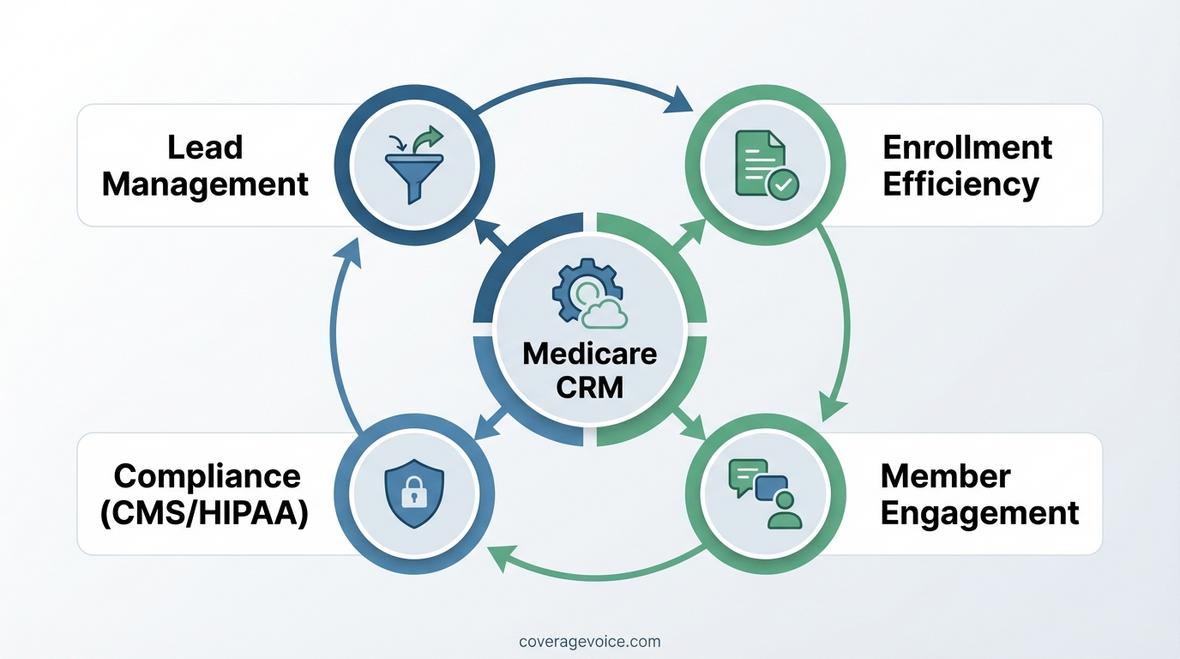
The diagram above illustrates how a centralized Medicare CRM creates a continuous operational cycle connecting lead management, enrollment efficiency, member engagement, and compliance. This integrated approach is particularly critical given 2026 market conditions, where carriers with worsened market relativity experienced enrollment declines ranging from 4-33%, while those who improved their competitive positioning saw growth as high as 22%.
Core Capabilities of High-Performance Medicare CRM Systems
Intelligent Lead Management and Qualification
Modern Medicare CRM platforms have transformed lead management from simple contact storage into sophisticated qualification engines. Advanced systems leverage AI-powered lead qualification to automatically segment prospects based on:
- Demographics: Age, location, current coverage status, and Special Enrollment Period (SEP) eligibility
- Behavioral Signals: Website engagement, email open rates, call response patterns, and appointment attendance history
- Intent Scoring: Predictive algorithms that identify high-probability enrollments based on historical conversion data
- Compliance Status: Verification that all required SOA documentation, consent recordings, and marketing disclosures are properly captured
The best Medicare CRM solutions integrate with virtual receptionist systems and pre-screening tools to qualify leads before they ever reach human agents significantly reducing cost per acquisition while improving conversion rates.
Enrollment Workflow Automation
Manual enrollment processes create bottlenecks, increase error rates, and drive up operational costs. Leading Medicare CRM platforms incorporate enrollment automation capabilities that:
- Auto-populate application forms with data already captured in the CRM
- Validate eligibility in real-time against carrier guidelines and CMS databases
- Generate compliant SOA documentation with digital signature capture
- Route applications to carrier portals with automatic status tracking
- Trigger follow-up workflows when applications require additional documentation
Organizations implementing robust Medicare CRM automation have documented substantial efficiency gains. Research from healthcare automation case studies shows that voice AI implementations can replace the workload of 45 agents, demonstrating the transformative potential of well-architected CRM workflows.
Comprehensive CMS and HIPAA Compliance Framework
Compliance failures carry severe consequences in Medicare distribution from financial penalties to loss of selling privileges. A robust Medicare CRM must provide:
- Scope of Appointment (SOA) Management: Digital capture, storage, and retrieval of SOA forms with timestamp validation and agent assignment tracking
- Marketing Material Compliance: Version control for CMS-approved marketing collateral with automatic distribution cutoff when approvals expire
- Call Recording and Consent: Integration with Medicare call center platforms to capture required disclosures and consent statements
- TCPA Compliance: Do-Not-Call list scrubbing, consent documentation, and calling hour restrictions to maintain TCPA compliance
- Audit Trail Maintenance: Comprehensive activity logs documenting every system interaction for CMS audit response
The compliance architecture within Medicare CRM systems protects organizations not just from regulatory penalties, but also from operational disruptions during peak enrollment periods when compliance violations can cascade into broader workflow failures.
Medicare CRM for Member Retention and Lifetime Value Optimization
Acquiring a new Medicare enrollee costs significantly more than retaining an existing member. According to CMS Medicare monthly enrollment data, beneficiary movement between plans and coverage types represents both churn risk and opportunity. A strategic Medicare CRM addresses retention through:
Proactive Member Engagement Workflows
Modern Medicare CRM platforms enable member retention and renewal strategies through automated touchpoint sequences:
- Welcome Series:New member welcome calls that establish relationships immediately post-enrollment
- Benefit Education: Targeted communications explaining plan features, particularly supplemental benefits like the Part B premium reductions now offered by 32% of MA plans according to KFF research on Medicare Advantage premium and benefit design trends
- Utilization Monitoring: Alerts triggered when members aren't accessing key benefits, enabling intervention before dissatisfaction develops
- Renewal Reminders: Strategically timed communications prior to AEP encouraging renewal while addressing potential concerns
Disenrollment Risk Identification and Prevention
With 2.6 million Medicare Advantage enrollees facing involuntary plan terminations in 2026, identifying at-risk members has never been more critical. Advanced Medicare CRM systems employ predictive analytics to flag members likely to disenroll based on engagement metrics, utilization patterns, and satisfaction indicators. Organizations can then deploy targeted retention interventions to reduce Medicare member churn through personalized outreach addressing specific concerns before members actively shop competitors.
Scaling Operations During Annual Enrollment Period with Medicare CRM
The Annual Enrollment Period represents both the greatest opportunity and the most intense operational challenge for Medicare organizations. Call volumes surge, lead quality varies dramatically, and compliance risks multiply as teams rush to meet enrollment deadlines. A purpose-built Medicare CRM transforms AEP chaos into orchestrated efficiency through AEP/OEP automation.
Dynamic Capacity Management
Leading Medicare CRM platforms integrate with voice AI systems for Medicare enrollment that can handle overflow call volume without proportional increases in staffing costs. These systems provide:
- 24/7 Availability:After-hours AI agents that capture leads and schedule appointments when human teams aren't available
- Intelligent Routing: Distribution of inbound contacts based on agent expertise, language requirements, and current workload
- Queue Management: Real-time monitoring of wait times with automatic overflow routing to AI-powered systems
- Callback Automation: Systems that automatically schedule return calls when queue times exceed thresholds, reducing abandonment rates
Multi-Channel Lead Orchestration
AEP leads arrive through diverse channels phone calls, web forms, live chat, SMS inquiries, and paid advertising campaigns. A robust Medicare CRM creates unified contact records across all touchpoints, ensuring consistent follow-up regardless of initial contact method. Integration with omnichannel client intake systems prevents duplicate outreach while ensuring no lead falls through operational gaps during high-volume periods.
Technology Integration and Ecosystem Connectivity
No Medicare CRM operates in isolation. The most effective implementations create seamless data flow across the entire technology ecosystem that supports Medicare distribution operations. Critical integrations include:
- Carrier Enrollment Portals: Direct API connections that submit applications and retrieve status updates without manual data entry
- Marketing Automation Platforms: Bidirectional sync ensuring lead source attribution and campaign performance tracking
- Telephony Systems: Integration with call center infrastructure for click-to-dial functionality, automatic call logging, and screen pop of member records
- Compliance Verification Services: Real-time connectivity to Do-Not-Call registries, identity verification systems, and eligibility databases
- Analytics and Reporting Tools: Data export to business intelligence platforms for advanced performance analysis and forecasting
Organizations evaluating Medicare CRM solutions should prioritize platforms with robust API frameworks and pre-built connectors to common Medicare ecosystem tools. The ability to create a unified technology stack dramatically accelerates implementation timelines and reduces total cost of ownership.
Medicare CRM Implementation: Build vs. Buy Decision Framework
Organizations face a critical strategic decision: should they build custom Medicare CRM capabilities or implement commercial platforms? This analysis explores the build versus buy cost considerations specific to Medicare CRM systems.
Custom Build Approach
Advantages:
- Complete customization to unique workflow requirements
- Potential long-term cost savings if scaled across large enrollment volumes
- Direct control over compliance architecture and data security protocols
Disadvantages:
- Significant upfront development investment (typically $500K-$2M+)
- Extended implementation timelines (12-24 months minimum)
- Ongoing maintenance burden requiring dedicated technical resources
- Risk of compliance gaps if internal teams lack Medicare regulatory expertise
Commercial Platform Approach
Advantages:
- Rapid deployment (often 30-90 days to full production)
- Built-in compliance frameworks developed by Medicare industry specialists
- Continuous feature enhancement without internal development resources
- Lower total cost of ownership for small to mid-sized organizations
Disadvantages:
- Ongoing subscription costs that scale with usage
- Potential workflow compromises where platform capabilities don't perfectly match requirements
- Vendor dependency for feature enhancements and technical support
For most Medicare marketing agencies, FMOs, and health plan call centers, commercial Medicare CRM platforms represent the optimal choice particularly solutions purpose-built for Medicare operations that incorporate compliance by design rather than requiring extensive customization.
Measuring Medicare CRM ROI: Key Performance Indicators
Implementing a Medicare CRM requires investment, and leadership teams rightfully demand evidence of return. Organizations should track these critical metrics:
- Cost Per Acquisition (CPA): Total marketing and operational costs divided by completed enrollments
- Lead-to-Enrollment Conversion Rate: Percentage of qualified leads that result in submitted applications
- Agent Productivity: Average enrollments per agent per day during AEP and throughout the year
- Member Retention Rate: Percentage of previous year enrollees who renew versus shop competitors
- Compliance Incident Rate: Number of CMS violations, HIPAA breaches, or TCPA complaints per thousand member interactions
- Average Handle Time: Duration of enrollment calls from initial contact through application submission
- First-Contact Resolution: Percentage of member inquiries resolved without requiring follow-up contacts
Organizations implementing comprehensive Medicare CRM solutions typically document 25-40% improvements in operational efficiency, 15-30% increases in conversion rates, and 20-50% reductions in compliance-related incidents. These improvements directly impact bottom-line profitability, particularly during the compressed AEP window when enrollment velocity determines annual revenue.
Emerging Trends in Medicare CRM: AI, Automation, and Member Experience
The Medicare CRM landscape continues rapid evolution, with several transformative trends reshaping how organizations approach member acquisition and retention:
Conversational AI Integration
Leading platforms now incorporate AI voice agents for Medicare enrollment that handle routine inquiries, qualify leads, and even complete enrollment interviews under agent supervision. These systems leverage natural language processing to conduct conversations that feel remarkably human while maintaining perfect compliance with scripting requirements. Organizations implementing conversational AI report the ability to scale AEP outreach without proportional staffing increases, fundamentally changing the economics of Medicare distribution.
Predictive Analytics and Machine Learning
Advanced Medicare CRM platforms now employ machine learning algorithms that identify patterns invisible to human analysts. These systems predict which leads are most likely to enroll, which members face the highest disenrollment risk, and which marketing channels deliver the best-quality prospects. Organizations leveraging predictive analytics can optimize marketing spend allocation, prioritize agent outreach, and implement targeted retention interventions before members actively shop competitors.
Member Experience Personalization
Generic, one-size-fits-all communications no longer drive engagement in competitive Medicare markets. Modern Medicare CRM systems enable sophisticated segmentation that tailors messaging based on member demographics, health conditions, utilization patterns, and engagement preferences. Personalized communications drive higher satisfaction scores, improved benefit utilization, and stronger retention particularly important given the direct correlation between member experience and Medicare Star Ratings that influence plan payment rates.
Selecting the Right Medicare CRM: Evaluation Framework
Organizations evaluating Medicare CRM solutions should assess vendors across these critical dimensions:
Compliance Credentials and Healthcare Expertise
Verify that vendors possess demonstrable Medicare industry expertise, maintain HIPAA compliance certifications, and provide regular platform updates aligned with evolving CMS regulations. Request case studies from similar organizations and references from clients who have operated the platform through multiple AEP cycles.
Technical Architecture and Scalability
Evaluate whether platforms can handle peak AEP call volumes without performance degradation. Cloud-based architectures generally provide superior scalability compared to on-premise systems. Assess API capabilities and integration ecosystem to ensure the CRM can connect with existing technology investments.
Implementation Support and Training
The most sophisticated Medicare CRM delivers limited value if users can't effectively operate it. Prioritize vendors offering comprehensive training programs, dedicated implementation support, and ongoing customer success resources. Organizations should budget 20-30% of first-year costs for training and change management.
Total Cost of Ownership
Look beyond subscription pricing to evaluate total implementation costs including integration work, data migration, training, and ongoing support. Request detailed pricing models that account for volume scaling during AEP versus baseline operations.
CoverageVoice: Purpose-Built Medicare CRM with Integrated Voice AI
CoverageVoice represents the next generation of Medicare CRM technology combining comprehensive relationship management with integrated voice AI automation specifically designed for Medicare organizations. The platform addresses the complete member lifecycle from initial lead capture through post-enrollment engagement.
Key differentiators include:
- Native Voice AI Integration: Purpose-built conversational AI that handles lead qualification, appointment scheduling, and enrollment support without requiring separate technology stacks
- Compliance by Design: Built-in SOA management, TCPA compliance, and HIPAA security architecture developed specifically for Medicare regulatory requirements
- Rapid Deployment: Organizations typically achieve full production implementation in 30-60 days versus 6-12 months for enterprise CRM customization projects
- Transparent Pricing: Consumption-based model that aligns costs with actual usage rather than requiring large upfront platform fees
Organizations interested in exploring how CoverageVoice compares to other Medicare technology solutions can review detailed comparisons including CareCycle versus CoverageVoice and Rivvi versus CoverageVoice.
Frequently Asked Questions
What is the difference between a general CRM and a Medicare CRM?
A Medicare CRM incorporates specialized compliance frameworks (CMS, HIPAA, TCPA), enrollment period workflows, carrier integration capabilities, and member lifecycle management tools specifically designed for Medicare insurance distribution. Generic CRMs lack these industry-specific features and require extensive customization to support Medicare operations.
How much does a Medicare CRM cost?
Pricing varies significantly based on deployment model, feature set, and organization size. Cloud-based Medicare CRM platforms typically range from $50-$200 per user per month, with additional fees for advanced features like integrated voice AI. Custom-built solutions require $500K-$2M+ in development investment plus ongoing maintenance costs.
Can Medicare CRM systems integrate with carrier enrollment portals?
Yes, leading Medicare CRM platforms provide API integrations with major carrier enrollment systems, enabling automated application submission and real-time status updates. Integration capabilities vary by vendor, so organizations should verify connectivity with their specific carrier mix during evaluation.
How does a Medicare CRM help with compliance?
Medicare CRM systems maintain audit trails, enforce SOA documentation requirements, manage marketing material version control, integrate with Do-Not-Call registries, capture required consent statements, and provide workflow guardrails that prevent common compliance violations. These built-in protections reduce regulatory risk while streamlining operations.
What ROI can organizations expect from Medicare CRM implementation?
Organizations typically document 25-40% operational efficiency improvements, 15-30% conversion rate increases, and 20-50% reductions in compliance incidents. Specific ROI depends on implementation quality, user adoption, and baseline operational efficiency. Most organizations achieve payback within 6-12 months.
Conclusion
The Medicare landscape in 2026 demands operational excellence, regulatory precision, and member-centric engagement that generic technology solutions simply cannot deliver. A purpose-built Medicare CRM transforms fragmented workflows into orchestrated systems that drive efficiency, ensure compliance, and maximize member lifetime value. Organizations that strategically implement Medicare CRM platforms position themselves to thrive despite market saturation, regulatory complexity, and intensifying competition. Whether you're a marketing agency scaling lead generation, an FMO optimizing enrollment operations, or a health plan call center improving member retention, the right Medicare CRM represents not just a technology investment but a competitive advantage that compounds with every enrollment cycle. Evaluate your current systems against the capabilities outlined in this guide, and consider whether your technology infrastructure truly supports your growth objectives or merely maintains status quo operations destined for disruption.
Ready to Transform Your Medicare Enrollment Process?
See how Coverage Voice AI can help you automate Medicare enrollment.