Medicare Enrollment AI: How Intelligent Automation Is Transforming AEP Operations In 2026

Introduction: The New Era of Medicare Enrollment
The Medicare enrollment landscape is undergoing a profound transformation in 2026. With Medicare Advantage enrollment growth slowed to 1% during 2026 AEP, down from the 7-10% annual growth seen between 2017-2024, health plans and FMOs are facing unprecedented pressure to maximize conversion efficiency. Traditional call center models simply cannot keep pace with the complexity of modern enrollment operations while maintaining HIPAA and CMS compliance. This is where Medicare enrollment AI emerges as a game-changing solution.
Medicare enrollment AI represents a category of intelligent automation technologies designed specifically to streamline the member acquisition journey from initial lead capture through final enrollment submission. For marketing agencies, Field Marketing Organizations, and health plan call centers managing thousands of simultaneous inquiries during Annual Enrollment Period (AEP), AI-powered systems offer the ability to scale operations without proportionally increasing costs or compliance risk.
According to industry analysis, 3.13 million beneficiaries impacted by 2026 Medicare Advantage plan changes, including 889 new launches and 765 terminations. This volatility creates massive lead processing challenges that Medicare enrollment AI is uniquely positioned to address. Furthermore, with 2.7 million non-SNP beneficiaries required to select new MA plans in 2026 due to plan terminations or service area reductions, the demand for efficient, compliant enrollment technology has never been higher.
Understanding Medicare Enrollment AI Technology
Medicare enrollment AI encompasses a suite of artificial intelligence capabilities specifically engineered for the healthcare insurance enrollment workflow. Unlike generic chatbots or basic interactive voice response (IVR) systems, purpose-built Medicare enrollment AI understands the nuanced compliance requirements, eligibility verification protocols, and data capture standards mandated by CMS.
Core Components of Medicare Enrollment AI
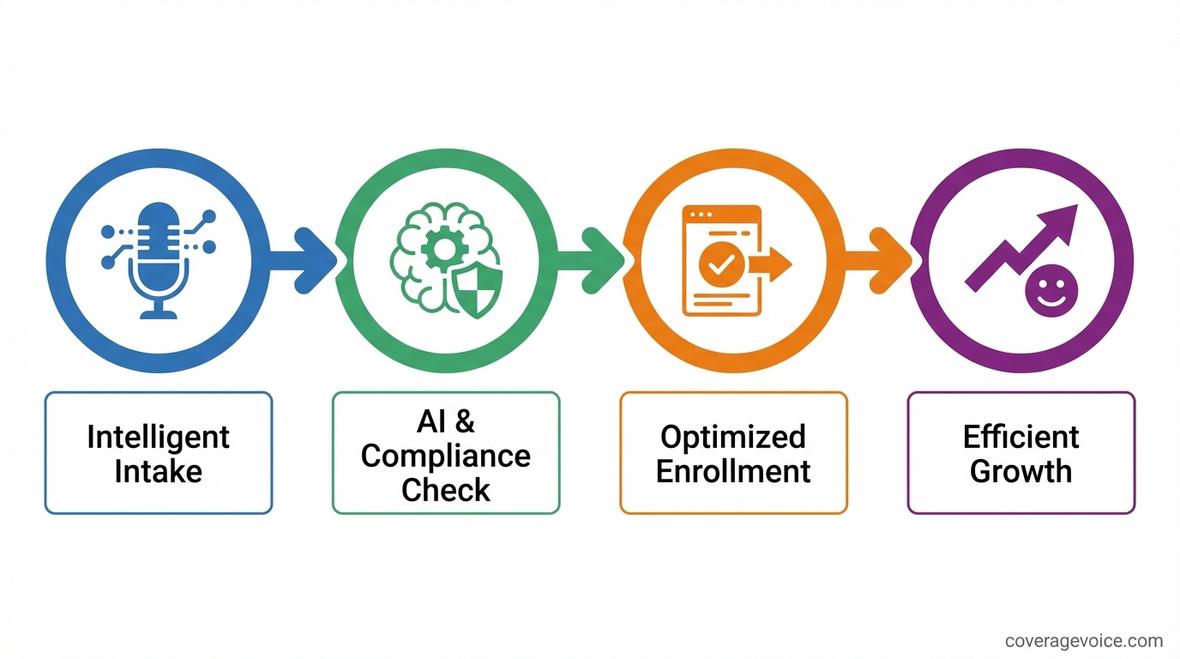
Modern Medicare enrollment AI platforms integrate several critical technologies working in concert. Natural language processing (NLP) enables conversational interactions that feel human while maintaining perfect compliance. Machine learning algorithms continuously improve qualification accuracy by analyzing historical conversion patterns. Speech recognition technology transcribes and analyzes voice interactions in real-time, while intelligent routing ensures complex cases seamlessly transfer to human specialists.
The most sophisticated systems incorporate pre-screening capabilities that automatically verify Medicare eligibility, identify Special Election Period (SEP) qualifications, and flag dual-eligible prospects for appropriate plan matching. This intelligent intake dramatically reduces wasted agent time on unqualified leads while improving the experience for legitimate prospects.
HIPAA and CMS Compliance by Design
For Medicare organizations, compliance is non-negotiable. Medicare enrollment AI platforms purpose-built for this sector incorporate compliance guardrails at the architectural level. Every interaction is recorded, timestamped, and stored in encrypted, HIPAA-compliant infrastructure. Automated compliance checks verify that required disclosures are delivered, consent is properly documented, and enrollment timelines adhere to CMS regulations.
Advanced systems like Medicare marketing compliance solutions monitor conversations in real-time, flagging potentially non-compliant language before it becomes a regulatory issue. This proactive compliance monitoring represents a significant advantage over traditional quality assurance approaches that only identify problems after the fact.
Operational Impact During Annual Enrollment Period
The Annual Enrollment Period represents the most critical and challenging window for Medicare organizations. Between October 15 and December 7, call centers experience volume spikes that can overwhelm even well-staffed operations. Medicare enrollment AI provides the scalability needed to handle these surges without compromising service quality or compliance standards.
Managing High-Volume Periods
During AEP 2025, leading organizations deployed AEP automation solutions that handled initial contact for up to 80% of inbound inquiries. These AI systems conducted preliminary qualification, scheduled appointments with licensed agents, and even completed full enrollment workflows for straightforward cases all while maintaining perfect documentation for CMS audit requirements.
The capacity advantage is substantial. While a traditional call center might require hiring and training dozens of seasonal agents to handle AEP volume, Medicare enrollment AI scales instantly. Organizations report maintaining consistent response times even during peak hours, eliminating the abandoned calls and long hold times that frustrate prospects and damage conversion rates.
Cost Efficiency Compared to Traditional Models
The financial case for Medicare enrollment AI becomes compelling when analyzing the total cost per enrollment. Traditional call center operations typically cost $150-300 per completed enrollment when accounting for agent wages, training, benefits, infrastructure, and quality assurance overhead. Medicare enrollment AI can reduce this cost to $40-80 per enrollment, delivering 60-75% cost savings while often improving conversion rates.
Organizations implementing comprehensive automation report even more dramatic results. One case study documented how Medicare voice AI replaces 45 agents, achieving the same enrollment volume with a fraction of the operational expense. These savings directly impact profitability, especially critical given the narrowing margins in Medicare Advantage plans.
Intelligent Lead Qualification and Conversion
Not all Medicare leads are created equal, and one of the most valuable applications of Medicare enrollment AI is intelligent lead qualification. Advanced systems analyze dozens of data points in real-time to score lead quality, predict conversion probability, and route prospects to the most appropriate enrollment pathway.
Multi-Factor Qualification Protocols
Modern Medicare enrollment AI platforms evaluate eligibility across multiple dimensions simultaneously. Age verification confirms Medicare qualification, geographic data validation ensures the prospect resides in serviceable areas, and income screening identifies potential Premium Tax Credit or Extra Help eligibility. Concurrent medication analysis can suggest plans with favorable formulary coverage, while provider network preferences help match prospects to appropriate MA plans.
This comprehensive qualification happens in seconds during the initial conversation, dramatically improving efficiency compared to manual agent qualification that might take 10-15 minutes per prospect. The time savings compound across thousands of interactions during AEP, creating capacity equivalent to dozens of full-time agents.
Personalized Engagement Strategies
Medicare enrollment AI excels at delivering personalized experiences at scale. By integrating with CRM systems and leveraging historical interaction data, AI agents can reference previous conversations, acknowledge specific health concerns, and tailor plan recommendations to individual circumstances. This personalization drives higher engagement rates and stronger conversion performance.
For organizations managing diverse lead sources, PPC ad follow-up automation ensures immediate engagement with paid search prospects while they have high intent. Speed-to-lead is critical in Medicare marketing, and AI systems can initiate contact within seconds of form submission a response time impossible to achieve with human-only operations.
Creating Seamless Omnichannel Enrollment Experiences
Today's Medicare beneficiaries interact across multiple channels phone calls, web forms, chat interfaces, SMS, and email. Medicare enrollment AI unifies these touchpoints into coherent omnichannel journeys that maintain context and compliance across every interaction.
Integrated Channel Management
Advanced platforms offer omnichannel client intake that allows prospects to start an enrollment conversation via web chat, continue by phone, and complete via SMS all without repeating information. The AI maintains a unified conversation history, ensuring seamless handoffs between channels and creating a frustration-free experience.
This channel flexibility proves especially valuable for the growing segment of tech-comfortable Medicare beneficiaries who prefer digital-first engagement. Simultaneously, the systems accommodate traditional phone-preferred prospects, ensuring no demographic is underserved.
24/7 Availability and After-Hours Support
Medicare prospects don't restrict their research and decision-making to business hours. Organizations deploying after-hour AI agents capture enrollment opportunities that would otherwise be lost to competitors with extended availability. These systems handle complete enrollment workflows at 2 AM with the same accuracy and compliance as midday interactions.
After-hours automation delivers particularly strong ROI because it captures incremental enrollments without requiring expensive night-shift staffing. The marginal cost of each additional AI-handled enrollment is negligible, making every after-hours conversion nearly pure profit contribution.
Data-Driven Insights and Continuous Optimization
Medicare enrollment AI generates unprecedented visibility into enrollment funnel performance. Every interaction produces structured data on qualification criteria, objection patterns, competitive intelligence, and conversion factors. This analytical foundation enables continuous optimization impossible with traditional operations.
Real-Time Performance Analytics
Modern platforms provide real-time dashboards tracking key enrollment metrics contact rate, qualification rate, appointment set rate, enrollment completion rate, and cost per acquisition. Managers can identify bottlenecks as they emerge and make immediate tactical adjustments rather than discovering problems days later through lagging reports.
The granular data also reveals insights about plan preference trends, common objections, and competitive pressure points. Organizations use this intelligence to refine messaging, adjust plan positioning, and allocate marketing spend more effectively.
Continuous Learning and Improvement
Machine learning models embedded in Medicare enrollment AI improve with every interaction. Conversation patterns that correlate with successful enrollments are identified and reinforced, while approaches that trigger drop-off are automatically adjusted. This continuous learning creates a virtuous cycle where system performance improves month over month without manual intervention.
Leading organizations report 15-25% conversion rate improvements in the first six months of Medicare enrollment AI deployment, with ongoing incremental gains as the system accumulates more training data and refines its qualification and engagement strategies.
Special Population Outreach and Enrollment
Certain Medicare populations require specialized outreach approaches and enrollment support. Medicare enrollment AI can be specifically configured to address the unique needs of dual-eligible beneficiaries, Low-Income Subsidy (LIS) recipients, and Special Needs Plan (SNP) candidates.
Dual-Eligible and LIS Enrollment
With SNP enrollment grew by 883,000 members to 23% of Medicare Advantage in 2026, specialized outreach to dual-eligible populations represents significant growth opportunity. Dual-eligible LIS outreach solutions incorporate income verification workflows, Medicaid coordination protocols, and simplified explanations appropriate for these often-vulnerable populations.
AI systems can navigate the complexity of dual-eligible enrollment, ensuring proper coordination between Medicare and Medicaid benefits while maintaining compliance with heightened consumer protection standards applicable to these special populations.
Language and Accessibility Considerations
Medicare enrollment AI platforms increasingly offer multilingual capabilities essential for reaching diverse beneficiary populations. Spanish, Mandarin, and other language support ensures compliance with CMS language access requirements while expanding addressable market reach.
Additionally, systems can accommodate hearing-impaired prospects through text-based interfaces and integrate with relay services, ensuring ADA compliance and inclusive enrollment access.
Post-Enrollment Member Retention and Engagement
Medicare enrollment AI delivers value beyond initial acquisition. The same technology that streamlines enrollment can drive retention, facilitate annual renewals, and support ongoing member engagement that improves satisfaction and Star Ratings performance.
Automated Renewal Campaigns
Organizations leverage member retention and renewal automation to proactively contact existing members during AEP, confirm satisfaction with current coverage, and facilitate plan renewals. These automated touchpoints reduce disenrollment risk while identifying members who might benefit from plan changes based on evolving health status or financial circumstances.
Proactive retention outreach proves especially valuable given market volatility. Organizations using AI-driven retention campaigns report 8-12% reductions in voluntary disenrollment, directly protecting revenue and improving member lifetime value.
Ongoing Member Engagement
Beyond enrollment and renewal, Medicare enrollment AI supports year-round member engagement initiatives. New member welcome calls delivered via AI ensure consistent onboarding experiences that orient members to plan benefits, explain utilization procedures, and establish positive initial impressions.
Ongoing touchpoints for benefits education, preventive care reminders, and medication adherence support improve member satisfaction while positively impacting Star Ratings metrics that determine plan quality bonuses and marketing advantages.
Implementation Considerations and Best Practices
Successfully deploying Medicare enrollment AI requires thoughtful planning, appropriate vendor selection, and strategic change management. Organizations that approach implementation systematically achieve faster time-to-value and stronger ROI.
Selecting the Right Platform
Not all AI platforms are created equal, and Medicare-specific requirements make vendor selection critical. Evaluation criteria should prioritize HIPAA and CMS compliance capabilities, Medicare domain expertise, integration capabilities with existing CRM and enrollment systems, scalability to handle AEP volume spikes, and transparent pricing models.
Organizations should request detailed compliance documentation, conduct thorough security audits, and verify vendor experience with Medicare-specific workflows before making platform commitments.
Integration with Existing Systems
Medicare enrollment AI delivers maximum value when tightly integrated with existing technology infrastructure. API connectivity to CRM platforms ensures lead data flows seamlessly, while integration with enrollment platforms enables end-to-end automation. Calendar system integration facilitates appointment scheduling without manual coordination.
Organizations should map integration requirements early in the evaluation process and verify vendor capabilities to support necessary data flows and system connections.
Change Management and Agent Training
Introducing Medicare enrollment AI represents significant operational change that requires thoughtful change management. Successful implementations involve agents early in the process, clearly communicate how AI augments rather than replaces human expertise, provide comprehensive training on working alongside AI systems, and celebrate early wins to build momentum and acceptance.
Organizations that position Medicare enrollment AI as an agent productivity tool rather than a replacement technology achieve smoother adoption and better long-term results.
Calculating ROI and Business Case Development
Building the financial justification for Medicare enrollment AI investment requires comprehensive ROI analysis that captures both direct cost savings and indirect value creation.
Direct Cost Savings
Quantifiable cost reductions include decreased agent headcount requirements, reduced training expenses, lower infrastructure costs, minimized overtime and seasonal staffing expenses, and decreased compliance risk and associated remediation costs.
A typical mid-size FMO processing 5,000 enrollments annually might invest $75,000-150,000 in Medicare enrollment AI implementation and subscription costs while achieving $300,000-500,000 in operational savings delivering 200-300% first-year ROI.
Revenue and Conversion Impact
Beyond cost savings, Medicare enrollment AI drives revenue growth through higher conversion rates from improved qualification and engagement, increased enrollment volume from expanded capacity, reduced disenrollment through proactive retention, and competitive advantage in speed-to-lead response.
Organizations should model both cost and revenue impacts when building comprehensive business cases that reflect the full value potential of Medicare enrollment AI investments.
Future Trends in Medicare Enrollment AI
The Medicare enrollment AI category continues rapid evolution, with emerging capabilities promising even greater operational impact in coming years.
Predictive Enrollment Analytics
Next-generation systems will leverage predictive analytics to identify high-conversion prospects before initial contact, optimize outreach timing based on individual propensity models, and recommend personalized engagement strategies for each prospect profile.
Hyper-Personalization
Future Medicare enrollment AI will deliver increasingly sophisticated personalization by integrating broader data sources, generating dynamic content tailored to individual circumstances, and adapting conversation strategies in real-time based on engagement signals.
Autonomous Enrollment Operations
The long-term trajectory points toward substantially autonomous enrollment operations where AI handles end-to-end workflows for the majority of straightforward cases, human agents focus exclusively on complex scenarios requiring judgment and empathy, and continuous learning creates ever-improving performance without manual optimization.
Frequently Asked Questions
Is Medicare enrollment AI truly HIPAA and CMS compliant?
Purpose-built Medicare enrollment AI platforms incorporate compliance by design, with encrypted data storage, comprehensive audit trails, automated disclosure delivery, and consent documentation that meets or exceeds regulatory requirements. Organizations should verify vendor compliance certifications and conduct security audits as part of vendor selection.
What does Medicare enrollment AI cost?
Pricing models vary by vendor and deployment scope. Typical implementations range from $1,500-5,000 monthly subscription fees for smaller operations to $10,000-25,000 monthly for enterprise deployments handling thousands of monthly enrollments. Most platforms offer per-interaction pricing that scales with usage, making costs predictable and aligned with enrollment volume.
How long does implementation take?
Implementation timelines depend on integration complexity and customization requirements. Basic deployments can launch in 2-4 weeks, while comprehensive implementations with extensive CRM integration and custom workflows may require 6-12 weeks. Organizations planning for AEP should initiate vendor selection and implementation at least 90 days before October 15 to ensure systems are fully operational for peak season.
Will AI replace human enrollment agents?
Medicare enrollment AI augments rather than replaces human expertise. AI handles routine qualification, data collection, and straightforward enrollments, while human agents focus on complex cases, relationship building, and scenarios requiring judgment and empathy. Organizations typically experience agent role evolution rather than elimination, with staff transitioning to higher-value activities.
Conclusion
Medicare enrollment AI represents a fundamental shift in how health plans, FMOs, and marketing agencies approach member acquisition and retention. With enrollment growth slowing and operational efficiency becoming critical to profitability, intelligent automation offers the scalability, compliance assurance, and cost efficiency needed to thrive in the evolving Medicare marketplace. Organizations that strategically deploy Medicare enrollment AI gain substantial competitive advantages through superior conversion rates, lower acquisition costs, and enhanced member experiences. As the technology continues maturing and adoption accelerates, Medicare enrollment AI will transition from competitive differentiator to operational necessity for organizations serious about sustainable growth in the Medicare space.
Ready to Transform Your Medicare Enrollment Process?
See how Coverage Voice AI can help you automate Medicare enrollment.