Medicare Enrollment Automation: Complete 2026 Guide To Intelligent Process Optimization For FMOs And Health Plans
Introduction to Medicare Enrollment Automation
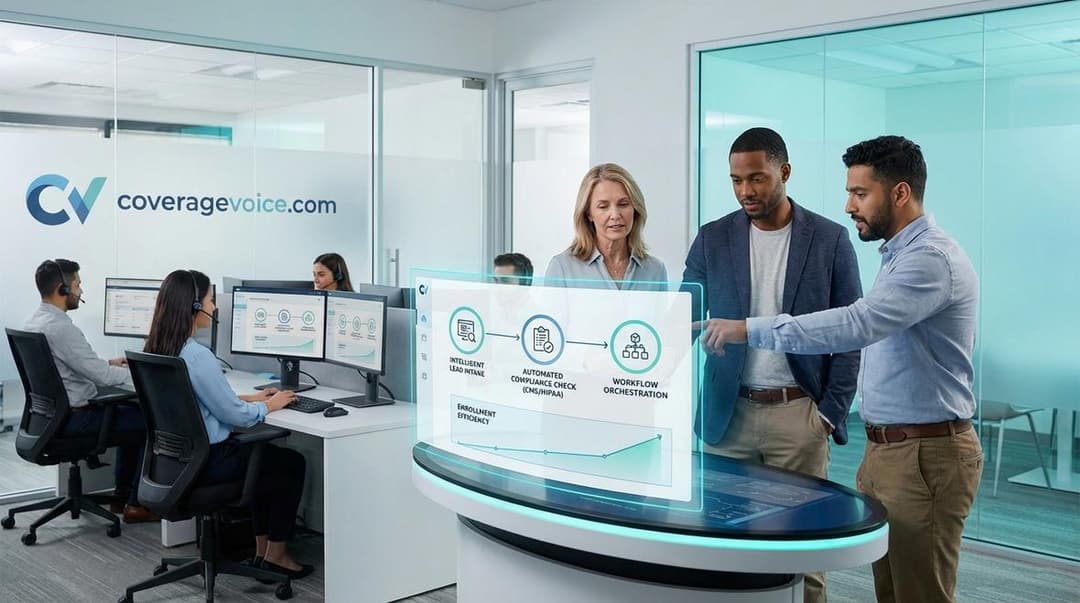
Medicare enrollment automation represents a transformative shift in how Field Marketing Organizations (FMOs), health plans, and call centers manage the complex, high-volume processes associated with beneficiary enrollment. As the Medicare landscape grows more intricate and Annual Enrollment Period (AEP) volumes surge, manual processes become unsustainable, leading to increased operational costs, compliance risks, and missed revenue opportunities.
Organizations handling Medicare enrollment face mounting pressure to deliver personalized member experiences while maintaining strict HIPAA compliance and CMS regulatory adherence. Traditional call center models struggle to scale efficiently during peak periods, resulting in agent burnout, inconsistent quality, and elevated cost-per-enrollment metrics that erode profitability.
Intelligent automation technologies including AI-powered voice agents, conversational AI platforms, and workflow orchestration systems are revolutionizing Medicare enrollment operations. These solutions enable organizations to process applications faster, reduce human error, ensure consistent compliance checks, and deliver superior member engagement throughout the enrollment journey. Understanding how to implement Medicare enrollment automation strategically is essential for maintaining competitive advantage in 2026 and beyond.
Understanding the Complexity of Medicare Enrollment Processes
The Medicare enrollment ecosystem presents unique operational challenges that distinguish it from other healthcare or insurance sectors. Complexity of Medicare enrollment decisions burdens operational processes, as MedPAC research demonstrates that beneficiary confusion leads to suboptimal plan selections and dramatically increases administrative workloads for FMOs and health plans during high-volume periods like AEP.
Multiple enrollment pathways exist across Original Medicare, Medicare Advantage, Part D prescription plans, and Medicare Supplement policies, each governed by distinct eligibility windows, documentation requirements, and compliance protocols. Beneficiaries transitioning from employer coverage, aging into Medicare at 65, or qualifying through disability status face different enrollment timelines and decision frameworks.
The higher Medicare Advantage enrollment rates among new beneficiaries sticking with status quo reveals significant automation opportunities historical analysis shows new Medicare beneficiaries overwhelmingly default to initial plan choices, underscoring how streamlined enrollment processes can capture market share during critical decision windows.
Processing a single Medicare enrollment application manually requires collecting personal information, verifying eligibility, conducting Scope of Appointment (SOA) documentation, confirming plan selections, submitting CMS-compliant enrollment forms, and executing post-enrollment follow-up communications. This multi-stage workflow involves numerous touchpoints across different systems, creating bottlenecks and compliance vulnerabilities when handled manually.
Annual Enrollment Period Operational Challenges
The Annual Enrollment Period from October 15 through December 7 concentrates approximately 40% of annual Medicare plan selection activity into just 54 days. According to CMS Medicare Advantage enrollment data trends, year-over-year growth patterns demonstrate that plans must prepare for significant volume spikes that can overwhelm traditional staffing models.
Organizations typically respond by hiring temporary staff, which introduces training challenges, quality control issues, and elevated cost structures. Seasonal agents require extensive onboarding on compliance protocols, product knowledge, and system navigation investments that deliver minimal return given the short employment duration. Medicare enrollment automation addresses these challenges by providing scalable capacity that maintains consistent quality regardless of volume fluctuations.
Core Components of Medicare Enrollment Automation Systems
Effective Medicare enrollment automation integrates multiple technology layers working in concert to replicate and enhance human-managed workflows. Understanding these foundational components helps organizations evaluate vendor capabilities and implementation requirements.
Intelligent Lead Intake and Qualification
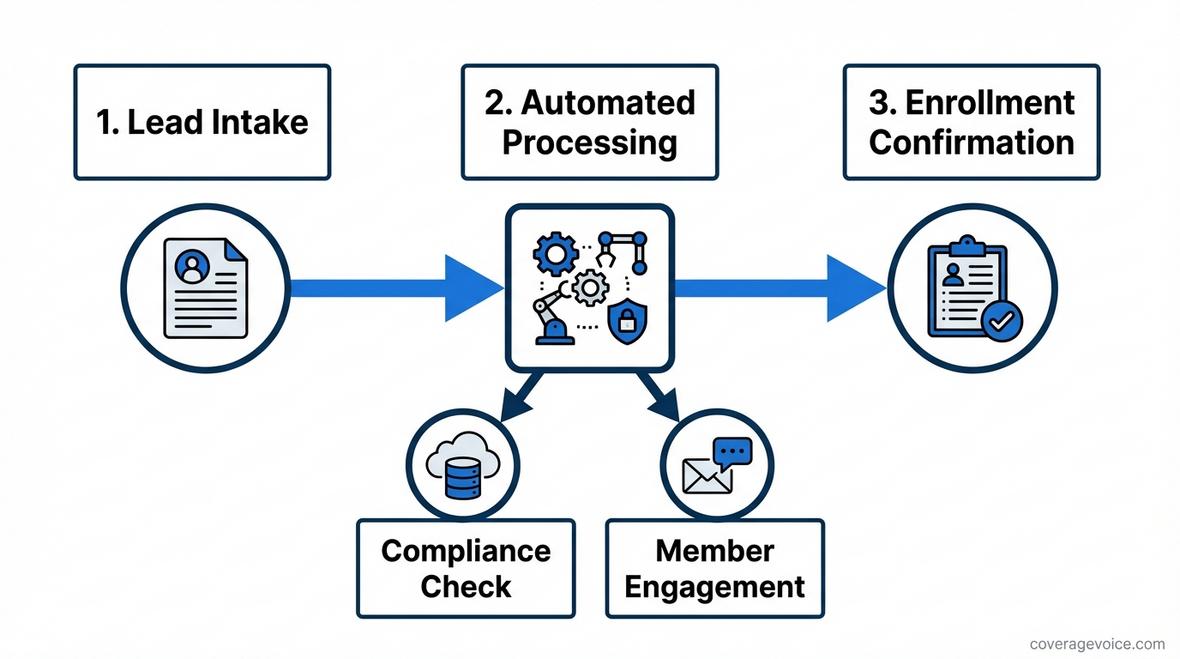
The enrollment journey begins with lead capture and initial qualification. Advanced Medicare enrollment automation platforms employ omnichannel client intake capabilities that unify phone, web, SMS, and email inquiries into consolidated workflows. AI-powered voice agents handle inbound calls 24/7, conducting preliminary qualification conversations that assess Medicare eligibility, coverage needs, and enrollment timeline.
These systems utilize natural language processing to understand beneficiary questions in conversational context, eliminating rigid IVR menu structures that frustrate callers. Intelligent routing directs qualified prospects to appropriate enrollment pathways while filtering out ineligible inquiries before consuming expensive human agent time. Pre-screening automation validates basic eligibility criteria including age, Medicare Part A/B enrollment status, and geographic service area before advancing leads through the enrollment funnel.
Automated Compliance and Regulatory Verification
Regulatory compliance represents the highest-risk element of Medicare enrollment operations. CMS marketing and enrollment regulations mandate strict protocols for Scope of Appointment documentation, enrollment form completion, and communication recording requirements. Manual compliance processes depend on agent training consistency and supervisory oversight both vulnerable to human error during high-volume periods.
Medicare enrollment automation systems embed compliance guardrails directly into conversation flows and data processing workflows. AI voice agents automatically complete required disclosures, document beneficiary consent, verify identity through knowledge-based authentication, and generate compliant SOA records without requiring agent intervention. Every interaction is recorded and tagged with compliance metadata, creating comprehensive audit trails that satisfy CMS documentation requirements.
Real-time validation engines cross-reference beneficiary information against CMS databases, identifying eligibility issues, conflicting coverage, and enrollment timing restrictions before applications reach submission. This proactive error detection prevents costly application rejections and reduces the rework burden that plagues manual enrollment operations.
Workflow Orchestration and CRM Integration
Effective automation requires seamless data flow across disparate systems including CRMs, enrollment platforms, carrier portals, and communication tools. Modern Medicare enrollment automation leverages API-based integration architectures that synchronize beneficiary data, application status, and communication history across the entire technology stack.
Workflow orchestration engines coordinate multi-step enrollment processes, automatically triggering follow-up actions based on application status changes. When a beneficiary completes initial qualification but doesn't schedule an enrollment appointment, the system automatically initiates nurture sequences via preferred communication channels. If a submitted application encounters CMS processing issues, automation routes the case to specialized remediation queues with complete context for rapid resolution.
Integration with HIPAA-compliant Medicare CRM systems ensures that all beneficiary interactions, preferences, and enrollment history remain accessible to both automated and human agents. This unified data foundation enables personalized engagement strategies that improve conversion rates and member satisfaction throughout the enrollment lifecycle.
Key Use Cases for Medicare Enrollment Automation
Medicare enrollment automation delivers value across multiple operational scenarios. Organizations should prioritize implementation based on their specific volume patterns, cost structures, and competitive positioning.
AEP and OEP Volume Management
The most immediate automation opportunity exists in managing AEP and OEP surge capacity without proportional staffing increases. AI voice agents handle the initial inquiry volume spike, qualifying prospects, scheduling appointments with human enrollment specialists, and collecting preliminary information that accelerates subsequent conversations.
During AEP, organizations can maintain lean permanent staff supplemented by scalable automation capacity that expands and contracts based on real-time demand. This hybrid model dramatically reduces temporary staffing costs while ensuring no qualified lead goes unaddressed during peak contact periods. Voice AI systems process hundreds of simultaneous conversations without wait times, eliminating the abandoned call rates that plague traditional call centers during enrollment season.
After-Hours and Weekend Availability
Medicare beneficiaries frequently research plan options outside standard business hours, particularly working individuals approaching age 65 or those managing coverage decisions alongside caregiving responsibilities. Traditional call centers operating 9-5 schedules miss significant conversion opportunities during evenings and weekends when prospects have time to focus on enrollment decisions.
After-hours AI agents provide continuous availability without overtime costs or shift differentials. These systems handle qualification conversations, answer plan comparison questions, schedule follow-up appointments with human agents, and capture enrollment applications 24/7/365. Organizations implementing comprehensive after-hours automation report 20-30% increases in qualified lead capture by eliminating time-based access barriers.
Dual-Eligible and LIS Beneficiary Outreach
Dual-eligible beneficiaries qualifying for both Medicare and Medicaid represent complex enrollment scenarios requiring specialized knowledge and proactive outreach. The 17 million Medicaid beneficiaries at risk in redetermination process highlights massive administrative challenges approximately 17 of 20 million Medicaid beneficiaries added during the pandemic faced potential coverage loss during unwinding, creating urgent opportunities for automated eligibility screening and enrollment assistance.
Dual-eligible and LIS outreach automation enables organizations to contact thousands of potentially qualifying beneficiaries efficiently, screen for program eligibility, explain available benefits, and guide enrollment in appropriate D-SNP or other specialized plans. AI systems navigate these conversations with cultural competency and language translation capabilities that would require prohibitively expensive multilingual staffing in traditional models.
Member Retention and Renewal Automation
Acquiring new Medicare members costs significantly more than retaining existing enrollees, yet many organizations focus automation efforts exclusively on new enrollment while neglecting retention workflows. Automated retention and renewal systems proactively engage current members months before their coverage anniversary, confirming satisfaction, addressing service concerns, explaining plan changes for the upcoming year, and securing renewal commitments before competitors initiate disenrollment campaigns.
Predictive analytics identify members exhibiting churn risk signals such as decreased engagement, service complaints, or competitive plan research activity. Automation triggers personalized outreach addressing specific concerns with tailored retention offers, benefits education, or service recovery actions. Organizations implementing systematic retention automation report 15-25% reductions in voluntary disenrollment rates, directly impacting long-term member lifetime value.
Implementation Strategy and Best Practices
Successful Medicare enrollment automation requires strategic planning beyond technology selection. Organizations should approach implementation as organizational transformation rather than simple software deployment.
Process Mapping and Optimization
Before automating existing workflows, organizations must critically evaluate current processes to identify inefficiencies, redundancies, and compliance gaps. Comprehensive process mapping documents every step in the enrollment journey from initial lead capture through post-enrollment welcome calls, identifying automation opportunities and human-essential touchpoints.
Many organizations discover that manual processes have evolved organically over years, incorporating workarounds for system limitations or legacy technology constraints. Automation implementation provides the catalyst for workflow redesign, eliminating unnecessary steps and optimizing the end-to-end enrollment experience. Engaging frontline agents in process mapping sessions captures institutional knowledge while building stakeholder buy-in for automation changes.
Designing Hybrid Human-AI Operating Models
Optimal Medicare enrollment automation doesn't eliminate human agents it repositions them for highest-value activities. AI agents versus live agents shouldn't be framed as replacement but as complementary capabilities that together exceed either approach independently.
Effective hybrid models assign routine qualification, scheduling, information gathering, and follow-up tasks to AI automation while reserving complex consultative enrollment conversations, objection handling, and relationship building for experienced human agents. This division of labor allows organizations to maintain smaller permanent staff focused on revenue-generating activities rather than administrative tasks.
Implementing intelligent escalation protocols ensures seamless handoffs when AI agents encounter scenarios requiring human judgment. Context preservation during transfers provides human agents with complete conversation history, eliminating frustrating beneficiary repetition and maintaining service quality throughout the enrollment journey.
Compliance Training and Governance Frameworks
Medicare enrollment automation systems require ongoing governance to ensure CMS compliance as regulations evolve. Organizations should establish cross-functional compliance committees including operations, legal, IT, and vendor representatives who review conversation scripts, validation rules, and documentation procedures quarterly.
All automation content voice agent scripts, compliance disclosures, plan comparison information requires the same rigorous review and approval processes applied to human agent training materials. Marketing and enrollment regulations change annually, necessitating systematic content update workflows that propagate approved changes across all automation touchpoints simultaneously.
Regular quality audits comparing AI agent performance against human agent baselines identify training opportunities and potential compliance drift. Organizations should monitor key metrics including disclosure completion rates, SOA documentation accuracy, application error rates, and beneficiary complaint patterns to maintain regulatory standards while scaling automation capacity.
Measuring Medicare Enrollment Automation ROI
Quantifying automation return on investment requires comprehensive metrics beyond simple cost-per-call comparisons. Organizations should track financial, operational, and strategic performance indicators to assess total program value.
Direct Cost Reduction Metrics
The most immediate ROI comes from reduced labor costs during peak enrollment periods. Organizations should calculate total cost savings including eliminated temporary staffing expenses, reduced overtime, lower training costs, and decreased supervisor overhead. Medicare Voice AI replacing 45 agents demonstrates real-world cost impact organizations achieving equivalent capacity with 90% fewer human agents while maintaining or improving service quality metrics.
Additional cost benefits emerge from reduced application errors and rework. Manual enrollment processes generate costly corrections when agents miss eligibility issues, document forms incorrectly, or fail to complete required compliance steps. Automation's consistent execution eliminates these error-driven costs while reducing CMS application rejection rates that delay member effective dates and revenue recognition.
Conversion Rate and Revenue Impact
Beyond cost savings, Medicare enrollment automation drives revenue growth through improved conversion rates and faster enrollment cycles. AI systems contact leads within seconds of inquiry, dramatically increasing connection rates compared to manual callback queues where prospects cool or engage competitors during wait periods.
Consistent qualification processes ensure every prospect receives optimal plan recommendations aligned with their specific needs and preferences. Organizations report 15-40% conversion rate improvements when implementing comprehensive enrollment automation, translating directly to incremental membership growth and commission revenue for FMOs.
Accelerated enrollment cycles compress the time between initial inquiry and submitted application, reducing competitive interference and improving member acquisition costs. Voice AI cutting resolution time 30x demonstrates operational velocity improvements that directly impact revenue realization and cash flow.
Member Experience and Satisfaction Metrics
Long-term automation success requires maintaining or improving member satisfaction throughout the enrollment journey. Organizations should track Net Promoter Scores, enrollment completion rates, first-call resolution metrics, and post-enrollment satisfaction surveys to ensure automation enhances rather than degrades beneficiary experience.
AI voice agents deliver consistent, patient interactions regardless of call volume or time of day, eliminating the service quality degradation that occurs when overwhelmed human agents rush through conversations during peak periods. Natural language capabilities allow beneficiaries to ask questions conversationally rather than navigating frustrating menu systems, improving satisfaction scores while gathering better qualification information.
Member experience improvements contribute to long-term retention and referral generation. Medicare Voice AI boosting Star Ratings illustrates how automation can positively impact plan quality metrics that drive both CMS bonus payments and competitive positioning in an increasingly quality-focused market.
Selecting the Right Medicare Enrollment Automation Platform
The Medicare enrollment automation market includes diverse vendors offering varying capabilities, integration approaches, and pricing models. Organizations should evaluate platforms against specific selection criteria aligned with their operational requirements and strategic priorities.
Medicare-Specific Functionality
Generic conversational AI platforms lack the specialized knowledge and compliance frameworks required for Medicare enrollment. Organizations should prioritize vendors demonstrating deep Medicare expertise including pre-built conversation flows for eligibility screening, plan comparison, SOA documentation, and enrollment application completion.
Medicare-specific enrollment automation platforms understand regulatory nuances including state-specific requirements, carrier submission protocols, and CMS marketing rule compliance. These systems include built-in validation for Medicare-specific data elements such as Medicare numbers, effective dates, and Part A/B enrollment status that generic platforms would require extensive customization to support.
Integration Capabilities and Ecosystem
Enrollment automation delivers maximum value when seamlessly integrated with existing technology infrastructure. Evaluate vendor integration capabilities including pre-built connectors for major Medicare CRMs, enrollment platforms, and carrier systems. API flexibility enables custom integrations with proprietary systems while supporting future technology additions as your stack evolves.
Organizations operating across multiple FMOs, health plans, or carrier relationships require automation platforms supporting multi-tenant architectures with workflow customization by organization, state, or product line. This configurability enables centralized platform management while accommodating diverse operational requirements across business units.
Compliance and Security Standards
Medicare enrollment automation handles sensitive personal health information requiring strict HIPAA compliance and robust security controls. Vendors should provide comprehensive compliance documentation including BAA agreements, SOC 2 Type II attestations, and regular security audits.
Evaluate data retention policies, encryption standards for data at rest and in transit, access controls, and incident response procedures. Cloud-based platforms should demonstrate compliance with healthcare-specific security frameworks and maintain geographically redundant infrastructure ensuring business continuity during outages or disasters.
The Future of Medicare Enrollment Automation
Medicare enrollment automation continues evolving rapidly as AI capabilities advance and regulatory frameworks adapt to technology-enabled processes. Organizations should anticipate emerging trends that will shape automation strategies in coming years.
Predictive Analytics and Hyper-Personalization
Next-generation automation platforms will leverage predictive analytics to anticipate beneficiary needs and proactively recommend optimal enrollment strategies. Machine learning models analyzing demographic data, health status indicators, prescription patterns, and historical behavior will generate personalized plan recommendations with unprecedented accuracy.
Conversational AI will deliver increasingly natural interactions indistinguishable from human conversations, understanding context, emotional cues, and implicit needs that current systems miss. This enhanced understanding will improve conversion rates while creating more satisfying beneficiary experiences throughout the enrollment journey.
Expanded Regulatory Acceptance
As automation technologies mature and demonstrate compliance reliability, CMS may expand permissible use cases for AI-driven enrollment processes. Current regulations require human agent involvement in certain enrollment scenarios, but successful automation deployments may influence future rule modifications that recognize technology-enabled compliance as equivalent to traditional human-executed processes.
Organizations implementing robust automation governance frameworks today position themselves to capitalize on regulatory evolution, potentially gaining competitive advantages through faster adoption of expanded automation permissions as they become available.
Getting Started: Implementation Action Plan
Organizations ready to implement Medicare enrollment automation should follow a structured approach that minimizes risk while accelerating time-to-value:
- Conduct Comprehensive Process Audit: Document current enrollment workflows identifying automation opportunities and human-essential touchpoints
- Define Success Metrics: Establish baseline performance for cost-per-enrollment, conversion rates, application error rates, and member satisfaction
- Pilot High-Impact Use Case: Begin with focused implementation such as automated appointment scheduling or after-hours qualification before expanding to full enrollment automation
- Engage Stakeholders Early: Include frontline agents, compliance teams, and IT in planning to build buy-in and capture institutional knowledge
- Select Medicare-Specialist Vendor: Prioritize platforms with demonstrated Medicare expertise like CoverageVoice over generic conversational AI tools requiring extensive customization
- Implement Phased Rollout: Deploy automation gradually, monitoring performance and refining workflows before expanding capacity
- Establish Governance Framework: Create ongoing oversight ensuring compliance, quality, and continuous improvement as automation scales
Organizations following this structured approach minimize implementation risks while building organizational capabilities for long-term automation success. The Medicare enrollment landscape will continue evolving toward technology-enabled operations strategic automation investment today establishes competitive positioning for sustained growth in increasingly digital healthcare markets.
Conclusion
Medicare enrollment automation represents a fundamental operational transformation that addresses the core challenges facing FMOs, health plans, and call centers in 2026. By intelligently combining AI voice agents, workflow orchestration, and compliance-embedded processes, organizations can scale enrollment capacity without proportional cost increases while maintaining regulatory adherence and improving member experiences. The complexity of Medicare decisions, intensifying AEP volume pressures, and escalating labor costs make automation not merely advantageous but essential for competitive sustainability. Organizations that strategically implement enrollment automation today position themselves to capture market share, improve operational efficiency, and deliver superior beneficiary engagement throughout the increasingly digital Medicare enrollment journey.
Ready to Transform Your Medicare Enrollment Process?
See how Coverage Voice AI can help you automate Medicare enrollment.