Medicare FMO Automation: Complete Guide To Streamlining Operations In 2026

Understanding Medicare FMO Automation
Medicare FMO automation represents a transformative approach to managing the complex operational demands faced by Field Marketing Organizations in the Medicare insurance ecosystem. As FMOs navigate increasingly competitive enrollment periods and stringent regulatory requirements, automation technologies have emerged as essential tools for maintaining compliance while maximizing efficiency. The modern Medicare FMO automation landscape encompasses everything from lead management and agent support to enrollment processing and member engagement, creating integrated systems that reduce manual workload while improving outcomes.
Field Marketing Organizations serve as critical intermediaries between insurance carriers and independent agents, managing vast networks that require constant communication, training, and support. Traditional manual processes create bottlenecks during high-volume periods like the Annual Enrollment Period, when call volumes can increase by 300-400%. Medicare FMO automation addresses these challenges by implementing intelligent systems that handle routine tasks, qualify leads, schedule appointments, and ensure every interaction meets HIPAA and CMS compliance standards without overwhelming human staff.
The evolution of Medicare FMO automation has accelerated dramatically, with artificial intelligence and machine learning now enabling conversational interactions that closely mirror human communication. Organizations implementing comprehensive automation solutions for Medicare brokers and FMOs report significant improvements in conversion rates, cost per enrollment, and agent productivity. These systems don't simply replace human workers; they augment capabilities, allowing staff to focus on complex cases requiring human judgment while automation handles high-volume, repetitive interactions.
Key Components of Medicare FMO Automation
Intelligent Lead Management and Qualification
Effective Medicare FMO automation begins with intelligent lead management systems that automatically capture, categorize, and qualify incoming prospects. Modern platforms integrate with multiple lead sources including digital marketing campaigns, referral programs, and inbound calls consolidating information into unified profiles that track every interaction. Automated pre-screening capabilities assess eligibility, determine plan fit, and identify high-intent prospects before human agents ever engage, dramatically improving conversion rates while reducing wasted effort on unqualified leads.
These systems leverage sophisticated algorithms to score leads based on demographic information, behavioral signals, and engagement patterns. When a prospect demonstrates high intent such as visiting specific plan pages multiple times or requesting immediate callback automation triggers prioritized routing to available agents or schedules appointments during optimal timeframes. This intelligent orchestration ensures that FMOs maximize the value of every lead while maintaining consistent follow-up that prevents prospects from falling through operational cracks.
Automated Appointment Scheduling and Calendar Management
Scheduling complexity represents one of the most time-consuming aspects of Medicare FMO operations, with agents juggling multiple appointments across different time zones while accommodating beneficiary preferences. Automated appointment scheduling eliminates this administrative burden by allowing prospects to select available times through conversational AI interactions or self-service portals. The system automatically coordinates with agent calendars, sends confirmation messages, and manages rescheduling requests without human intervention.
Advanced scheduling automation integrates reminder sequences that reduce no-show rates a persistent challenge that costs FMOs significant revenue during enrollment periods. Automated reminders via SMS, email, and voice calls reach beneficiaries through their preferred channels at optimal intervals, typically 24 hours and 2 hours before scheduled appointments. When cancellations occur, the system immediately makes those slots available and can proactively reach out to waitlisted prospects, maximizing calendar utilization throughout peak seasons.
Compliance Automation and Documentation
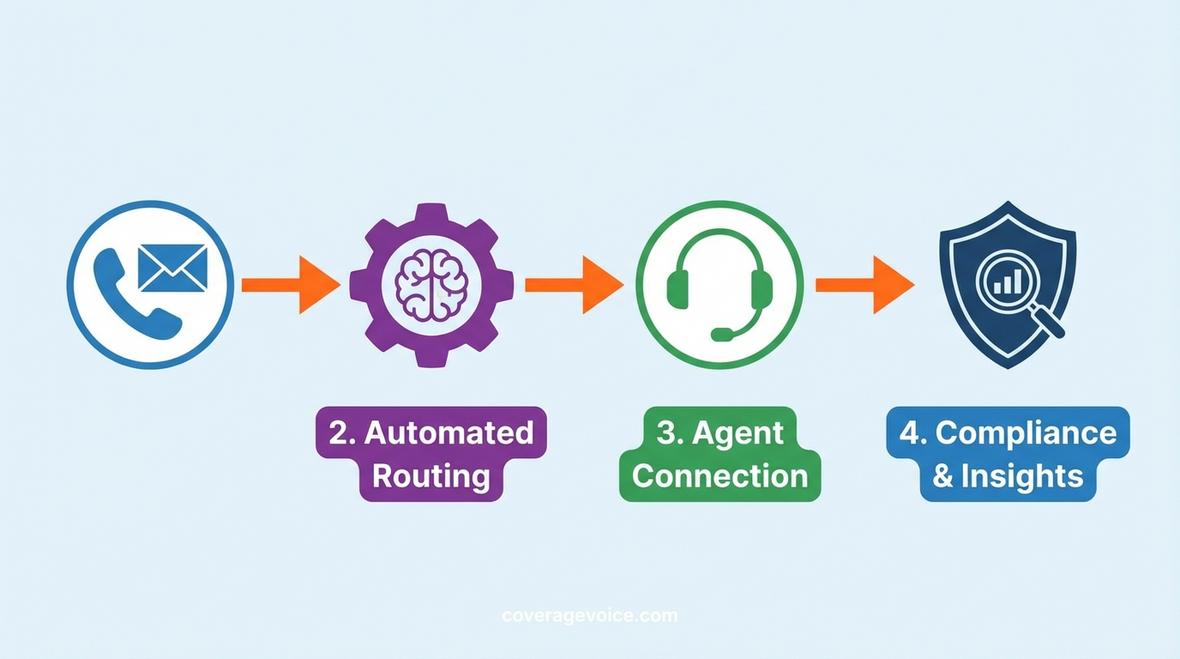
Regulatory compliance remains paramount for Medicare FMOs, with CMS imposing strict requirements around beneficiary interactions, documentation, and marketing practices. Medicare FMO automation platforms incorporate compliance safeguards directly into workflows, automatically recording calls, documenting consent, and flagging potentially non-compliant language in real-time. These systems maintain comprehensive audit trails that demonstrate adherence to CMS guidelines, protecting FMOs from penalties while reducing compliance officer workload.
Modern Medicare marketing compliance solutions leverage natural language processing to monitor conversations for prohibited statements, ensure required disclosures are delivered, and verify that beneficiaries receive mandated information before enrollment. Automated systems can pause interactions when compliance issues are detected, prompt agents with corrective language, and escalate complex situations to supervisors. This real-time compliance support transforms regulatory adherence from a reactive audit function into a proactive operational capability that protects both beneficiaries and organizations.
Operational Benefits of Medicare FMO Automation
Cost Reduction and Efficiency Gains
The financial impact of Medicare FMO automation extends across multiple operational dimensions, with organizations typically achieving 40-60% reductions in cost per enrollment after implementation. Labor represents the largest expense category for most FMOs, and automation dramatically reduces the human hours required for routine tasks. Voice AI enrollment solutions can handle initial prospect interactions, qualification, and scheduling without agent involvement, effectively multiplying workforce capacity during high-demand periods without proportional increases in staffing costs.
Beyond direct labor savings, Medicare FMO automation reduces overhead expenses associated with hiring, training, and managing large seasonal workforces. Organizations can maintain smaller core teams supplemented by automation rather than scaling headcount dramatically for AEP and OEP. This approach also eliminates costs related to employee turnover, which typically ranges from 30-50% annually in call center environments. Automated systems maintain consistent performance regardless of volume fluctuations, eliminating the quality degradation that often accompanies rapid workforce expansion.
Enhanced Member Experience and Engagement
Beneficiary expectations have evolved significantly, with Medicare-eligible consumers now expecting immediate responses and omnichannel accessibility similar to their experiences with mainstream consumer brands. Medicare FMO automation enables FMOs to meet these expectations by providing 24/7 availability, instant responses to common questions, and seamless transitions between communication channels. After-hours AI agents ensure that prospects reaching out during evenings and weekends receive immediate assistance rather than encountering voicemail or facing delays until business hours resume.
The personalization capabilities enabled by automation significantly enhance engagement throughout the member lifecycle. Systems track individual preferences, interaction history, and plan selections, enabling tailored communications that reference specific circumstances and needs. Automated new member welcome calls can be triggered immediately after enrollment, walking beneficiaries through their benefits and next steps while their interest remains high. This proactive engagement improves member satisfaction, reduces buyer's remorse, and establishes positive relationships that support long-term retention.
Scalability During Peak Enrollment Periods
Annual Enrollment Period presents the most significant operational challenge for Medicare FMOs, compressing the majority of annual enrollment activity into a concentrated seven-week window. Traditional staffing approaches struggle with this extreme seasonality, requiring organizations to hire and train hundreds of temporary workers who may lack the expertise to handle complex beneficiary questions effectively. AEP and OEP automation transforms this dynamic by providing virtually unlimited scalability without quality degradation or compliance risk.
Automated systems handle exponential volume increases without performance decline, simultaneously managing thousands of interactions while maintaining response quality and regulatory adherence. This capability enables FMOs to capture opportunities that would otherwise be lost to capacity constraints, converting prospects who might have abandoned their inquiries after encountering busy signals or extended hold times. Organizations implementing comprehensive Medicare FMO automation report 200-300% increases in contact handling capacity during peak periods, directly translating to enrollment growth without proportional cost increases.
Implementation Considerations for Medicare FMO Automation
Technology Selection and Integration
Selecting appropriate automation technology requires careful evaluation of capabilities, compliance features, and integration requirements. Medicare FMO automation platforms vary significantly in sophistication, with some offering basic scripted interactions while advanced solutions leverage conversational AI that adapts to individual beneficiary needs. Organizations should prioritize platforms specifically designed for Medicare operations, ensuring built-in compliance safeguards and industry-specific functionality rather than attempting to adapt generic customer service automation.
Integration capabilities represent a critical selection criterion, as Medicare FMO automation must connect seamlessly with existing CRM systems, enrollment platforms, and carrier interfaces. Comprehensive integration support enables automated workflows that span multiple systems, automatically updating records, triggering follow-up sequences, and synchronizing information across the technology ecosystem. Organizations should evaluate integration options during vendor selection, confirming that proposed solutions can connect with their specific technology stack without requiring extensive custom development.
Change Management and Staff Training
Successful Medicare FMO automation implementation extends beyond technology deployment to encompass organizational change management and comprehensive staff training. Many employees initially perceive automation as threatening their job security, creating resistance that can undermine adoption efforts. Effective change management communicates how automation augments rather than replaces human capabilities, positioning technology as a tool that eliminates tedious tasks and enables staff to focus on higher-value activities requiring human judgment and empathy.
Training programs should prepare staff to work effectively alongside automated systems, understanding when to intervene in automated interactions and how to leverage automation-generated insights. Agents need skills in interpreting AI-generated lead scores, managing escalations from automated conversations, and utilizing automated scheduling tools to optimize their calendars. Organizations that invest in comprehensive training report significantly faster adoption, higher staff satisfaction, and better outcomes than those treating automation as a simple technology deployment.
Continuous Optimization and Performance Measurement
Medicare FMO automation requires ongoing optimization to maximize value and adapt to evolving operational requirements. Initial implementations should establish baseline performance metrics across key dimensions including contact handling capacity, conversion rates, cost per enrollment, compliance adherence, and member satisfaction. Regular analysis of these metrics identifies optimization opportunities, revealing where automation performs exceptionally well and where adjustments or human intervention may improve outcomes.
Advanced platforms incorporate machine learning capabilities that continuously improve performance based on interaction data. Conversational AI systems analyze successful enrollments to identify patterns in language, timing, and approach that correlate with positive outcomes, automatically refining their interactions to replicate these successful elements. Organizations should establish regular review cycles typically monthly during standard periods and weekly during AEP to assess performance, implement optimizations, and ensure automation remains aligned with business objectives and regulatory requirements.
Advanced Medicare FMO Automation Capabilities
Outbound Campaign Automation
While inbound inquiry management represents the most common Medicare FMO automation application, outbound campaign automation offers substantial additional value for proactive member engagement. Automated outbound dialers enable FMOs to conduct large-scale outreach campaigns for member retention, plan renewals, and cross-selling opportunities without tying up agent capacity. These systems can simultaneously manage thousands of outbound calls, connecting with beneficiaries to deliver important information, gather feedback, or schedule appointments with human agents for complex discussions.
Intelligent outbound automation goes beyond simple robocalls by enabling conversational interactions that respond to beneficiary questions and adapt based on responses. Systems can conduct lead reactivation campaigns that re-engage prospects who previously expressed interest but didn't complete enrollment, using personalized messaging that references their specific circumstances and prior interactions. This capability transforms outbound calling from a resource-intensive activity requiring extensive agent time into an automated function that generates qualified appointments and engagement opportunities.
Multichannel and Omnichannel Automation
Modern beneficiaries interact with FMOs across multiple channels phone calls, web chat, SMS messaging, email, and social media expecting consistent experiences regardless of their chosen communication method. Omnichannel client intake automation unifies these touchpoints into cohesive experiences, maintaining context as beneficiaries move between channels and ensuring information captured in one interaction informs subsequent communications through other channels.
This multichannel capability proves particularly valuable for younger Medicare beneficiaries those newly eligible at 65 who often prefer digital interactions over traditional phone calls. Automated chat interfaces on FMO websites can handle initial inquiries, qualify prospects, and schedule appointments without requiring phone conversations. When beneficiaries do call after initial digital interactions, automation ensures agents have complete context from prior engagements, eliminating repetitive information gathering and creating seamless experiences that improve satisfaction and conversion rates.
Measuring ROI of Medicare FMO Automation
Quantitative Metrics and KPIs
Demonstrating return on investment for Medicare FMO automation requires tracking comprehensive metrics across operational and financial dimensions. Primary quantitative indicators include cost per enrollment, which typically decreases 40-60% after automation implementation; contact handling capacity, measured as total interactions processed per period; and conversion rates from initial contact through completed enrollment. Organizations should establish baseline measurements before automation deployment, enabling accurate comparison of pre- and post-implementation performance.
Additional financial metrics include agent productivity, measured as enrollments or qualified appointments per agent hour; seasonal staffing costs, comparing temporary workforce expenses before and after automation; and revenue per interaction, reflecting improved conversion of incoming contacts. Voice AI ROI calculators help quantify these benefits, projecting financial returns based on organizational volume, current costs, and anticipated automation impact. Most FMOs implementing comprehensive automation achieve positive ROI within 3-6 months, with benefits accelerating as systems optimize over time.
Qualitative Benefits and Organizational Impact
Beyond quantitative metrics, Medicare FMO automation delivers significant qualitative benefits that enhance organizational capability and market positioning. Compliance confidence improves substantially when automated systems ensure consistent adherence to CMS requirements, reducing anxiety around audits and enforcement actions. Staff satisfaction typically increases as automation eliminates tedious tasks, allowing agents to focus on meaningful interactions where they can apply expertise and build relationships with beneficiaries.
Competitive differentiation represents another important qualitative benefit, as FMOs with advanced automation capabilities can offer superior agent support, faster response times, and more comprehensive services compared to competitors relying on manual processes. This technological sophistication attracts high-performing agents who prefer working with organizations that provide tools enabling their success. Organizations should document these qualitative benefits through staff surveys, compliance audit results, and agent retention rates, complementing quantitative ROI calculations with broader organizational impact assessments.
Future Trends in Medicare FMO Automation
The Medicare FMO automation landscape continues evolving rapidly, with emerging technologies promising even greater capabilities and operational benefits. Advanced natural language processing will enable increasingly sophisticated conversational interactions that better understand context, emotion, and complex beneficiary situations. Predictive analytics will identify beneficiaries likely to disenroll before they take action, triggering proactive retention campaigns that address concerns before they escalate into plan switches.
Integration between Medicare FMO automation and broader healthcare data ecosystems will enable more personalized plan recommendations based on medical histories, prescription needs, and healthcare utilization patterns. Organizations exploring comprehensive enrollment automation should select platforms with flexible architectures that can incorporate these emerging capabilities without requiring complete system replacements. The FMOs that establish strong automation foundations today will be best positioned to leverage future innovations, maintaining competitive advantages as technology continues advancing.
Frequently Asked Questions
How does Medicare FMO automation ensure CMS compliance?
Medicare FMO automation platforms designed specifically for the Medicare industry incorporate CMS compliance requirements directly into their functionality. These systems automatically record all beneficiary interactions, document required disclosures, monitor conversations for prohibited language using natural language processing, and maintain comprehensive audit trails. Real-time compliance monitoring can pause interactions when potential violations are detected, prompt agents with corrective language, and escalate issues to supervisors. This proactive compliance support significantly reduces regulatory risk compared to manual processes that rely on post-interaction review and agent memory.
What is the typical implementation timeline for Medicare FMO automation?
Implementation timelines vary based on system complexity and organizational readiness, but most Medicare FMO automation deployments follow a 60-90 day timeline from contract signing to full production launch. This process includes initial configuration and integration (2-3 weeks), compliance review and approval (2-3 weeks), staff training (1-2 weeks), pilot testing with limited volume (2-3 weeks), and phased rollout to full production. Organizations beginning implementations 4-5 months before Annual Enrollment Period can typically achieve full operational capability before peak season begins, maximizing automation benefits during the highest-volume period.
Can automation handle complex beneficiary situations or only simple inquiries?
Modern Medicare FMO automation leverages conversational AI capable of managing substantial complexity, including multi-condition medical situations, prescription coverage questions, and comparative plan analysis. However, automation works most effectively when paired with intelligent escalation to human agents for situations requiring judgment, empathy, or deep expertise. Advanced systems identify when conversations exceed automation capabilities and seamlessly transfer to qualified agents with complete context from the automated interaction. This hybrid approach handles 60-80% of inquiries entirely through automation while ensuring complex cases receive appropriate human attention.
How does Medicare FMO automation impact agent roles and employment?
Rather than eliminating agent positions, Medicare FMO automation typically transforms agent roles from high-volume transactional work to higher-value consultative interactions. Automation handles routine inquiries, qualification, scheduling, and follow-up, freeing agents to focus on complex beneficiary situations, relationship building, and consultative plan recommendations. Organizations implementing automation often maintain similar total staffing levels while dramatically increasing enrollment capacity, as agents spend more time on revenue-generating activities and less time on administrative tasks. This evolution generally improves agent satisfaction by eliminating tedious work and enabling more meaningful beneficiary interactions.
Conclusion
Medicare FMO automation has evolved from a competitive advantage to an operational necessity for organizations seeking to thrive in the increasingly complex Medicare marketplace. By implementing comprehensive automation spanning lead management, appointment scheduling, compliance monitoring, and member engagement, FMOs achieve dramatic improvements in efficiency, cost-effectiveness, and beneficiary satisfaction while maintaining rigorous regulatory adherence. The technology has matured to the point where sophisticated conversational AI can handle the majority of routine interactions, freeing human agents to focus on complex situations requiring judgment and expertise. Organizations that strategically implement Medicare FMO automation position themselves for sustainable growth, operational excellence, and competitive differentiation in an industry where technology adoption increasingly separates market leaders from struggling competitors.
Ready to Transform Your Medicare Enrollment Process?
See how Coverage Voice AI can help you automate Medicare enrollment.