Medicare Voice AI For FMOs: The Complete 2026 Guide To Intelligent Automation & Enrollment

Introduction
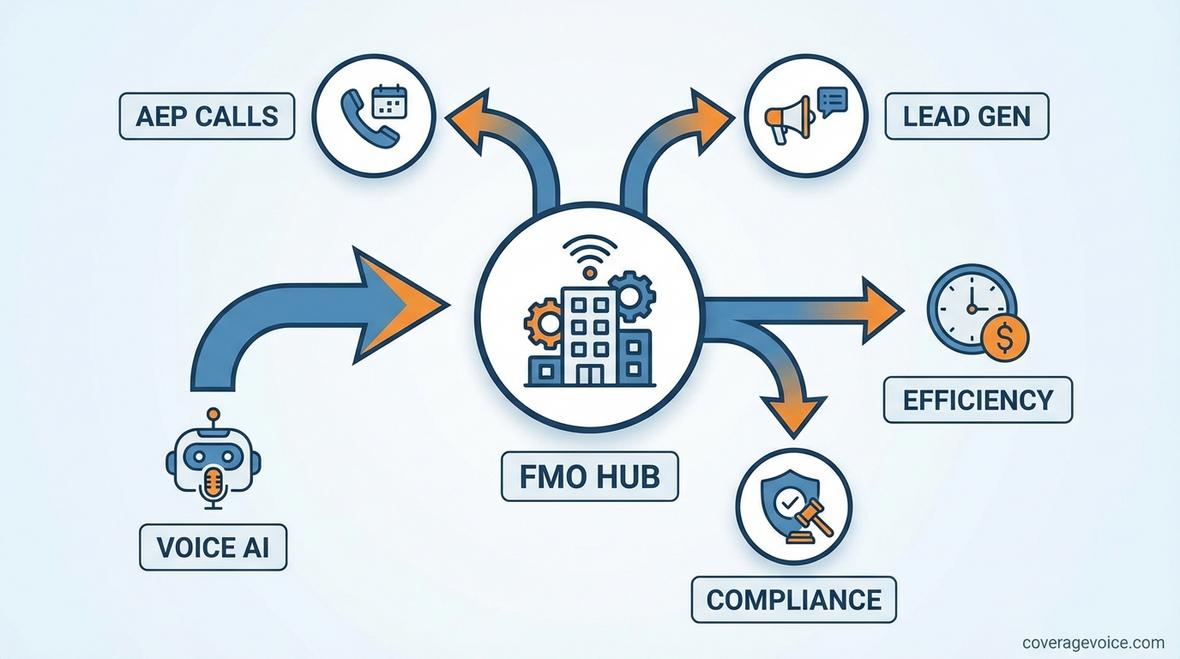
Field Marketing Organizations (FMOs) face unprecedented operational challenges in 2026. During Annual Enrollment Period (AEP) and Open Enrollment Period (OEP), call volumes surge, compliance requirements intensify, and the pressure to convert leads while maintaining member satisfaction reaches critical levels. Medicare voice AI for FMOs has emerged as the transformative solution that addresses these challenges head-on, enabling organizations to scale operations, reduce costs, and maintain strict regulatory adherence.
This comprehensive guide explores how Medicare voice AI for FMOs is revolutionizing the industry, delivering measurable improvements in lead generation, enrollment automation, and member engagement. We'll examine the technology's core capabilities, implementation strategies, compliance frameworks, and real-world performance metrics that demonstrate why forward-thinking FMOs are making voice AI a central pillar of their operational strategy.
Understanding Medicare Voice AI for FMOs
Medicare voice AI for FMOs represents a sophisticated application of conversational artificial intelligence specifically designed for the Medicare insurance ecosystem. Unlike generic chatbots or basic interactive voice response (IVR) systems, these specialized AI agents understand Medicare terminology, navigate complex plan details, and handle sensitive health information while maintaining HIPAA and CMS compliance.
Core Capabilities of Voice AI Systems
Modern Medicare voice AI for FMOs delivers several essential capabilities that directly address the operational pain points of Field Marketing Organizations:
- Intelligent Call Routing: AI agents analyze caller intent within seconds, routing complex cases to specialized human agents while handling routine inquiries autonomously.
- 24/7 Availability: Voice AI eliminates operational hour constraints, capturing leads and serving members during evenings, weekends, and holidays when traditional call centers are closed.
- Natural Language Processing: Advanced NLP engines understand regional dialects, industry jargon, and the varied communication styles of Medicare beneficiaries.
- Dynamic Script Adaptation: AI agents adjust conversation flow based on caller responses, previous interactions, and CRM data to deliver personalized experiences.
- Compliance Monitoring: Built-in safeguards ensure every interaction adheres to CMS marketing guidelines, TCPA regulations, and HIPAA requirements.
How Voice AI Differs from Traditional Call Center Technology
Traditional call centers rely on human agents supported by basic scripting tools and IVR systems that frustrate callers with rigid menu trees. Medicare voice AI for FMOs transforms this model entirely by creating conversational experiences that feel natural while simultaneously processing data, accessing multiple systems, and executing complex workflows in real-time.
The technology leverages machine learning models trained on thousands of Medicare-specific conversations, enabling AI agents to handle objections, answer plan-specific questions, and guide beneficiaries through enrollment processes with minimal human intervention. This represents a fundamental shift from labor-intensive operations to intelligent automation that scales effortlessly during peak periods.
Business Impact: Why FMOs Are Adopting Voice AI
The adoption of Medicare voice AI for FMOs is driven by measurable business outcomes that directly impact revenue, operational efficiency, and competitive positioning. Organizations implementing voice AI report transformative results across multiple performance dimensions.
Cost Reduction and Operational Efficiency
Labor costs represent the largest expense category for most FMOs, particularly during AEP when organizations must rapidly scale staffing to handle increased call volumes. Voice AI systems can replace the work of 45+ agents while maintaining superior response times and consistency.
Traditional call centers incur costs of $35-$50 per hour per agent when accounting for salaries, benefits, training, supervision, and infrastructure. Medicare voice AI for FMOs reduces this to a fraction of the cost, with AI interactions costing pennies rather than dollars. Organizations implementing comprehensive voice AI solutions report 60-75% reductions in customer service operational expenses within the first year.
Lead Generation and Conversion Rate Improvements
Speed-to-lead is critical in Medicare marketing. Research consistently shows that contacting leads within five minutes of inquiry increases conversion rates by 400% compared to waiting 30 minutes or longer. However, achieving this response time with human agents during high-volume periods is virtually impossible without massive overstaffing.
Medicare voice AI for FMOs solves this challenge by instantly engaging every inbound lead regardless of time or call volume. AI-powered lead reactivation systems also re-engage prospects who didn't convert initially, systematically working through lead databases to schedule appointments and qualify prospects without requiring agent time.
Enhanced Member Engagement and Retention
Member retention directly impacts FMO profitability, as retaining existing members costs significantly less than acquiring new ones. Voice AI enables proactive outreach strategies that were previously cost-prohibitive, including welcome calls for new members, medication adherence reminders, preventive care outreach, and renewal conversations.
Medicare voice AI for member retention can contact thousands of members simultaneously during critical touchpoint windows, delivering personalized messages based on plan type, health conditions, and previous interactions. This systematic engagement approach reduces disenrollment rates and increases member lifetime value.
HIPAA and CMS Compliance: The Non-Negotiable Foundation
Regulatory compliance represents the most critical consideration when evaluating Medicare voice AI for FMOs. The consequences of non-compliance including substantial fines, loss of CMS certification, and reputational damage make it imperative that voice AI solutions are built on robust compliance frameworks from the ground up.
HIPAA Compliance Requirements for Voice AI
The Health Insurance Portability and Accountability Act (HIPAA) establishes strict requirements for protecting Protected Health Information (PHI). Voice AI systems handling Medicare conversations must implement comprehensive safeguards across technical, administrative, and physical domains.
Technical safeguards include end-to-end encryption of all voice data, secure data storage with role-based access controls, comprehensive audit logging of all PHI access, and automatic de-identification of recordings for quality assurance purposes. HIPAA-compliant voice AI systems must also provide Business Associate Agreements (BAAs) and undergo regular security assessments.
CMS Marketing and Communication Guidelines
CMS imposes specific requirements on Medicare Advantage and Part D marketing communications, including prohibited claims, required disclosures, and documentation standards. Medicare voice AI for FMOs must be programmed to adhere to these guidelines in every interaction.
AI agents must provide required disclaimers at appropriate points in conversations, avoid making prohibited statements about plan benefits, document the scope of appointment (SOA) process correctly, and maintain recordings of marketing interactions as required by CMS. The AI system should flag potential compliance violations in real-time and prevent agents from making unauthorized claims.
TCPA and Consent Management
The Telephone Consumer Protection Act (TCPA) regulates outbound calling, requiring prior express written consent before contacting prospects on cell phones using automated dialing systems. Voice AI systems must integrate consent management to verify permissions before initiating calls and maintain detailed records of consent documentation.
Leading Medicare voice AI for FMOs platforms include built-in consent verification, do-not-call list integration, and time-zone aware calling restrictions that prevent calls outside permitted hours. These safeguards protect FMOs from costly TCPA violations while maximizing outreach effectiveness.
Implementing Medicare Voice AI: Strategic Considerations for FMOs
Successful implementation of Medicare voice AI for FMOs requires careful planning, stakeholder alignment, and phased deployment strategies that minimize disruption while maximizing adoption and results.
Build vs. Buy: Evaluating Your Options
FMOs face a fundamental decision: building custom voice AI infrastructure or partnering with specialized vendors. The build-versus-buy analysis reveals that developing proprietary voice AI systems requires substantial investment in AI/ML talent, infrastructure, compliance expertise, and ongoing maintenance.
Building custom solutions typically costs $500,000-$2,000,000 in initial development plus ongoing annual costs of $200,000-$500,000 for maintenance, updates, and compliance monitoring. Deployment timelines extend 12-24 months before reaching production readiness. In contrast, enterprise voice AI platforms offer deployment in weeks, include built-in compliance frameworks, and operate on predictable subscription models that align costs with usage.
Integration with Existing Systems
Medicare voice AI for FMOs must integrate seamlessly with existing technology infrastructure, including CRM systems, enrollment platforms, appointment scheduling tools, and telephony infrastructure. Modern voice AI platforms offer pre-built integrations with leading Medicare CRM systems and flexible APIs for custom connections.
Integration enables voice AI to access prospect and member data in real-time, update records automatically, trigger workflows in other systems, and provide agents with complete interaction histories when live transfers occur. This connectivity is essential for delivering the personalized, context-aware experiences that drive conversion and satisfaction.
Change Management and Staff Training
Introducing Medicare voice AI for FMOs requires thoughtful change management to ensure staff adoption and maximize performance. Agents may initially perceive AI as a threat to job security, making it critical to position voice AI as a tool that handles routine tasks and allows agents to focus on complex, high-value interactions.
Effective implementation includes comprehensive training on when AI should transfer calls to humans, how to review AI-handled interactions for quality assurance, and strategies for collaborating with AI systems to optimize outcomes. Organizations that invest in change management report significantly higher adoption rates and faster time-to-value.
Key Use Cases for Medicare Voice AI in FMO Operations
Medicare voice AI for FMOs delivers value across the entire member lifecycle, from initial lead contact through enrollment, onboarding, ongoing engagement, and renewal. Understanding specific use cases helps FMOs prioritize implementation and measure results.
AEP and OEP Call Volume Management
The Annual Enrollment Period creates extreme operational stress for FMOs, with call volumes increasing 300-500% over baseline levels. Voice AI for AEP and OEP automation enables FMOs to handle this surge without proportional increases in staffing costs.
AI agents can simultaneously handle hundreds of calls, answering common questions about plan changes, eligibility, and enrollment deadlines. The system escalates complex cases to human agents while autonomously resolving routine inquiries, dramatically reducing wait times and abandoned call rates during peak periods.
Intelligent Lead Qualification and Routing
Not all Medicare leads represent equal opportunity. Voice AI can conduct systematic qualification of every lead, gathering information about current coverage, health conditions, budget constraints, and enrollment timeline to score leads and prioritize agent follow-up.
AI-powered pre-screening eliminates wasted agent time on unqualified prospects while ensuring high-potential leads receive immediate attention from experienced enrollment specialists. This optimization increases agent productivity by 40-60% and improves conversion rates by focusing human expertise where it delivers maximum impact.
Automated Appointment Scheduling and Confirmation
Appointment no-shows represent significant lost revenue for FMOs, with typical no-show rates ranging from 15-30%. Voice AI appointment scheduling systems reduce no-shows through automated confirmation calls, reminders at optimal intervals, and easy rescheduling options.
The AI can also conduct pre-appointment preparation, ensuring beneficiaries have required documentation ready and understand what to expect, which increases show rates and improves appointment quality when conversations occur.
Dual-Eligible and LIS Member Outreach
Dual-eligible beneficiaries and those qualifying for Low-Income Subsidy (LIS) programs represent high-value segments that require specialized outreach. Voice AI for dual-eligible outreach can systematically contact these populations, explain available benefits, and guide them through enrollment processes that are often more complex than standard Medicare Advantage plans.
According to CDC health literacy and Medicare navigation stats, many beneficiaries face significant barriers in understanding and accessing available benefits. AI-driven plain-language tools help overcome these obstacles, improving enrollment rates among underserved populations while supporting health equity objectives.
After-Hours and Weekend Support
Medicare beneficiaries often need assistance outside traditional business hours, particularly working-age individuals shopping for coverage for elderly parents. After-hours AI agents ensure FMOs never miss opportunities, capturing leads, answering questions, and scheduling appointments regardless of when prospects make contact.
This 24/7 availability represents a competitive differentiator, as many FMOs still operate on limited schedules that force prospects to wait or contact competitors who are available immediately.
Measuring ROI: Key Performance Indicators for Voice AI
Demonstrating return on investment is essential for securing executive buy-in and optimizing voice AI performance over time. FMOs should track specific KPIs that connect voice AI implementation to business outcomes.
Operational Efficiency Metrics
Key operational metrics include average handle time (AHT), first-call resolution rate, abandonment rate, and cost per interaction. Medicare voice AI for FMOs typically reduces AHT by 30-50% for routine inquiries while maintaining or improving resolution rates. Some implementations achieve 30x faster resolution for common questions compared to traditional agent-handled calls.
Revenue and Conversion Metrics
Revenue-focused metrics include lead-to-appointment conversion rate, appointment-to-enrollment conversion rate, average policy value, and member lifetime value. Organizations implementing voice AI consistently report 15-35% improvements in lead conversion rates due to improved response times and systematic follow-up processes.
Compliance and Quality Metrics
Compliance metrics track adherence to CMS guidelines, HIPAA protocols, and internal quality standards. Voice AI systems provide 100% interaction recording and automated compliance monitoring that identifies potential violations before they result in regulatory issues. Quality scores typically improve 20-40% as AI eliminates common agent errors and ensures consistent adherence to approved scripts.
Selecting the Right Medicare Voice AI Platform for Your FMO
The Medicare voice AI market includes numerous vendors with varying capabilities, compliance frameworks, and pricing models. FMOs should evaluate potential partners based on specific criteria that align with organizational priorities.
Critical Evaluation Criteria
Essential evaluation criteria include Medicare-specific expertise, compliance certifications (HIPAA, SOC 2), integration capabilities with existing systems, scalability to handle AEP volume surges, natural language processing quality, and vendor financial stability and client references.
FMOs should request detailed demonstrations using actual Medicare scenarios, review sample compliance documentation, and speak with existing clients about implementation experiences and ongoing support quality. Specialized platforms built specifically for Medicare brokers and FMOs typically deliver faster time-to-value and better performance than generic voice AI tools adapted for healthcare use.
Understanding Pricing Models
Voice AI pricing typically follows per-minute, per-call, or per-user subscription models. Transparent pricing structures help FMOs accurately forecast costs and compare alternatives. Be cautious of vendors with complex pricing that includes hidden fees for essential features like compliance monitoring, CRM integrations, or premium support.
Total cost of ownership should include implementation fees, monthly subscription costs, per-interaction charges, integration development, training, and ongoing optimization support. Request detailed pricing scenarios based on your projected call volumes to enable accurate comparison.
Future Trends: What's Next for Medicare Voice AI
The Medicare voice AI landscape continues to evolve rapidly, with emerging capabilities that will further transform FMO operations in the coming years.
Multimodal AI Experiences
Future Medicare voice AI for FMOs will seamlessly blend voice, text, and visual channels, allowing beneficiaries to start conversations via phone, continue via text message, and complete enrollment through web portals all within a single, AI-orchestrated experience. This omnichannel approach accommodates diverse communication preferences while maintaining context across touchpoints.
Predictive Analytics and Proactive Outreach
Advanced analytics will enable voice AI to predict which members are at risk of disenrollment, identify cross-sell opportunities, and recommend optimal outreach timing for maximum engagement. These predictive capabilities transform voice AI from reactive customer service to proactive member relationship management.
Enhanced Personalization Through AI Learning
Machine learning models will continuously improve through every interaction, developing increasingly sophisticated understanding of individual member preferences, communication styles, and needs. This personalization will drive higher satisfaction scores and stronger member relationships over time.
Frequently Asked Questions
How long does it take to implement Medicare voice AI for FMOs?
Implementation timelines vary based on complexity and integration requirements. Basic deployments with standard CRM integrations can be operational in 2-4 weeks, while comprehensive implementations with custom workflows and multiple system integrations may require 6-12 weeks. Proper implementation planning significantly accelerates deployment and reduces post-launch issues.
Can voice AI handle complex Medicare Advantage plan comparisons?
Yes, advanced Medicare voice AI systems can access plan databases in real-time, compare benefits across multiple carriers, and explain differences in coverage, costs, and provider networks. The AI guides beneficiaries through decision frameworks that help them identify plans aligned with their specific health needs and budget constraints.
What happens when voice AI encounters a question it cannot answer?
Quality Medicare voice AI for FMOs includes intelligent escalation protocols that seamlessly transfer calls to human agents when queries exceed AI capabilities. The system provides agents with complete conversation context, eliminating the need for beneficiaries to repeat information. This hybrid approach ensures beneficiaries always receive accurate answers while maximizing AI efficiency.
How does voice AI maintain member privacy and HIPAA compliance?
Enterprise voice AI platforms implement comprehensive security controls including end-to-end encryption, secure data storage, role-based access controls, and automatic PHI redaction in transcripts. Vendors provide Business Associate Agreements and undergo regular security audits to validate compliance with HIPAA requirements.
What ROI can FMOs expect from Medicare voice AI implementation?
ROI varies based on implementation scope and current operational efficiency, but most FMOs report 200-400% ROI within the first year through reduced labor costs, improved conversion rates, and increased member retention. ROI calculators help organizations model expected returns based on their specific metrics.
Conclusion
Medicare voice AI for FMOs represents a fundamental transformation in how Field Marketing Organizations operate, compete, and serve beneficiaries. The technology delivers measurable improvements across every critical performance dimension reducing costs, increasing conversion rates, enhancing compliance, and improving member satisfaction.
As regulatory complexity increases and competitive pressures intensify, FMOs that embrace intelligent automation will gain substantial advantages over organizations relying on traditional, labor-intensive operations. The question is no longer whether to implement voice AI, but how quickly your organization can deploy these capabilities to capture market opportunity.
By following the strategic frameworks, evaluation criteria, and implementation best practices outlined in this guide, FMOs can successfully navigate the voice AI landscape and position their organizations for sustained success in an increasingly technology-driven Medicare marketplace.
Ready to Transform Your Medicare Enrollment Process?
See how Coverage Voice AI can help you automate Medicare enrollment.