Medicare Voice AI: The Complete Guide To Conversational AI For Enrollment, Compliance & Member Engagement In 2026

Introduction: The Rise of Medicare Voice AI
The Medicare insurance landscape is undergoing a transformative shift as organizations face mounting pressure to improve operational efficiency, maintain strict regulatory compliance, and deliver exceptional member experiences. Medicare voice AI has emerged as a critical technology for health plans, Field Marketing Organizations (FMOs), and call centers seeking to modernize their operations while reducing costs.
The adoption of voice AI in healthcare is accelerating rapidly. According to recent industry analysis, the Voice AI market has reached $22.5B in 2026, growing at a 34.8% CAGR, with Gartner forecasting $80 billion in contact center labor cost savings applicable to Medicare operations. This growth reflects the technology's proven ability to handle high-volume enrollment periods, ensure compliance, and enhance member engagement without the traditional overhead of human-only operations.
For Medicare organizations, Medicare voice AI represents more than just automation it's a strategic advantage that enables teams to scale during Annual Enrollment Period (AEP) spikes, maintain HIPAA and CMS compliance, and deliver personalized experiences that drive conversion and retention.
Understanding Medicare Voice AI Technology
Medicare voice AI refers to conversational artificial intelligence systems specifically designed to handle voice-based interactions within the Medicare ecosystem. These systems leverage natural language processing (NLP), machine learning, and advanced speech recognition to conduct real-time conversations with beneficiaries, prospects, and members.
Core Capabilities of Medicare Voice AI Systems
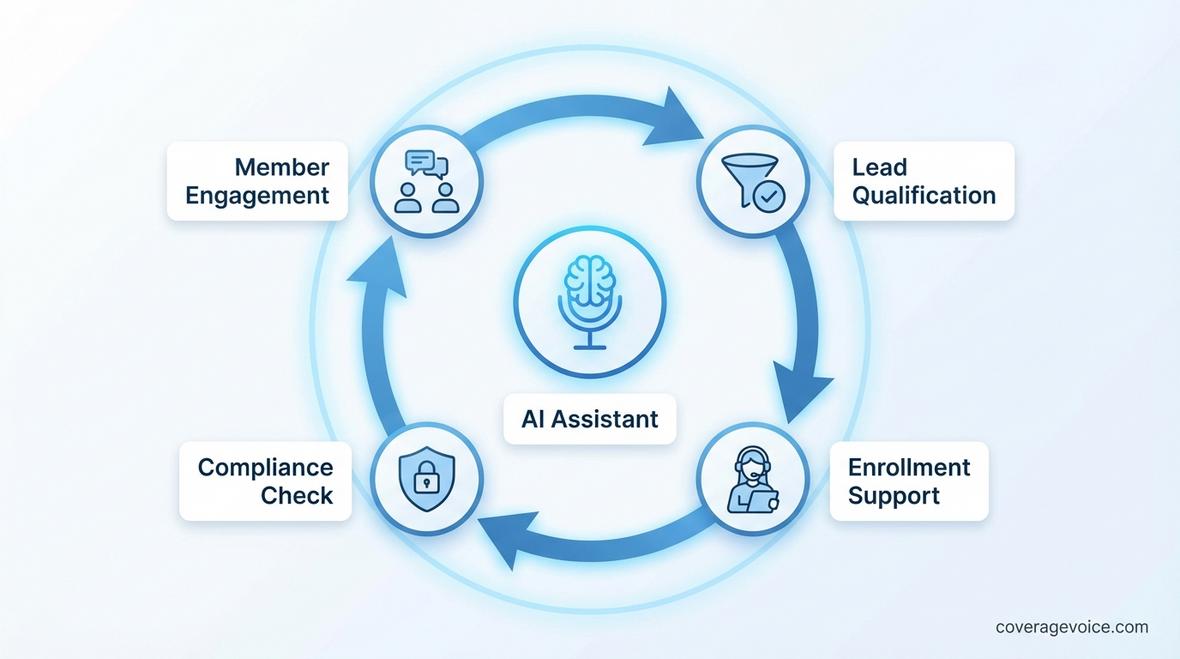
Modern Medicare voice AI platforms deliver several essential capabilities tailored to the unique requirements of Medicare organizations:
- Lead Qualification: Intelligent screening of inbound and outbound calls to identify high-intent prospects based on eligibility, plan preferences, and engagement signals
- Enrollment Support: Guided assistance through Medicare plan selection, application completion, and enrollment verification with real-time validation
- Compliance Monitoring: Automatic adherence to CMS marketing and communication regulations, TCPA requirements, and HIPAA privacy standards
- Member Engagement: Proactive outreach for wellness programs, medication adherence, preventive care reminders, and retention campaigns
The CMS AI RFI for Medicare solicits real-time conversational AI, including voice advisors for routine Medicare call center inquiries, signaling a significant policy shift as AI use cases double across federal agencies. This regulatory acknowledgment validates the technology's readiness for mission-critical Medicare operations.
How Medicare Voice AI Differs from General Contact Center AI
Unlike generic voice automation tools, Medicare voice AI must navigate complex regulatory frameworks, handle sensitive health information, and understand Medicare-specific terminology including plan types (Original Medicare, Medicare Advantage, Part D), enrollment periods (AEP, OEP, SEP), and eligibility criteria (dual-eligible, LIS, IRMAA).
Organizations deploying Medicare call center solutions require platforms that integrate seamlessly with existing CRM systems, maintain detailed audit trails for compliance verification, and deliver measurable improvements in key performance indicators such as conversion rates, average handling time, and member satisfaction scores.
Key Use Cases: Where Medicare Voice AI Delivers Maximum Impact
The versatility of Medicare voice AI enables organizations to deploy it across multiple operational scenarios, each delivering distinct ROI:
Annual Enrollment Period & Open Enrollment Period Automation
During peak enrollment windows, Medicare organizations face call volume spikes that can overwhelm traditional staffing models. AEP and OEP automation powered by voice AI enables teams to handle 10x call volumes without proportional increases in headcount. AI agents can simultaneously manage thousands of conversations, qualifying leads, answering plan questions, scheduling agent appointments, and even completing enrollments for straightforward cases.
Organizations implementing Medicare voice AI for enrollment periods report significant cost reductions compared to seasonal hiring and training investments. The technology maintains consistent quality and compliance across every interaction, eliminating the variability inherent in rapid staff scaling.
Intelligent Lead Qualification and Scoring
Not all Medicare leads carry equal conversion potential. Voice AI for Medicare lead qualification employs sophisticated algorithms to assess prospect readiness based on conversation cues, eligibility confirmation, plan preferences, and engagement signals.
By automatically routing high-intent leads to licensed agents while nurturing lower-intent prospects through automated follow-up sequences, organizations maximize agent productivity and improve conversion rates. The technology captures granular conversation data that feeds into lead scoring models, continuously improving qualification accuracy over time.
End-to-End Enrollment Automation
For straightforward enrollment scenarios, Medicare voice AI can guide beneficiaries through the complete application process without human intervention. Medicare enrollment features include identity verification, eligibility confirmation, plan recommendation, application completion, and enrollment submission all conducted conversationally via voice.
This capability is particularly valuable for dual-eligible and LIS outreach programs, where organizations must process high volumes of applications with limited margin for error. AI-driven enrollment ensures data accuracy, regulatory compliance, and consistent member experience across all touchpoints.
Member Retention and Renewal Campaigns
Acquiring new Medicare members is expensive; retaining existing members delivers superior lifetime value. Member retention and renewal solutions powered by voice AI enable proactive outreach at scale, identifying at-risk members through behavioral signals and engagement patterns.
Medicare voice AI can conduct thousands of personalized retention calls, addressing member concerns, highlighting plan value, and facilitating renewal processes. According to industry research, proactive engagement through voice AI can reduce member churn by 20-35%, directly impacting revenue and Star Ratings performance.
24/7 After-Hours Support
Medicare beneficiaries don't limit their questions to business hours. After-hours AI agents provide round-the-clock support for common inquiries, appointment scheduling, and urgent assistance routing, ensuring no lead or member inquiry goes unanswered.
This always-on availability improves lead capture rates, enhances member satisfaction, and reduces the burden on daytime staff who would otherwise handle overflow voicemails and callback requests.
Compliance and Regulatory Considerations for Medicare Voice AI
Regulatory compliance is non-negotiable in Medicare operations. Organizations implementing Medicare voice AI must ensure their technology adheres to multiple regulatory frameworks:
CMS Marketing and Communication Rules
The Centers for Medicare & Medicaid Services (CMS) enforces strict regulations governing how organizations communicate with Medicare beneficiaries. Medicare marketing compliance solutions must incorporate:
- Required disclaimers and disclosures delivered in compliant language
- Documentation of all marketing interactions with timestamps and conversation recordings
- Prohibition of misleading claims or pressure tactics
- Proper identification of the calling organization and purpose
Leading Medicare voice AI platforms include built-in compliance guardrails that prevent non-compliant language, automatically insert required disclaimers, and maintain comprehensive audit trails for CMS reporting requirements.
TCPA and Consent Management
The Telephone Consumer Protection Act (TCPA) requires explicit consent before making automated calls to consumers. Organizations must implement robust TCPA compliance for Medicare voice AI, including:
- Verified opt-in collection with clear disclosure of automated calling
- Easy opt-out mechanisms honored in real-time
- Do-Not-Call list scrubbing and suppression
- Detailed consent documentation and timestamps
Failure to maintain TCPA compliance can result in significant financial penalties, making it essential to select Medicare voice AI vendors with proven compliance track records.
HIPAA Privacy and Security Standards
Medicare conversations frequently involve Protected Health Information (PHI), requiring strict HIPAA compliance. Voice AI platforms must provide:
- End-to-end encryption for voice data in transit and at rest
- Business Associate Agreements (BAAs) with clear liability terms
- Access controls and audit logging for PHI handling
- Secure integration with HIPAA-compliant CRM and data systems
Organizations evaluating vendors should verify HIPAA compliance certifications and request detailed security documentation before deployment.
ROI and Cost Analysis: Medicare Voice AI vs. Traditional Operations
The financial case for Medicare voice AI rests on multiple value drivers that compound over time:
Labor Cost Reduction
Traditional Medicare call centers face significant staffing costs, particularly during AEP when temporary hiring surges. A single AI agent can handle the workload equivalent of 3-5 human agents at a fraction of the cost. Organizations replacing even a portion of their call center capacity with voice AI report 40-60% reductions in labor expenses while maintaining or improving service levels.
According to healthcare AI adoption research, healthcare AI spending nearly tripled to $1.4 billion in 2025, with eight AI unicorns created, indicating rapid adoption trends driven by measurable ROI across health plans and provider organizations.
Conversion Rate Improvement
Speed-to-lead is critical in Medicare marketing. Medicare voice AI enables instant response to inbound inquiries and immediate outbound follow-up, dramatically improving conversion rates. Organizations implementing voice AI for lead response report 25-40% increases in lead-to-enrollment conversion, directly impacting revenue without additional marketing spend.
Operational Efficiency Gains
Beyond direct cost savings, Medicare voice AI delivers operational efficiencies including:
- Reduced average handling time through efficient information gathering
- Elimination of manual data entry errors and rework
- Automatic CRM updates and activity logging
- Scalability without infrastructure investments
Organizations seeking to scale Medicare enrollment with voice AI can expand capacity instantly without the lead time required for recruitment, hiring, training, and facility expansion.
Build vs. Buy Decision Framework
Some organizations consider building proprietary Medicare voice AI solutions in-house. However, build vs. buy cost analysis reveals that custom development typically requires 12-18 months, investment of $500K-$2M, and ongoing maintenance expenses that far exceed commercial platform subscriptions.
Commercial platforms offer immediate deployment, proven compliance frameworks, continuous feature updates, and vendor-supported integrations advantages that make the buy decision financially and strategically superior for most organizations.
Implementation Best Practices for Medicare Voice AI
Successful Medicare voice AI deployment requires thoughtful planning and execution across several dimensions:
Use Case Prioritization
Rather than attempting organization-wide transformation immediately, focus initial deployment on high-impact, well-defined use cases such as appointment scheduling, lead pre-screening, or new member welcome calls. Early wins build organizational confidence and provide data for expanding to additional applications.
Human Agent Training and Collaboration
Voice AI works best when integrated with human agents, not as a replacement. Train staff on escalation protocols, AI handoff procedures, and how to leverage AI-generated insights for more effective conversations. Organizations that position Medicare voice AI as agent augmentation rather than replacement experience smoother adoption and better outcomes.
Continuous Optimization and Monitoring
Initial deployment is just the beginning. Establish metrics for conversation quality, conversion performance, compliance adherence, and member satisfaction. Use conversation analytics to identify improvement opportunities, refine scripts, and optimize AI decision logic. Leading organizations review voice AI performance weekly and make iterative improvements based on data-driven insights.
Integration with Existing Systems
Effective Medicare voice AI requires seamless integration with CRM platforms, enrollment systems, telephony infrastructure, and compliance tools. Evaluate vendors based on their integration capabilities and pre-built connectors to minimize implementation complexity and time-to-value.
Selecting the Right Medicare Voice AI Platform
The Medicare voice AI market includes multiple vendors with varying capabilities, compliance credentials, and pricing models. Organizations should evaluate platforms across several critical dimensions:
Medicare-Specific Expertise
Generic voice AI platforms lack the Medicare-specific knowledge, compliance frameworks, and workflow understanding required for this specialized market. Prioritize vendors with proven experience serving Medicare brokers and FMOs, marketing agencies, and health plans.
Compliance Certifications and Documentation
Request detailed compliance documentation including HIPAA BAAs, SOC 2 reports, CMS compliance attestations, and TCPA consent management capabilities. Verify that the vendor maintains dedicated compliance teams and provides regular updates aligned with regulatory changes.
Deployment Flexibility and Scalability
Your needs during AEP differ dramatically from off-season volumes. Ensure the platform can scale instantly without performance degradation and offers flexible pricing that aligns with seasonal demand patterns rather than fixed per-seat licensing.
Evaluating Competitive Alternatives
Organizations comparing Medicare voice AI platforms should review detailed comparisons such as Rivvi vs. CoverageVoice and CareCycle vs. CoverageVoice to understand feature differentiation, pricing models, and implementation requirements across leading vendors.
Future Trends: The Evolution of Medicare Voice AI
The Medicare voice AI landscape continues to evolve rapidly with several emerging trends shaping the next generation of capabilities:
Multimodal Conversational Experiences
Future platforms will seamlessly blend voice, text, and visual channels, enabling beneficiaries to start conversations via phone and continue through SMS or web portals with full context preservation. This omnichannel client intake approach meets members where they are and accommodates diverse communication preferences.
Predictive Analytics and Proactive Engagement
Advanced AI will analyze member behavior patterns, claims data, and engagement history to predict needs before members articulate them. Proactive outreach for medication refills, preventive screenings, or plan optimization opportunities will shift from reactive support to anticipatory service.
Regulatory Evolution and AI Governance
As CMS and other regulatory bodies become more familiar with AI capabilities, expect more specific guidance on acceptable use cases, disclosure requirements, and performance standards. Organizations should monitor CMS modernization initiatives for Medicare voice channels that seek AI tools to enhance digital and voice channels for operational efficiency.
Frequently Asked Questions About Medicare Voice AI
How accurate is Medicare voice AI in understanding diverse accents and speech patterns?
Modern Medicare voice AI platforms utilize advanced natural language processing trained on diverse voice datasets, achieving 95%+ accuracy across various accents, dialects, and speech patterns. The technology continuously improves through machine learning as it processes more conversations, adapting to regional variations and individual speech characteristics.
Can Medicare voice AI keep up with changing CMS regulations?
Leading platforms employ dedicated compliance teams that monitor regulatory changes and update AI scripting, disclosures, and guardrails accordingly. Organizations should select vendors with proven track records of rapid compliance updates and transparent change management processes.
What is the typical implementation timeline for Medicare voice AI?
Implementation timelines vary based on use case complexity and integration requirements. Simple applications like virtual receptionist services can deploy in 2-4 weeks, while comprehensive enrollment automation may require 6-12 weeks for full integration, testing, and staff training.
Do Medicare beneficiaries accept voice AI interactions?
Acceptance rates are high when AI is deployed transparently with clear disclosure and seamless escalation to human agents when needed. Research indicates that beneficiaries value quick responses and 24/7 availability more than they resist AI assistance, particularly for routine inquiries and administrative tasks.
How does voice AI impact Medicare Star Ratings?
Properly implemented Medicare voice AI can positively influence multiple Star Ratings measures including member satisfaction, medication adherence, preventive screenings, and care coordination. Organizations have documented Star Ratings improvements through AI-enabled proactive outreach and member engagement programs.
Conclusion
Medicare voice AI represents a fundamental shift in how health plans, FMOs, and call centers engage with beneficiaries throughout the enrollment lifecycle and beyond. The technology delivers measurable improvements in operational efficiency, regulatory compliance, conversion rates, and member satisfaction all while reducing costs compared to traditional human-only operations.
As the Medicare market grows more competitive and regulatory scrutiny intensifies, organizations that strategically implement Medicare voice AI will gain sustainable advantages in lead conversion, member retention, and operational scalability. The key to success lies in selecting the right platform, prioritizing high-impact use cases, maintaining rigorous compliance standards, and continuously optimizing based on performance data. Organizations ready to explore voice AI capabilities should evaluate comprehensive solutions designed specifically for Medicare operations to ensure both immediate ROI and long-term strategic value.
Ready to Transform Your Medicare Enrollment Process?
See how Coverage Voice AI can help you automate Medicare enrollment.