Multi-Turn Conversations: The Complete Guide To AI Dialogue Excellence In Medicare Enrollment

Understanding Multi-Turn Conversations in Healthcare AI
Multi-turn conversations represent the backbone of natural human dialogue a back-and-forth exchange where context, memory, and intent accumulate across multiple interactions. Unlike single-turn exchanges that treat each query as isolated, multi-turn conversations enable AI systems to maintain coherence, clarify ambiguities, and guide users through complex processes like Medicare enrollment with remarkable precision.
For Medicare organizations, call centers and Field Marketing Organizations (FMOs), the ability to engage beneficiaries through multi-turn conversations isn't merely a technological advantage it's a competitive necessity. These interactions mirror how experienced agents naturally converse, asking follow-up questions, confirming understanding, and adapting responses based on previous statements.
The pharmaceutical complexity of Medicare Advantage plans, prescription drug coverage, and eligibility requirements demands conversational systems that can navigate nuanced discussions. Traditional IVR systems fail here precisely because they lack the contextual memory essential for multi-turn conversations. When a beneficiary asks about supplemental benefits mid-conversation, the system must remember their earlier mention of chronic conditions to provide relevant guidance.
Why Multi-Turn Conversations Matter for Medicare Operations
The Medicare ecosystem presents unique conversational challenges. Beneficiaries frequently need clarification on plan differences, coverage details, and enrollment deadlines questions that rarely resolve in a single exchange. Multi-turn conversations address this reality by creating dialogue flows that accommodate the iterative nature of healthcare decision-making.
Research demonstrates that effective multi-turn conversations increase enrollment completion rates by maintaining engagement through complex information exchanges. When an AI agent can remember that a caller mentioned prescription needs three exchanges ago and reference that context when discussing formulary coverage, the experience transforms from frustrating to helpful.
For Medicare brokers and FMOs, this conversational capability directly impacts operational metrics. Multi-turn conversations reduce call abandonment, decrease repeat contacts, and improve first-call resolution rates all critical during the high-volume Annual Enrollment Period when every interaction counts.
The Technical Foundation of Multi-Turn Dialogue Systems
At their core, multi-turn conversations require three essential components: context management, intent tracking, and state maintenance. Context management ensures the system remembers what was discussed previously, intent tracking identifies what the user wants to accomplish across multiple exchanges, and state maintenance keeps the conversation progressing toward resolution.
Modern conversational AI platforms achieve this through sophisticated natural language understanding (NLU) models combined with dialogue state tracking. When a beneficiary asks, 'What about dental coverage?'—the system must understand this references a plan discussed two turns earlier, not a new inquiry requiring complete context reset.
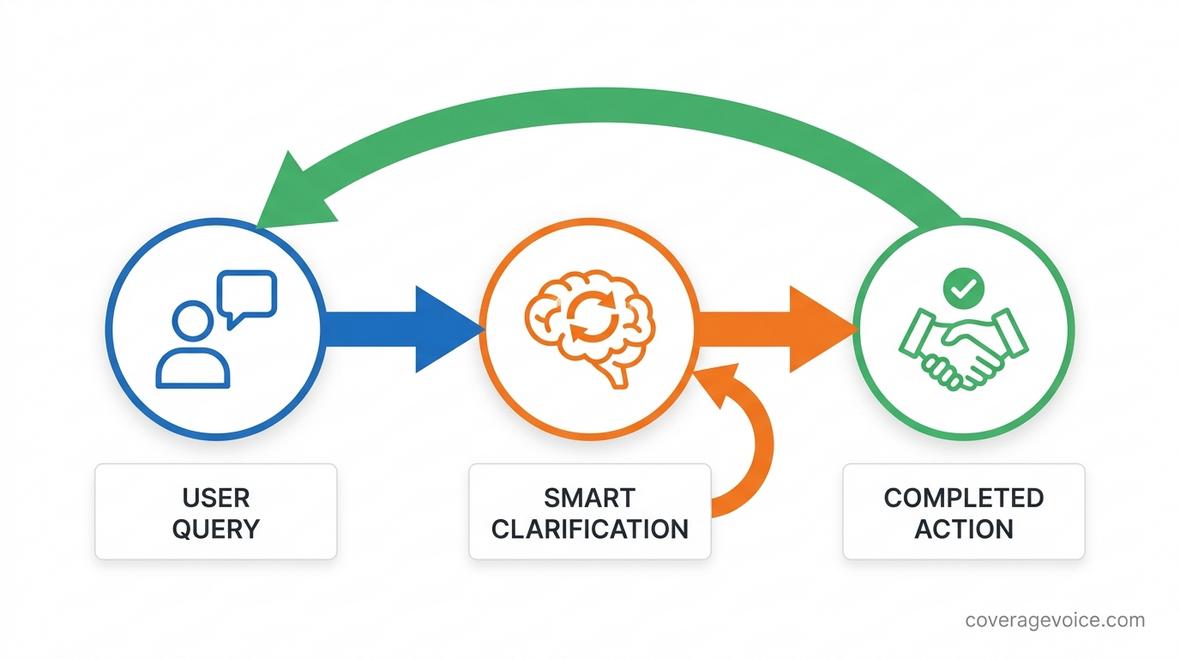
The workflow illustrated in successful multi-turn systems follows a clear pattern: user query, intelligent clarification, and completed action. This cycle repeats seamlessly, with each iteration building on accumulated context. The system doesn't just respond it remembers, adapts, and guides.
Medicare-Specific Applications of Multi-Turn Conversations
The practical application of multi-turn conversations in Medicare operations extends across the entire beneficiary lifecycle. During initial lead qualification, AI agents engage prospects through extended dialogues that assess eligibility, understand coverage needs, and identify plan preferences all while maintaining HIPAA compliance and CMS regulatory adherence.
Consider AEP and OEP automation scenarios. A beneficiary calls inquiring about changing plans. The multi-turn conversation begins with understanding their current coverage, progresses through discussing dissatisfaction points, explores alternative options, clarifies specific benefit questions, addresses cost concerns, and ultimately guides toward enrollment all in a single call that feels natural rather than scripted.
Enrollment Automation Through Conversational Excellence
Multi-turn conversations revolutionize enrollment automation by transforming what was once a tedious form-filling exercise into an engaging dialogue. Instead of navigating rigid menu trees, beneficiaries answer questions conversationally while the AI extracts necessary enrollment data, confirms accuracy through clarifying questions, and completes submission all while maintaining conversational flow.
The distinction between effective and ineffective enrollment conversations lies in how gracefully the system handles interruptions, tangential questions, and clarification requests. When a beneficiary asks mid-enrollment, 'Wait, does this plan cover my cardiologist?'—the system must pause the enrollment flow, address the question with relevant provider network information, then seamlessly resume where the process left off.
This contextual flexibility significantly reduces enrollment abandonment. Traditional linear processes force users through predetermined paths regardless of their concerns. Multi-turn conversations adapt the path based on expressed needs, creating a personalized experience that respects the beneficiary's decision-making process.
Implementation Considerations for Medicare Organizations
Successfully deploying multi-turn conversational AI in Medicare operations requires careful attention to compliance, integration, and user experience design. HIPAA and CMS regulations mandate specific consent processes, data handling protocols, and documentation requirements all of which must function within conversational flows.
Organizations must ensure their multi-turn conversation systems properly capture consent at appropriate junctures, maintain audit trails of all exchanges, and handle Protected Health Information (PHI) with required security measures. The conversational interface doesn't exempt organizations from regulatory obligations it must elegantly incorporate them into natural dialogue.
Integration with Existing Medicare Technology Stacks
Multi-turn conversational AI doesn't operate in isolation. Effective implementation requires integration with CRM systems, enrollment platforms, eligibility databases, and agent desktop applications. The conversation engine must query real-time data to provide accurate responses while updating systems based on information gathered during exchanges.
For marketing agencies managing Medicare campaigns, this integration extends to lead management systems. When a multi-turn conversation qualifies a lead, that context including all expressed preferences, concerns, and demographic details must flow into downstream systems to enable personalized follow-up.
The technical architecture supporting multi-turn conversations typically includes API connections to carrier plan databases, real-time eligibility verification services, and agent handoff systems for complex scenarios requiring human expertise. This hybrid approach AI for routine multi-turn conversations with seamless escalation to human agents optimizes both efficiency and member satisfaction.
Measuring Multi-Turn Conversation Quality and Effectiveness
Assessing the performance of multi-turn conversational systems requires metrics beyond traditional call center KPIs. Conversation completion rate measures how often dialogues reach intended outcomes. Turn efficiency evaluates whether the system resolves queries in appropriate exchange counts neither too few (missing context) nor too many (causing frustration).
Context retention accuracy assesses whether the system appropriately references earlier conversation elements. If a beneficiary mentions hypertension medication needs in turn three, and the system references this context in turn seven when discussing pharmacy networks, that demonstrates effective context management a hallmark of quality multi-turn conversations.
User Satisfaction in Multi-Turn Medicare Interactions
Beneficiary satisfaction with multi-turn conversations correlates strongly with perceived naturalness and task completion efficiency. Post-interaction surveys should specifically assess whether users felt the system 'understood' their needs, remembered their context, and helped them accomplish their goals without unnecessary repetition or confusion.
For Medicare organizations using appointment scheduling features within conversational AI, success metrics include scheduling completion rates, time-to-schedule, and rescheduling frequency. Effective multi-turn conversations should handle date negotiations, time zone clarifications, and appointment type selections within a smooth dialogue flow.
Advanced Capabilities in Multi-Turn Conversation Design
Sophisticated multi-turn conversation systems incorporate proactive guidance, anticipatory responses, and intelligent suggestion capabilities. Rather than merely reacting to user inputs, advanced systems anticipate likely next questions based on conversation trajectory and proactively address them.
When discussing Medicare Advantage plans with a beneficiary who mentioned travel interests, an advanced system might proactively mention national provider network benefits before being asked. This anticipatory approach grounded in conversation context demonstrates the intelligence that distinguishes exceptional multi-turn systems from merely functional ones.
Handling Complex Scenarios and Edge Cases
The true test of multi-turn conversation capability emerges in handling complex scenarios: dual-eligible beneficiaries navigating both Medicare and Medicaid, special enrollment period qualifications requiring life event documentation, or coordination of benefits questions involving multiple coverage sources.
Effective systems gracefully manage these complexities through structured dialogue paths that break complex topics into manageable exchanges while maintaining overall conversation coherence. For dual-eligible and LIS outreach, multi-turn conversations must navigate intricate eligibility rules while remaining comprehensible to beneficiaries unfamiliar with program complexities.
Compliance and Regulatory Considerations in Conversational AI
Medicare organizations implementing multi-turn conversational AI must navigate a complex regulatory landscape. CMS marketing and communication guidelines apply to AI interactions just as they do to human agent conversations. Systems must avoid misleading statements, provide required disclaimers, and document all beneficiary interactions for compliance auditing.
The conversational nature of multi-turn systems introduces unique compliance challenges. Unlike static web content easily reviewed for compliance, dynamic conversations generate unique paths based on user inputs. Organizations must implement guardrails ensuring all conversation branches maintain compliance regardless of how the dialogue unfolds.
For organizations seeking Medicare marketing compliance solutions, multi-turn conversational AI offers advantages over traditional outreach when properly implemented. Conversations can be programmatically constrained to compliant language while remaining flexible in flow, and comprehensive logging provides complete audit trails for regulatory review.
ROI and Business Impact of Multi-Turn Conversation Implementation
The financial impact of effective multi-turn conversational AI extends across multiple dimensions. Direct cost reduction comes from decreased agent handle times as routine interactions automate completely. Indirect benefits include improved conversion rates as more engaging conversations reduce drop-off during enrollment processes.
Organizations implementing sophisticated multi-turn conversation systems report significant improvements in lead-to-enrollment conversion often seeing 20-30% increases as friction points in the enrollment journey smooth out. The continuous availability of conversational AI means beneficiaries can complete enrollments during evening hours or weekends when traditional call centers might be closed or understaffed.
Cost-Efficiency Analysis for Medicare Operations
When evaluating multi-turn conversational AI investments, Medicare organizations should consider total cost of ownership including platform licensing, integration expenses, ongoing optimization, and compliance management. These costs must be weighed against displaced labor expenses, increased conversion revenue, and improved operational efficiency.
For FMOs managing large agent networks, multi-turn conversational AI offers scalability advantages particularly valuable during AEP surges. Rather than hiring and training temporary staff to handle volume spikes, organizations deploy conversational capacity that scales instantly handling thousands of simultaneous multi-turn conversations without quality degradation.
Future Trends in Multi-Turn Conversation Technology
The evolution of multi-turn conversation technology continues accelerating with advances in large language models, emotional intelligence capabilities, and multimodal interaction support. Future systems will seamlessly blend voice, text, and visual information within coherent multi-turn exchanges showing plan comparison charts while verbally explaining differences.
Emotional intelligence represents a frontier area for multi-turn conversations in Medicare contexts. Systems that detect frustration, confusion, or satisfaction through vocal cues and adapt conversation strategies accordingly will provide more empathetic, effective beneficiary experiences. When a system recognizes confusion and automatically shifts to simpler explanations or offers human agent transfer, it demonstrates intelligence beyond mere information exchange.
Personalization and Continuous Learning
Advanced multi-turn conversation systems increasingly incorporate personalization engines that remember beneficiary preferences across sessions, adapting interaction styles to individual communication preferences. A beneficiary who prefers direct, concise responses receives different conversation pacing than one who appreciates detailed explanations even when discussing identical topics.
Continuous learning mechanisms allow multi-turn systems to improve over time by analyzing successful conversation patterns and incorporating insights into dialogue management strategies. Organizations using lead reactivation features benefit as systems learn which conversational approaches most effectively re-engage previously disinterested prospects.
Selecting the Right Multi-Turn Conversation Platform
Medicare organizations evaluating conversational AI platforms should prioritize several critical capabilities. Context window size how many previous conversation turns the system actively maintains directly impacts dialogue coherence. Intent recognition accuracy determines whether the system correctly interprets user goals across extended exchanges.
Integration flexibility proves essential for organizations with established technology ecosystems. Platforms offering pre-built connectors to common Medicare CRM, enrollment, and carrier connectivity platforms reduce implementation timelines and technical complexity. Organizations should specifically evaluate how candidate platforms handle integrations with their existing tech stacks.
Compliance features deserve particular scrutiny. Does the platform provide conversation guardrails preventing non-compliant statements? Are comprehensive audit logs automatically generated? Can conversations be reviewed and categorized for CMS audit preparation? These capabilities distinguish Medicare-appropriate platforms from general-purpose conversational AI solutions.
Implementation Best Practices and Success Strategies
Successful multi-turn conversation implementations follow structured approaches beginning with clearly defined use cases. Organizations should prioritize high-volume, routine interactions for initial automation qualifying leads, scheduling appointments, answering common plan questions before tackling complex scenarios requiring nuanced dialogue management.
Pilot programs with limited scope allow organizations to refine conversation flows, test compliance controls, and train staff on hybrid AI-human workflows before full-scale deployment. These pilots should include diverse beneficiary segments to ensure conversation designs accommodate varying communication styles, health literacy levels, and technological comfort.
Continuous optimization represents an ongoing requirement rather than post-launch luxury. Organizations should establish regular conversation analysis processes reviewing interaction logs, identifying confusion points, and refining dialogue paths. This iterative improvement approach supported by analytics showing where conversations succeed or fail drives long-term performance gains.
Frequently Asked Questions About Multi-Turn Conversations
What distinguishes multi-turn conversations from traditional chatbots?
Multi-turn conversations maintain context and memory across exchanges, enabling coherent extended dialogues. Traditional chatbots typically treat each input as independent, lacking the contextual awareness necessary for complex interactions like Medicare enrollment guidance.
How do multi-turn conversation systems ensure HIPAA compliance?
Compliant systems encrypt all data transmissions, maintain detailed audit logs, implement access controls on PHI, and provide consent management workflows within conversation flows. Platform architecture should include dedicated compliance features rather than treating security as an afterthought.
Can multi-turn conversational AI handle multiple languages for diverse Medicare populations?
Advanced platforms support multilingual conversations, maintaining context across languages and even handling code-switching when beneficiaries alternate between languages within a single conversation. This capability proves particularly valuable for organizations serving diverse Medicare populations.
What happens when a multi-turn conversation encounters a question it cannot answer?
Well-designed systems gracefully acknowledge limitations and offer alternatives providing relevant information related to the question, suggesting human agent transfer, or scheduling follow-up. The key is maintaining conversation coherence rather than abruptly failing or providing irrelevant responses.
How long does typical implementation take for Medicare organizations?
Implementation timelines vary based on use case complexity and integration requirements, typically ranging from 8-16 weeks for initial deployment. Organizations with established technical infrastructure and clearly defined use cases often complete implementations faster than those requiring extensive custom development or complex integrations.
Conclusion
Multi-turn conversations represent the essential foundation for effective conversational AI in Medicare operations. By maintaining context, adapting to beneficiary needs, and guiding complex interactions toward successful outcomes, these systems transform how Medicare organizations engage prospects and serve members. The technology has matured beyond experimental applications into proven solutions delivering measurable improvements in conversion rates, operational efficiency, and beneficiary satisfaction. Organizations that strategically implement multi-turn conversational capabilities position themselves for competitive advantage in an increasingly digital Medicare marketplace, while those relying on legacy interaction models risk falling behind in member expectations and operational performance.
Ready to Transform Your Medicare Enrollment Process?
See how Coverage Voice AI can help you automate Medicare enrollment.