Regal AI: Revolutionizing Medicare Enrollment & Healthcare Communication In 2026

What Is Regal AI and Why It Matters for Healthcare Organizations
The healthcare industry faces unprecedented challenges in patient communication, enrollment processing, and member engagement. Regal AI represents a category of advanced artificial intelligence platforms designed to transform how healthcare organizations interact with members, streamline enrollment processes, and optimize operational efficiency. As Medicare enrollment complexity increases and regulatory requirements tighten, organizations are turning to sophisticated AI solutions to maintain compliance while delivering exceptional patient experiences.
Regal AI technologies leverage natural language processing, machine learning, and conversational AI to automate traditionally labor-intensive healthcare workflows. From Medicare call centers to enrollment automation systems, these platforms are reshaping the healthcare landscape. According to research from the Healthcare Information and Management Systems Society (HIMSS), healthcare organizations implementing AI-powered communication systems report up to 40% reductions in operational costs while simultaneously improving patient satisfaction scores.
For Medicare brokers, FMOs, health systems, and insurance agencies, understanding how regal AI solutions compare to traditional approaches and identifying the right platform has become a strategic imperative. This comprehensive guide examines regal AI capabilities, implementation strategies, and how specialized platforms like CoverageVoice are purpose-built for Medicare-specific challenges.
Understanding Regal AI Technology: Core Components and Capabilities
Regal AI platforms incorporate multiple technological components that work synergistically to deliver superior healthcare communication outcomes. At the foundation lies advanced natural language understanding (NLU), which enables systems to comprehend patient intent, medical terminology, and context-specific queries with remarkable accuracy.
Premium Data Input: The Foundation of Effective Regal AI
The effectiveness of any regal AI system begins with the quality of data it processes. Premium data input involves sophisticated aggregation of patient records, eligibility information, plan details, and historical interaction data. Leading platforms integrate with existing CRM systems, electronic health records (EHR), and enrollment databases to create comprehensive member profiles that inform every interaction.
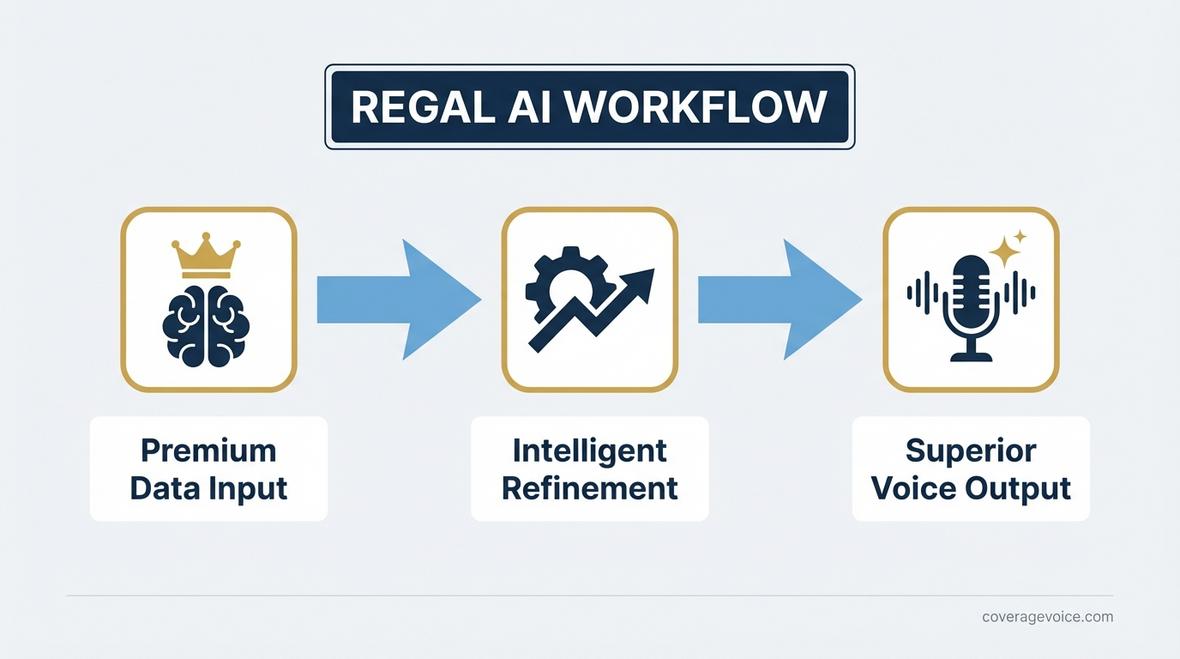
This three-stage workflow premium data input, intelligent refinement, and superior voice output represents the operational framework that distinguishes enterprise-grade regal AI from basic chatbot solutions. The intelligent refinement stage applies machine learning algorithms to continuously improve response accuracy, while the superior voice output ensures natural, compliant, and contextually appropriate communication.
Intelligent Automation for Medicare-Specific Workflows
Medicare enrollment and management present unique challenges that generic regal AI platforms often struggle to address. The complexity of Medicare Advantage plans, supplement options, Part D coordination, and annual enrollment periods (AEP) requires specialized knowledge encoding. Purpose-built solutions like AEP/OEP automation platforms incorporate Medicare-specific regulatory guardrails, ensuring every automated interaction maintains CMS compliance.
According to data from the Centers for Medicare & Medicaid Services (CMS), enrollment errors cost the healthcare industry over $2.1 billion annually in corrections, appeals, and member churn. Intelligent regal AI systems reduce these errors through validation workflows, eligibility verification, and real-time benefits confirmation capabilities that dramatically improve first-call resolution rates.
Healthcare Applications of Regal AI: From Enrollment to Retention
Regal AI technologies address the entire patient lifecycle, from initial contact through long-term retention. Understanding these application areas helps organizations identify where AI implementation delivers maximum return on investment.
Medicare Enrollment Automation
Traditional Medicare enrollment processes involve multiple touchpoints, extensive paperwork, and significant manual verification. Regal AI platforms transform this experience by automating pre-screening, eligibility determination, plan comparison, and application completion. Advanced systems can conduct entire enrollment conversations via voice or text, guiding applicants through complex decisions while capturing all necessary information.
The impact on operational efficiency is substantial. Research from McKinsey & Company indicates that healthcare organizations implementing AI-driven enrollment automation experience 60-70% reductions in processing time and 45% decreases in administrative costs. For Medicare brokers managing hundreds or thousands of annual enrollments, these efficiencies translate directly to competitive advantage and improved profitability.
Member Engagement and Retention
Acquiring new Medicare members costs significantly more than retaining existing ones. According to industry analysis, the average cost to acquire a new Medicare Advantage member ranges from $600 to $1,200, while retention efforts cost a fraction of that amount. Regal AI enables proactive engagement strategies that identify at-risk members, automate wellness check-ins, and deliver personalized outreach at scale.
Member retention and renewals benefit from AI-powered predictive analytics that identify churn risk factors before members disenroll. By analyzing interaction patterns, benefit utilization, and satisfaction indicators, regal AI systems trigger timely interventions that preserve membership relationships. This proactive approach addresses the rapid disenrollment challenges many Medicare Advantage plans face during the first 90 days of coverage.
Call Center Transformation
Traditional Medicare call centers struggle with seasonal volume fluctuations, particularly during AEP when call volumes can increase 300-400%. Regal AI addresses this challenge through intelligent call routing, automated tier-one support, and virtual receptionist capabilities that handle routine inquiries without human intervention.
CoverageVoice's implementation in Medicare call centers demonstrates the transformative potential. In one documented case study, a Medicare organization replaced 45 agents with voice AI, maintaining service quality while reducing operational costs by 68%. The system handled appointment scheduling, benefit inquiries, and basic troubleshooting autonomously, escalating only complex cases requiring human expertise.
Regal AI vs. Purpose-Built Medicare Solutions: A Critical Comparison
While regal AI platforms offer broad communication automation capabilities, Medicare-specific requirements often demand specialized solutions. Organizations evaluating technology options should understand the differences between general-purpose regal AI systems and Medicare-focused platforms like CoverageVoice.
Compliance and Regulatory Considerations
Medicare communication is heavily regulated under CMS guidelines, HIPAA requirements, and TCPA restrictions. Generic regal AI platforms typically require extensive customization to meet these standards, increasing implementation costs and ongoing compliance risks. Medicare-specialized platforms build these requirements into their core architecture, ensuring every interaction meets regulatory standards by default.
TCPA compliance for Medicare voice AI involves complex call-time restrictions, consent management, and documentation requirements that general platforms often overlook. Purpose-built solutions incorporate automated compliance checking, consent verification workflows, and comprehensive audit trails that protect organizations from costly violations.
Medicare Knowledge Encoding
Effective Medicare communication requires deep understanding of plan structures, benefit coordination, eligibility rules, and enrollment periods. While general regal AI platforms can be trained on this information, Medicare-specific solutions come pre-configured with this knowledge base, dramatically reducing implementation timelines.
For example, explaining the differences between Medicare Advantage vs. Original Medicare requires nuanced understanding of coverage options, cost structures, and individual circumstances. Purpose-built platforms handle these conversations naturally, while generic systems often provide oversimplified or potentially misleading information.
Integration with Medicare Ecosystems
Medicare organizations operate within complex technology ecosystems including CRM systems, enrollment platforms, benefits verification tools, and agent management systems. CoverageVoice offers native integrations with Medicare-specific platforms, enabling seamless data flow and unified operational workflows.
This integration depth extends to specialized functions like automated Medicare benefits verification and dual-eligible coordination. Generic regal AI platforms typically require custom API development and ongoing maintenance to achieve similar functionality, increasing total cost of ownership.
Implementing Regal AI: Strategic Considerations for Healthcare Organizations
Successful regal AI implementation requires careful planning, stakeholder alignment, and phased deployment strategies. Organizations that approach implementation systematically achieve faster time-to-value and higher adoption rates.
Build vs. Buy: Cost and Capability Analysis
Healthcare organizations face a fundamental decision: build custom regal AI capabilities or implement existing platforms. The Medicare voice AI build vs. buy cost analysis reveals that custom development typically requires $500,000 to $2 million in initial investment, 12-18 months for minimum viable product delivery, and ongoing maintenance costs of $200,000+ annually.
By contrast, enterprise platforms like CoverageVoice offer subscription-based pricing that eliminates capital expenditure, provides immediate deployment, and includes continuous platform improvements. For most organizations, the buy decision delivers faster ROI and lower risk, particularly when selecting Medicare-specialized solutions that require minimal customization.
Change Management and Team Training
Introducing regal AI into existing workflows impacts multiple stakeholder groups including call center agents, enrollment specialists, compliance officers, and IT teams. Effective implementations include comprehensive change management programs that address concerns, demonstrate value, and provide adequate training.
Leading organizations position regal AI as augmentation rather than replacement, emphasizing how automation handles routine tasks while freeing human agents for complex, high-value interactions. This framing reduces resistance and accelerates adoption. Training programs should cover system capabilities, escalation protocols, and quality monitoring processes that maintain service standards.
Performance Monitoring and Continuous Optimization
Regal AI platforms generate extensive interaction data that informs continuous improvement. Organizations should establish clear key performance indicators (KPIs) including first-call resolution rates, average handling time, member satisfaction scores, and compliance metrics. Regular analysis of these metrics identifies optimization opportunities and demonstrates ROI to stakeholders.
Advanced platforms provide analytics dashboards that visualize performance trends, identify common inquiry patterns, and highlight areas where AI accuracy can be improved. CoverageVoice's analytics capabilities enable organizations to track Medicare voice AI ROI in real-time, quantifying cost savings, efficiency gains, and quality improvements.
Industry-Specific Regal AI Applications Across Healthcare Segments
Different healthcare organization types benefit from regal AI in distinct ways. Understanding these segment-specific applications helps organizations identify highest-value use cases.
Medicare Brokers and FMOs
Independent brokers and Field Marketing Organizations face unique scalability challenges during AEP. Medicare brokers and FMOs leverage regal AI to handle initial lead qualification, appointment scheduling, and follow-up communications automatically. This automation enables small broker teams to compete with larger organizations by managing significantly higher lead volumes without proportional staff increases.
The Medicare FMO voice AI enrollment workflow typically includes automated outbound calling to prospect lists, intelligent qualification based on age and location, benefit explanation, and seamless handoff to licensed agents for enrollment completion. This hybrid approach maximizes agent productivity while maintaining regulatory compliance.
Health Systems, ACOs, and MSOs
Large healthcare delivery organizations use regal AI to manage patient access, coordinate care transitions, and optimize revenue cycle operations. Health systems and ACO/MSOs benefit from AI-powered appointment scheduling, pre-registration workflows, and post-visit follow-up that reduces no-show rates and improves patient satisfaction.
For organizations managing Medicare Advantage contracts, regal AI supports Medicare Star Ratings improvement initiatives by automating health risk assessments, medication adherence outreach, and preventive care reminders. These interventions directly impact quality metrics that determine bonus payments and competitive positioning.
Marketing Agencies and Lead Generation
Marketing agencies specializing in Medicare leverage regal AI to qualify leads immediately upon capture, dramatically improving conversion rates and client satisfaction. AI lead qualification reduces the cost per qualified lead by 40-60% compared to manual approaches, according to industry benchmarks.
The ability to provide live transfer leads that have been pre-qualified and warmed through AI conversation represents a significant competitive differentiator. Agencies using this approach command premium pricing while delivering higher-quality prospects to insurance carrier and broker clients.
Emerging Trends and the Future of Regal AI in Healthcare
The regal AI landscape continues evolving rapidly, with several emerging trends poised to reshape healthcare communication in coming years.
Generative AI and Large Language Models
Generative AI for Medicare virtual agents represents the next frontier in conversational capabilities. Unlike rule-based systems, generative models can handle unprecedented query variety, provide nuanced explanations, and adapt communication style to individual preferences. However, implementing these technologies in regulated healthcare environments requires careful guardrails to prevent hallucinations and ensure factual accuracy.
Omnichannel Experience Coordination
Modern members expect seamless experiences across voice, text, email, and portal interactions. Omnichannel client intake capabilities enable members to start conversations via their preferred channel and continue across others without repetition. Regal AI platforms increasingly orchestrate these multi-channel journeys, maintaining context and continuity regardless of communication medium.
Predictive and Proactive Engagement
Future regal AI implementations will shift from reactive response to proactive outreach based on predictive analytics. Systems will identify members likely to experience health events, benefit confusion, or disenrollment risk, then initiate timely interventions before problems escalate. This proactive approach transforms AI from cost-reduction tool to strategic member retention asset.
Building the Business Case: ROI and Implementation Costs
Securing organizational buy-in for regal AI requires compelling financial justification. Comprehensive ROI analyses should consider both direct cost savings and strategic value creation.
Direct Cost Reduction
The most immediate ROI comes from reduced labor costs. Organizations implementing comprehensive voice AI solutions typically reduce call center staffing requirements by 40-60% while maintaining or improving service levels. For a 50-agent Medicare call center with average fully-loaded costs of $45,000 per agent annually, this translates to $900,000 to $1.35 million in annual savings.
Additional cost reductions include decreased training expenses, reduced real estate requirements, and lower technology costs for agent-facing systems. The Medicare AEP cost reduction through voice AI analysis demonstrates that organizations can reduce seasonal staffing costs by 70% while actually improving capacity during peak periods.
Revenue and Quality Improvements
Beyond cost savings, regal AI drives revenue through improved conversion rates, reduced member churn, and enhanced Star Ratings performance. Organizations report 15-25% improvements in enrollment conversion when implementing AI-powered lead qualification and follow-up. For Medicare Advantage plans, even modest Star Ratings improvements generate millions in additional bonus payments.
Member retention improvements deliver particularly strong ROI given acquisition costs. Reducing annual churn by just 5% for a 10,000-member plan saves $300,000 to $600,000 in avoided acquisition costs while preserving ongoing premium revenue.
Frequently Asked Questions About Regal AI
What is the difference between regal AI and traditional call center software?
Regal AI platforms use advanced natural language processing and machine learning to conduct autonomous conversations, understanding intent and responding intelligently. Traditional call center software primarily routes calls and provides agents with information, but doesn't independently handle conversations. Regal AI can completely replace human agents for routine interactions while traditional systems only assist them.
How long does it take to implement a regal AI solution for Medicare?
Implementation timelines vary based on scope and customization requirements. Purpose-built Medicare platforms like CoverageVoice typically deploy in 4-8 weeks for standard use cases, including integration with existing systems, knowledge base configuration, and team training. Generic regal AI platforms requiring extensive Medicare customization may require 3-6 months for comparable functionality.
Can regal AI maintain compliance with CMS and TCPA regulations?
Yes, when properly configured. Medicare-specialized regal AI platforms build compliance requirements directly into their architecture, including call-time restrictions, consent verification, required disclosures, and documentation standards. Organizations should verify that any platform under consideration includes Medicare-specific compliance features rather than relying solely on general-purpose capabilities.
What happens when regal AI encounters a question it cannot answer?
Advanced regal AI systems recognize when queries exceed their capability and seamlessly escalate to human agents with full conversation context. Quality platforms provide confidence scoring that identifies uncertain responses before they reach members. Organizations should establish clear escalation protocols and regularly review unhandled queries to continuously improve AI knowledge bases.
How does regal AI impact existing call center staff?
Most organizations implement regal AI through augmentation rather than wholesale replacement. AI handles routine, repetitive interactions while human agents focus on complex cases requiring judgment, empathy, and specialized expertise. This typically results in more satisfying work for agents, reduced burnout, and improved retention. Some organizations redeploy agents to higher-value roles in member services, enrollment support, or relationship management.
Conclusion
Regal AI represents a transformative opportunity for healthcare organizations seeking to improve operational efficiency, enhance member experiences, and navigate increasingly complex regulatory environments. While generic regal AI platforms offer broad capabilities, Medicare-specific solutions like CoverageVoice deliver purpose-built functionality that addresses the unique challenges of healthcare communication, enrollment automation, and member engagement.
Organizations evaluating regal AI should consider compliance capabilities, Medicare knowledge depth, integration ecosystems, and total cost of ownership when making platform decisions. The evidence demonstrates that purpose-built solutions deliver faster time-to-value, lower implementation risk, and superior ROI compared to generic alternatives requiring extensive customization.
As the healthcare industry continues its digital transformation, regal AI will evolve from competitive differentiator to operational necessity. Organizations that implement these technologies strategically focusing on member value, regulatory compliance, and operational excellence will be positioned to thrive in an increasingly automated healthcare landscape. To explore how CoverageVoice's Medicare-specialized voice AI can transform your organization's enrollment and engagement capabilities, visit coveragevoice.com to schedule a demonstration.
Ready to Transform Your Medicare Enrollment Process?
See how Coverage Voice AI can help you automate Medicare enrollment.