Smart Match Medicare: The Complete Guide To Intelligent Lead Routing And Enrollment Automation

In today's hyper-competitive Medicare landscape, connecting the right lead with the right agent at the right time is no longer a luxury it's a necessity. Smart match Medicare technology represents the evolution of lead management, leveraging artificial intelligence and intelligent routing algorithms to maximize conversion rates, ensure compliance, and dramatically reduce operational costs. For Medicare brokers, Field Marketing Organizations (FMOs), and health plan call centers, implementing a smart match system can be the difference between thriving during Annual Enrollment Period (AEP) and burning through budget with diminishing returns.
This comprehensive guide explores how smart match Medicare systems work, the technology behind them, measurable benefits, compliance considerations, and practical implementation strategies that can transform your Medicare operations in 2026 and beyond.
What Is Smart Match Medicare?
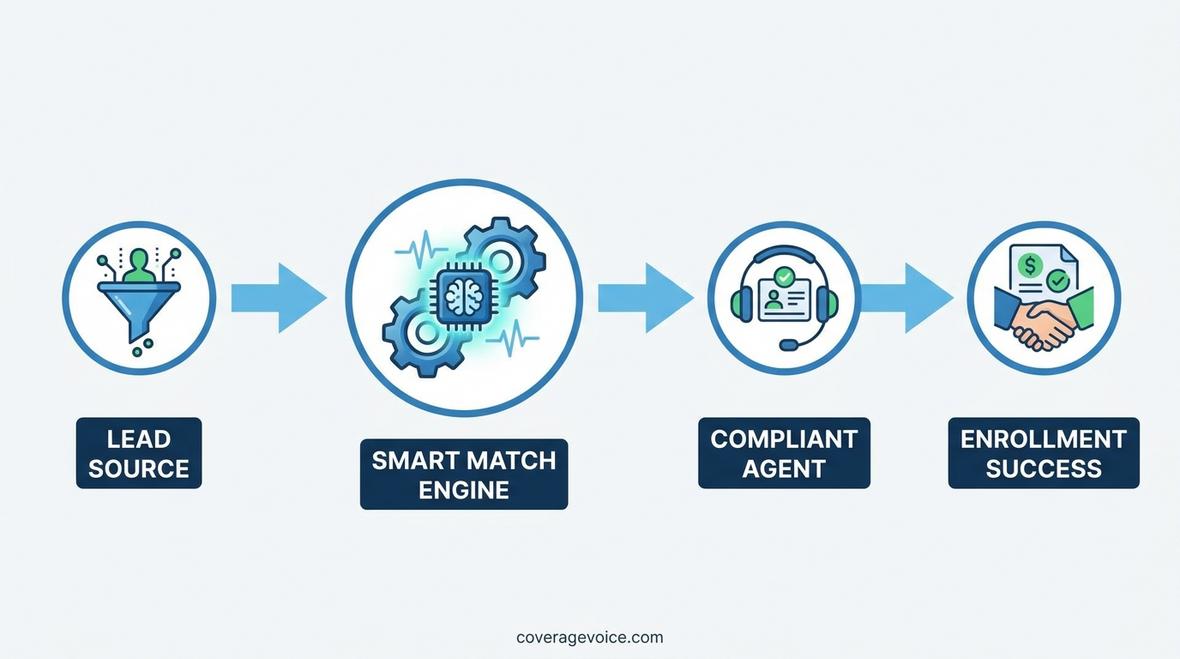
Smart match Medicare refers to intelligent lead routing and qualification systems that use data analytics, machine learning, and automated workflows to connect Medicare-eligible consumers with the most appropriate licensed agents or enrollment pathways. Unlike traditional round-robin or random assignment methods, smart match systems analyze multiple variables including geographic location, plan preferences, language requirements, agent specialization, historical performance data, and compliance status to create optimal matches that increase enrollment success rates.
The core components of a smart match Medicare system typically include:
- Real-time data validation: Instant verification of Medicare eligibility, contact information, and qualifying life events
- Intelligent routing algorithms: AI-powered decision trees that evaluate dozens of matching criteria in milliseconds
- Compliance guardrails: Automated checks for TCPA consent, CMS marketing guidelines, and state-specific regulations
- Performance optimization: Continuous learning systems that adjust routing based on conversion data and agent performance metrics
- Multi-channel integration: Seamless coordination across phone, web, SMS, and email touchpoints
For organizations managing hundreds or thousands of Medicare leads during peak enrollment periods, AEP automation solutions powered by smart match technology can reduce response times from hours to seconds while maintaining rigorous compliance standards.
Why Traditional Lead Routing Fails Medicare Organizations
Before exploring the advantages of smart match Medicare technology, it's essential to understand why conventional approaches consistently underperform:
Round-Robin Inefficiency
Traditional round-robin systems distribute leads sequentially without considering agent expertise, availability, or historical performance. This results in mismatched conversations where agents lack the specific knowledge to address consumer needs, leading to abandoned calls and wasted marketing dollars. During high-volume periods like AEP, this inefficiency compounds exponentially.
Compliance Blind Spots
Manual routing systems struggle to maintain real-time compliance verification. With CMS regulations evolving annually and state-specific requirements varying widely, human-dependent processes create significant regulatory risk. According to an HHS OIG report on Medicare Advantage encounter data, billions in excess payments stem from coding and risk score issues problems that automated compliance checks in smart match systems can help prevent during the enrollment process.
Missed Optimization Opportunities
Without data-driven routing, organizations cannot leverage performance analytics to continuously improve. High-performing agents may receive the same volume as struggling team members, while specialization opportunities (dual-eligible expertise, specific carrier knowledge, language capabilities) remain untapped.
The Technology Powering Smart Match Medicare Systems
Modern smart match Medicare platforms integrate several sophisticated technologies to deliver intelligent routing and qualification:
Artificial Intelligence and Machine Learning
AI algorithms analyze historical enrollment data to identify patterns that predict successful matches. These systems learn which agent characteristics, timing factors, and lead attributes correlate with completed enrollments, then optimize routing decisions accordingly. Over time, the system becomes increasingly accurate as it processes more interactions.
Natural Language Processing
Advanced conversational AI for Medicare uses natural language processing to understand consumer intent during initial interactions. This technology can identify urgency signals, plan preferences, and potential qualifying events from unstructured conversation data, enabling more nuanced routing decisions.
CRM Integration and Data Orchestration
Smart match systems integrate with Medicare CRM platforms to access comprehensive lead histories, previous interaction records, and relationship data. This orchestration ensures that returning consumers connect with agents who understand their context, dramatically improving experience and conversion rates.
Real-Time Compliance Engines
Built-in compliance validation checks every routing decision against current CMS guidelines, TCPA requirements, and state regulations. The system maintains audit trails for all interactions, providing documentation that supports regulatory reviews and demonstrates adherence to marketing standards.
Measurable Benefits of Smart Match Medicare Implementation
Organizations that transition from manual or basic routing to intelligent smart match Medicare systems report substantial operational improvements:
Conversion Rate Increases
By matching leads with optimally suited agents, smart match systems typically increase enrollment conversion rates by 25-45%. This improvement stems from better expertise alignment, reduced wait times, and higher-quality initial conversations that address consumer needs more effectively.
Cost Per Enrollment Reduction
When conversion rates improve while operational costs remain stable or decrease through automation, cost per enrollment drops significantly. Many Medicare brokers and FMOs report 30-50% reductions in acquisition costs after implementing smart match technology, representing millions in savings during a single AEP cycle.
Agent Productivity Optimization
Smart routing eliminates wasted agent time on poorly matched leads. Agents spend more time in productive conversations within their areas of expertise, leading to higher job satisfaction, reduced turnover, and better utilization of training investments. High-performing agents can handle increased volume without quality degradation.
Compliance Risk Mitigation
Automated compliance checks reduce human error in a heavily regulated industry. With CMS continually scrutinizing Medicare Advantage marketing practices, documented compliance workflows provide essential protection. The OIG 2024 analysis of Medicare Advantage health risk assessments highlights how diagnoses reported only on assessments generated an estimated $7.5 billion in risk-adjusted payments for 2023, underscoring the critical importance of compliant data validation throughout enrollment workflows.
Implementing Smart Match Medicare in Your Organization
Transitioning to a smart match Medicare system requires strategic planning and phased execution:
Assessment and Planning Phase
Begin by auditing your current lead routing processes, identifying pain points, and establishing baseline metrics (current conversion rates, average handling time, cost per enrollment, compliance incidents). Define specific goals for improvement and determine which lead sources and agent segments will be included in the initial implementation.
Technology Selection and Integration
Evaluate smart match Medicare platforms based on integration capabilities with your existing technology stack, compliance features, customization options, and vendor support quality. Solutions like CoverageVoice offer purpose-built Medicare automation with native compliance engines and proven integration pathways for common industry CRMs and telephony systems.
Agent Training and Change Management
Successful implementation requires agent buy-in. Communicate how smart match technology will make their jobs easier by reducing unqualified leads and matching them with consumers they're best equipped to help. Provide training on new workflows and establish feedback channels to identify system refinements.
Pilot Testing and Iteration
Launch with a controlled pilot involving a subset of leads and agents. Monitor performance closely, gather qualitative feedback, and adjust routing parameters based on real-world results. This iterative approach minimizes disruption while building organizational confidence in the new system.
Full Deployment and Continuous Optimization
After validating the pilot results, expand to full deployment while maintaining continuous performance monitoring. Smart match systems improve over time as they accumulate more interaction data, so establish regular review cycles to analyze performance trends and implement ongoing optimizations.
Smart Match Medicare and Compliance Considerations
Medicare marketing is one of the most heavily regulated areas of the insurance industry, making compliance integration essential for any smart match system:
CMS Marketing Guidelines
All routing and agent assignment decisions must align with CMS requirements for scope of appointment, permissible contact methods, and documentation standards. Smart match systems should enforce these guidelines automatically, preventing non-compliant interactions before they occur.
TCPA Consent Management
The Telephone Consumer Protection Act requires proper consent for automated calls and texts. TCPA-compliant smart match systems verify consent status before routing leads and maintain comprehensive records of consent artifacts for potential disputes or regulatory audits.
State-Specific Regulations
Medicare regulations vary by state, with some jurisdictions imposing additional requirements beyond federal standards. Smart match technology must account for these variations in routing logic, ensuring leads are only directed to appropriately licensed agents who understand state-specific rules.
Data Privacy and HIPAA
Although Medicare marketing typically occurs before enrollment (and thus before full HIPAA applicability), consumer data must still be protected. Smart match systems should implement encryption, access controls, and audit logging consistent with healthcare data protection best practices.
Smart Match Medicare vs. Traditional Call Centers
The contrast between smart match automation and conventional call center operations highlights the transformative potential of this technology:
| Dimension | Traditional Call Center | Smart Match Medicare |
|---|---|---|
| Response Time | Minutes to hours | Seconds |
| Routing Logic | Round-robin or manual assignment | AI-powered multi-factor optimization |
| Compliance Verification | Manual checks, error-prone | Automated real-time validation |
| Scalability | Linear (add agents to add capacity) | Exponential (technology scales efficiently) |
| Cost Structure | High fixed costs (agent salaries, facilities) | Variable costs aligned with volume |
| Performance Optimization | Periodic manager reviews | Continuous algorithmic learning |
Organizations leveraging Medicare call center solutions with integrated smart match technology can achieve the best of both worlds human expertise where it matters most, combined with intelligent automation that eliminates inefficiency.
Advanced Smart Match Medicare Applications
Beyond basic lead routing, sophisticated smart match Medicare systems enable several advanced applications:
Predictive Disenrollment Prevention
By analyzing engagement patterns and satisfaction signals, smart match technology can identify members at risk of disenrollment and proactively route them to retention specialists. This application of AI-powered member retention helps health plans and brokers protect their book of business.
Dual-Eligible Specialized Routing
Consumers eligible for both Medicare and Medicaid (dual-eligibles) represent a complex segment requiring specialized knowledge. Smart match systems can identify dual-eligible status and route these leads to agents with specific training in D-SNP plans and coordinated benefits, improving enrollment success for this high-value population.
Multilingual Matching
Language accessibility is both a regulatory requirement and a competitive advantage. Smart match Medicare platforms can detect language preferences and route consumers to native or fluent speakers, dramatically improving communication quality and compliance with language access requirements.
Carrier-Expertise Alignment
Agents often develop specialized expertise with specific carriers' products, networks, and enrollment processes. Smart match systems can leverage this specialization by routing leads based on carrier preference or optimal fit, reducing training requirements while improving conversion rates.
Measuring ROI of Smart Match Medicare Implementation
To justify investment in smart match technology, organizations should establish clear measurement frameworks:
Primary Metrics
- Conversion rate improvement: Percentage increase in leads that result in completed enrollments
- Cost per enrollment reduction: Decrease in total marketing and operational costs divided by enrollments
- Average handling time: Reduction in time spent per lead interaction
- Lead response time: Decrease in elapsed time between lead capture and first contact
- Agent utilization rate: Increase in productive time as percentage of total work hours
Secondary Metrics
- Compliance incident reduction: Decrease in marketing guideline violations or consumer complaints
- Agent retention improvement: Reduction in turnover among enrollment specialists
- Customer satisfaction scores: Improvement in post-interaction surveys or Net Promoter Score
- Revenue per lead: Increase in lifetime value of enrolled members
Organizations implementing comprehensive Medicare enrollment automation typically see positive ROI within a single enrollment period, with compounding benefits in subsequent years as systems continue learning and optimizing.
The Future of Smart Match Medicare Technology
As artificial intelligence continues advancing, smart match Medicare systems will become increasingly sophisticated:
Emotion AI and Sentiment Analysis
Next-generation systems will analyze vocal tone, speech patterns, and linguistic cues to assess consumer emotional state and urgency, enabling even more nuanced routing decisions that match consumer mindset with agent communication style.
Predictive Plan Recommendations
By analyzing consumer demographics, stated preferences, and historical enrollment patterns, future smart match systems will not only route to optimal agents but also pre-identify the most suitable plan options, accelerating the decision process and improving satisfaction.
Autonomous Enrollment Agents
For straightforward cases, AI voice agents will handle complete enrollment workflows without human intervention, reserving human agents for complex situations or high-touch service preferences. This hybrid approach optimizes both efficiency and member experience.
Blockchain-Based Compliance Verification
Distributed ledger technology may eventually provide immutable compliance records, creating tamper-proof audit trails that streamline regulatory reviews and reduce documentation burden for Medicare organizations.
Choosing the Right Smart Match Medicare Provider
When evaluating smart match Medicare platforms, consider these essential criteria:
- Medicare-specific design: General-purpose routing systems lack the compliance features and industry knowledge required for Medicare applications
- Integration capabilities: Seamless connectivity with your existing CRM, telephony, and marketing automation tools
- Compliance pedigree: Demonstrated understanding of CMS, TCPA, and state-specific requirements
- Scalability: Ability to handle volume spikes during AEP without performance degradation
- Transparency: Clear visibility into routing logic and decision factors for optimization and auditing
- Support quality: Responsive technical assistance and strategic guidance from industry experts
Platforms like CoverageVoice's enrollment automation solution are purpose-built for Medicare organizations, combining intelligent routing with voice AI capabilities and comprehensive compliance frameworks that address the unique challenges of Medicare marketing and enrollment.
Common Implementation Challenges and Solutions
Data Quality Issues
Challenge: Smart match systems depend on accurate lead data; poor data quality undermines routing effectiveness.
Solution: Implement automated data validation at point of capture, establish data hygiene protocols, and use AI-powered data enrichment to supplement incomplete records.
Agent Resistance
Challenge: Experienced agents may resist new technology, fearing job displacement or preferring familiar workflows.
Solution: Involve agents in system design, clearly communicate how technology enhances rather than replaces their role, and showcase early wins that demonstrate personal benefits.
Integration Complexity
Challenge: Legacy systems may lack modern APIs, complicating integration efforts.
Solution: Work with vendors offering flexible integration options including middleware, file-based transfers, and custom development support. Prioritize high-value integrations first.
Maintaining the Human Touch
Challenge: Over-automation can create impersonal experiences that alienate consumers seeking human guidance.
Solution: Design workflows that use automation for efficiency while preserving human interaction at critical decision points, particularly for complex situations or vulnerable populations.
Smart Match Medicare: Industry-Specific Applications
For FMOs and Marketing Agencies
Marketing agencies working with multiple carrier clients benefit from smart match technology's ability to route leads based on carrier contracts, commission structures, and appointment status. This ensures leads are directed to appropriately licensed agents while maximizing revenue opportunities across the portfolio.
For Health Plans and MA Organizations
Medicare Advantage plans can use smart match technology to optimize member acquisition costs while improving enrollment quality. By routing prospective members to specialists who understand specific plan features, networks, and supplemental benefits, plans increase both enrollment rates and member satisfaction from day one.
For Independent Brokers
Even smaller broker operations benefit from smart match Medicare principles through automated pre-screening and appointment scheduling that qualify leads before they consume broker time. This technology levels the playing field, allowing independent agents to compete with larger organizations.
Frequently Asked Questions About Smart Match Medicare
How quickly can smart match Medicare systems be implemented?
Implementation timelines vary based on organizational complexity and existing technology infrastructure. Basic implementations can be operational within 4-6 weeks, while comprehensive deployments with extensive integrations may require 3-4 months. Phased rollouts allow organizations to realize benefits quickly while continuing to expand capabilities.
Does smart match technology comply with CMS marketing guidelines?
Quality smart match Medicare platforms are specifically designed to enforce CMS compliance requirements. They incorporate scope of appointment rules, contact frequency limitations, documentation standards, and other regulatory requirements directly into routing logic. However, organizations remain responsible for ensuring their specific implementation and processes maintain compliance.
Can smart match systems work with existing call center infrastructure?
Yes, modern smart match platforms integrate with major telephony systems, CRMs, and marketing automation tools through APIs and standard integration protocols. This allows organizations to enhance existing infrastructure rather than replacing it entirely.
What happens if the smart match system routes a lead incorrectly?
Sophisticated platforms include feedback mechanisms that allow agents to flag misrouted leads. The system learns from these corrections, continuously improving accuracy. Additionally, most implementations include backup routing rules to ensure every lead receives appropriate attention even if optimal matching is unavailable.
How does smart match Medicare technology impact lead costs?
While smart match platforms require technology investment, they typically reduce overall cost per enrollment by improving conversion efficiency. Many organizations find that increased conversion rates more than offset platform costs, resulting in lower total acquisition costs and improved marketing ROI.
Is smart match Medicare technology suitable for small broker operations?
Smart match principles scale to organizations of all sizes. While large call centers may implement comprehensive platforms, smaller brokers benefit from simplified versions focusing on automated qualification, appointment scheduling, and basic routing rules. The key is selecting solutions appropriately sized to operational volume and complexity.
Conclusion
Smart match Medicare technology represents a fundamental shift in how Medicare organizations approach lead management and enrollment. By leveraging artificial intelligence, real-time data validation, and intelligent routing algorithms, these systems deliver measurable improvements in conversion rates, compliance adherence, and operational efficiency. For Medicare brokers, FMOs, health plans, and call centers facing intensifying competition and tightening margins, smart match technology is no longer optional it's essential for sustainable growth. Organizations that embrace this transformation position themselves to thrive in an increasingly automated, data-driven Medicare marketplace while delivering superior experiences to the consumers they serve.
Ready to Transform Your Medicare Enrollment Process?
See how Coverage Voice AI can help you automate Medicare enrollment.