Top AI Healthcare Companies 2026: Leaders Transforming Medicare Enrollment & Patient Engagement

The Rise of AI in Healthcare: Transforming Medicare Operations
The healthcare industry is experiencing a technological revolution, with artificial intelligence reshaping how organizations approach patient engagement, enrollment automation, and compliance monitoring. As Medicare enrollment becomes increasingly complex and member expectations rise, understanding which companies lead the AI healthcare transformation is essential for FMOs, call centers, and marketing agencies seeking competitive advantages. The top ai healthcare companies are not just developing innovative technology they're solving real operational challenges that impact conversion rates, regulatory adherence, and member satisfaction.
According to recent industry analysis, AI-optimized campaigns in healthcare yield significant operational improvements. Forrester conversion rates for AI campaigns demonstrate that AI-powered approaches deliver 15-25% higher conversion rates compared to traditional methods, directly enhancing member enrollment outcomes during critical periods like AEP and OEP.
This comprehensive guide examines the leading AI healthcare companies, their specialized capabilities, and how organizations can leverage these solutions to reduce costs, improve compliance, and transform member engagement in 2026 and beyond.
Understanding the AI Healthcare Company Landscape
The top ai healthcare companies operate across multiple domains, from clinical decision support to administrative automation. For Medicare-focused organizations, the most impactful solutions address enrollment bottlenecks, compliance requirements, and member communication challenges.
Key Categories of AI Healthcare Solutions
AI healthcare companies typically specialize in one or more of these critical areas:
- Conversational AI & Voice Automation: Companies providing intelligent voice agents for inbound and outbound member communications, enrollment support, and after-hours assistance
- Predictive Analytics: Organizations offering forecasting capabilities for enrollment trends, member churn risk, and operational capacity planning
- Compliance Monitoring: Solutions ensuring HIPAA, TCPA, and CMS adherence through automated call monitoring and documentation
- Enrollment Automation: Platforms streamlining application processing, eligibility verification, and enrollment workflows
- Member Engagement: Technologies enhancing retention through personalized outreach, medication adherence support, and proactive health management
Critical Selection Criteria for Medicare Organizations
When evaluating the top ai healthcare companies, Medicare-focused organizations should prioritize:
- Regulatory Compliance: Built-in HIPAA and CMS compliance features rather than bolt-on solutions
- Integration Capabilities: Seamless connectivity with existing CRM, telephony, and enrollment platforms
- Scalability: Ability to handle AEP volume surges without degraded performance
- Measurable ROI: Clear metrics demonstrating cost reduction, conversion improvement, or operational efficiency gains
- Medicare Specialization: Deep understanding of Medicare-specific workflows, terminology, and regulatory requirements
Top AI Healthcare Companies Leading Medicare Innovation
The healthcare AI landscape includes both established technology giants and specialized Medicare-focused innovators. Here's an analysis of companies making the greatest impact on Medicare enrollment and member engagement operations.
CoverageVoice: Purpose-Built for Medicare Operations
CoverageVoice represents a new generation of top ai healthcare companies specifically designed for Medicare enrollment ecosystems. Unlike general-purpose AI platforms requiring extensive customization, CoverageVoice delivers turnkey solutions addressing Medicare-specific challenges.
Core Capabilities:
- HIPAA-Compliant Voice AI: Automated inbound and outbound calling that maintains full regulatory compliance while reducing agent workload by up to 70%
- AEP/OEP Automation: Specialized workflows for high-volume enrollment periods, enabling organizations to scale without proportional cost increases
- Intelligent Call Routing: Context-aware distribution ensuring complex cases reach specialized agents while AI handles routine inquiries
- Compliance Monitoring: Real-time call analysis ensuring CMS script adherence and proper documentation
- Predictive Analytics: Enrollment forecasting and member churn prediction enabling proactive intervention
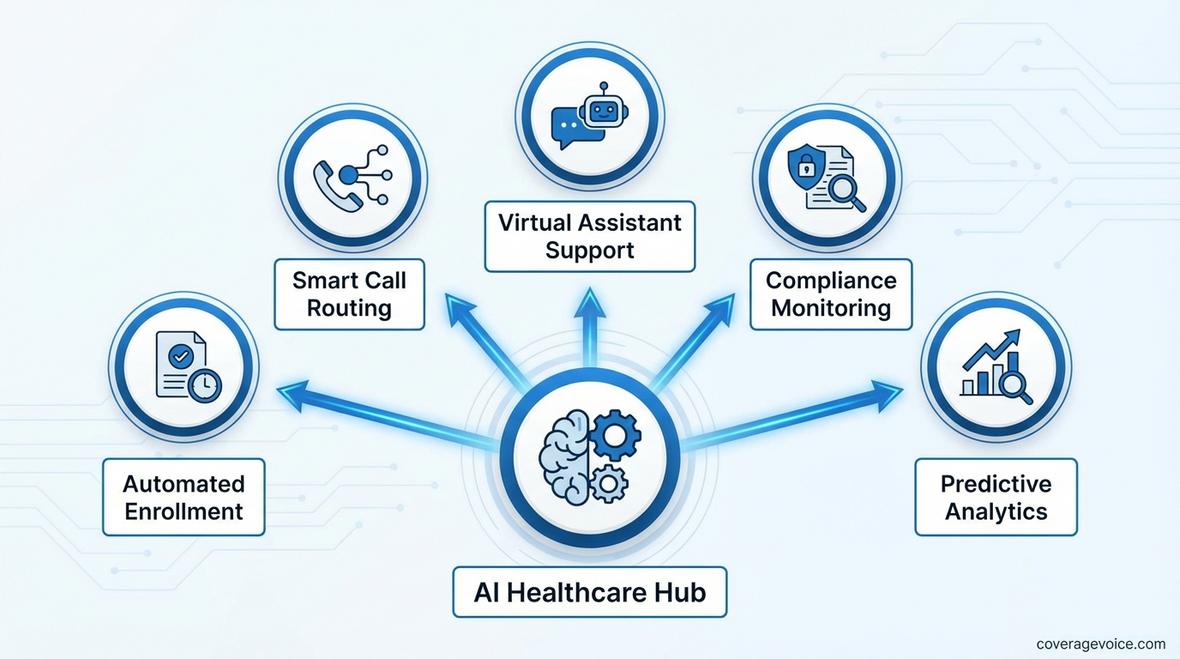
Organizations implementing AEP automation solutions report significant operational improvements, with some replacing up to 45 agents while maintaining or improving conversion rates. The platform's virtual receptionist capabilities ensure 24/7 availability without the costs associated with traditional after-hours staffing.
Enterprise AI Platforms with Healthcare Applications
Several technology giants offer AI platforms adapted for healthcare use cases:
Google Health AI: Leverages Google's machine learning expertise for clinical decision support and medical imaging analysis. While powerful for clinical applications, requires significant customization for Medicare enrollment workflows.
IBM Watson Health: Provides natural language processing and analytics capabilities across various healthcare domains. Strong in data analysis but less specialized for real-time member engagement scenarios.
Microsoft Healthcare AI: Offers cloud-based AI services with strong security and compliance frameworks. Requires integration expertise to adapt for Medicare-specific use cases.
Specialized Medicare Technology Providers
The Medicare technology space includes several companies offering complementary or competing solutions:
Rivvi: Focuses on Medicare marketing compliance and lead management. Organizations comparing options can review detailed Rivvi vs CoverageVoice analysis to understand capability differences.
CareCycle: Provides member engagement and care coordination tools. A comprehensive CareCycle comparison highlights automation depth differences for enrollment scenarios.
Goldrock: Offers CRM and enrollment management platforms. The Goldrock vs CoverageVoice comparison demonstrates voice AI integration advantages.
How Voice AI is Transforming Medicare Enrollment
Among the various AI healthcare technologies, conversational voice AI delivers the most immediate impact for Medicare organizations facing enrollment and engagement challenges.
Key Advantages of Voice AI for Medicare
24/7 Availability Without Staffing Costs: Voice AI agents handle inquiries, schedule appointments, and qualify leads around the clock. Organizations implementing after-hours AI agents capture leads that would otherwise be lost to competitors with extended availability.
Consistent Compliance: Unlike human agents who may inadvertently deviate from approved scripts, AI maintains perfect adherence to CMS guidelines and HIPAA requirements on every interaction. This consistency reduces compliance risk while ensuring quality member experiences.
Scalable Capacity: During AEP when call volumes can increase 300-500%, voice AI scales instantly without the recruitment, training, and supervision costs of temporary staff expansion.
Improved Conversion Rates: AI systems never experience fatigue, maintain consistent enthusiasm, and can instantly access member data to personalize conversations factors that collectively improve enrollment conversion rates.
Critical Use Cases for Medicare Organizations
The top ai healthcare companies specializing in voice AI enable these high-impact applications:
- Lead Qualification: Initial screening of inbound leads to identify enrollment readiness, eligibility, and plan preferences before human agent involvement
- Appointment Scheduling: Automated booking of agent consultations, enrollment appointments, and follow-up calls without administrative overhead
- Benefits Verification: Automated confirmation of Medicare eligibility, current coverage status, and qualification for special programs like dual-eligible benefits
- Enrollment Assistance: Guided application completion with real-time error detection and correction, reducing incomplete submissions
- Member Retention: Proactive outreach to at-risk members identified through predictive analytics, addressing concerns before disenrollment
Organizations can explore detailed implementation guidance through resources on voice AI for Medicare enrollment and AI voice agents for healthcare.
Regulatory Compliance: Non-Negotiable for Medicare AI
When evaluating the top ai healthcare companies, compliance capabilities must be the primary consideration not an afterthought. Medicare organizations face strict regulatory oversight, and AI implementations that compromise compliance create existential risk.
HIPAA Compliance Fundamentals
Any AI system handling protected health information (PHI) must provide:
- End-to-End Encryption: Secure transmission and storage of all member communications and data
- Access Controls: Role-based permissions ensuring only authorized personnel access sensitive information
- Audit Trails: Complete logging of all system interactions for compliance documentation
- Business Associate Agreements: Formal BAAs establishing vendor compliance responsibilities
Organizations should review comprehensive guidance on HIPAA-compliant AI voice automation before implementation.
CMS Script Adherence and TCPA Compliance
Medicare-specific regulations add complexity beyond standard HIPAA requirements:
CMS Script Requirements: AI systems must follow approved marketing scripts precisely, including required disclaimers, benefit explanations, and enrollment disclosures. Leading solutions include built-in script validation preventing non-compliant variations.
TCPA Calling Regulations: Automated calling systems must maintain proper consent documentation, honor do-not-call requests, and provide opt-out mechanisms. Comprehensive TCPA compliance guidance helps organizations avoid costly violations.
Recording and Documentation: All member interactions must be properly recorded and retained according to CMS requirements, with AI systems automatically generating compliant documentation.
Implementation Strategy: Building vs. Buying AI Solutions
Organizations exploring AI healthcare solutions face a critical decision: build custom capabilities or implement proven platforms from the top ai healthcare companies.
Cost and Timeline Considerations
Building proprietary AI solutions requires:
- 12-24 months development timeline before production deployment
- Significant upfront investment in data science talent, infrastructure, and compliance expertise
- Ongoing maintenance, updates, and regulatory adaptation costs
- Risk of technical debt as AI technologies evolve rapidly
Implementing proven platforms offers:
- 30-60 day deployment timelines for most use cases
- Predictable subscription costs without capital expenditure
- Immediate access to latest AI capabilities without development lag
- Vendor-managed compliance updates as regulations evolve
Organizations can evaluate specific cost implications through detailed build vs. buy cost analysis frameworks.
Integration with Existing Systems
Successful AI implementations require seamless connectivity with:
- CRM Platforms: Bidirectional data flow ensuring lead information, interaction history, and enrollment status remain synchronized
- Telephony Systems: Integration with existing phone infrastructure for unified call handling
- Enrollment Platforms: Direct connection to application processing systems reducing manual data entry
- Analytics Tools: Data export capabilities enabling comprehensive performance reporting
The most capable top ai healthcare companies offer pre-built integrations with common Medicare technology platforms, dramatically reducing implementation complexity.
Measuring ROI: Key Performance Indicators for AI Healthcare Solutions
Organizations investing in AI healthcare technologies need clear metrics demonstrating value creation. The most impactful KPIs vary by use case but typically include:
Operational Efficiency Metrics
- Cost Per Enrollment: Total enrollment costs divided by completed applications, typically decreasing 40-60% with effective AI implementation
- Agent Productivity: Enrollments per agent per day, increasing as AI handles routine tasks and qualification
- Call Handling Capacity: Total calls processed without proportional staff increases during peak periods
- After-Hours Conversion: Percentage of inquiries occurring outside business hours that convert to enrollments
Quality and Compliance Metrics
- Script Compliance Rate: Percentage of calls maintaining perfect adherence to CMS-approved language
- First-Call Resolution: Inquiries resolved without requiring follow-up, improving member satisfaction
- Application Completion Rate: Reduction in incomplete or abandoned enrollment applications
- Compliance Violations: Number of HIPAA, TCPA, or CMS violations detected (target: zero)
Business Outcome Metrics
- Conversion Rate: Percentage of qualified leads converting to enrolled members
- Member Retention: Year-over-year member retention rates, particularly for AI-engaged cohorts
- Customer Satisfaction: NPS or CSAT scores for AI-assisted interactions compared to human-only
- Revenue Per Member: Lifetime value of members acquired through AI-enabled channels
Future Trends: What's Next for AI in Medicare
The top ai healthcare companies are already developing next-generation capabilities that will further transform Medicare operations in the coming years.
Emerging AI Capabilities
Hyper-Personalization: AI systems will leverage comprehensive member data to deliver individually tailored enrollment recommendations, benefit explanations, and engagement strategies moving beyond demographic segments to true one-to-one personalization.
Predictive Intervention: Advanced analytics will identify members at risk of health complications, disenrollment, or low Star Ratings contribution before issues manifest, enabling proactive outreach that improves outcomes and retention.
Multimodal Interaction: Integration of voice, text, email, and video channels into unified AI experiences, allowing members to switch modalities mid-conversation while maintaining context and continuity.
Autonomous Enrollment: Fully automated enrollment processes requiring zero human intervention for straightforward cases, with seamless escalation to specialists only when complexity demands human judgment.
Regulatory Evolution and AI
CMS and regulatory bodies are developing frameworks specifically addressing AI in Medicare contexts. Forward-thinking organizations should anticipate:
- Expanded disclosure requirements when AI handles member interactions
- Standardized AI fairness and bias testing for enrollment algorithms
- Enhanced documentation requirements demonstrating AI decision rationale
- Specialized certifications for AI healthcare vendors serving Medicare populations
Partnering with the top ai healthcare companies that actively participate in regulatory development ensures solutions remain compliant as standards evolve.
Conclusion
The top ai healthcare companies are fundamentally reshaping Medicare enrollment, member engagement, and operational efficiency. Organizations that strategically implement AI solutions particularly voice automation, predictive analytics, and compliance monitoring gain significant competitive advantages through reduced costs, improved conversion rates, and enhanced member experiences. Success requires selecting partners with deep Medicare expertise, proven compliance capabilities, and seamless integration with existing workflows. As AI technologies continue advancing, early adopters position themselves to capture disproportionate value while building organizational competencies that will define market leadership in the years ahead. The question is no longer whether to implement AI, but which solutions and partners will deliver maximum impact for your specific operational challenges.
Ready to Transform Your Medicare Enrollment Process?
See how Coverage Voice AI can help you automate Medicare enrollment.