Top Artificial Intelligence Healthcare Companies In 2026: Leaders Transforming Medicare Enrollment & Patient Engagement

Introduction
The healthcare industry is experiencing a monumental shift as artificial intelligence healthcare companies revolutionize how organizations manage patient engagement, enrollment automation, and operational efficiency. For Medicare insurance professionals whether managing call centers, field marketing organizations (FMOs), or health plan operations understanding which AI providers deliver compliant, results-driven solutions has become mission-critical heading into 2026.
This comprehensive guide examines the leading artificial intelligence healthcare companies transforming Medicare operations, with particular focus on enrollment automation, member engagement, and HIPAA-compliant voice AI technologies. We'll explore how these platforms address the unique challenges faced by Medicare professionals during high-volume periods like the Annual Enrollment Period (AEP), while delivering measurable ROI through reduced operational costs and improved conversion rates.
The Evolution of AI in Healthcare: From Promise to Performance
The integration of artificial intelligence into healthcare operations has matured significantly over the past three years. What began as experimental chatbot implementations has evolved into sophisticated, compliant automation platforms that handle complex Medicare workflows with remarkable accuracy.
According to Accenture Healthcare AI Implementation Benchmarks, organizations implementing AI-driven administrative automation have achieved operational cost reductions of 30-40% while simultaneously improving member enrollment conversion rates by up to 25%. These performance metrics demonstrate why Medicare organizations are rapidly prioritizing AI investments.
For Medicare-focused operations, the requirements extend beyond general healthcare AI capabilities. Solutions must navigate the intricate compliance landscape governed by CMS regulations, HIPAA privacy standards, and TCPA telecommunication rules all while delivering seamless member experiences across multiple touchpoints.
Key Criteria for Evaluating Artificial Intelligence Healthcare Companies
When assessing artificial intelligence healthcare companies for Medicare operations, several critical evaluation factors distinguish truly effective platforms from generic solutions:
Medicare-Specific Compliance Architecture
Generic AI platforms rarely address the unique compliance requirements of Medicare operations. Leading providers build HIPAA and CMS compliance into their core architecture, ensuring every conversation, data exchange, and automated process adheres to regulatory standards. This includes proper handling of Protected Health Information (PHI), compliant call recording and storage, and documented consent management.
Organizations implementing Medicare marketing compliance solutions have found that native compliance capabilities reduce audit risk while accelerating deployment timelines.
Conversational AI Sophistication
The effectiveness of AI-powered member interactions depends on natural language processing capabilities that understand Medicare-specific terminology, benefits questions, and enrollment nuances. Advanced artificial intelligence healthcare companies deploy conversational AI trained specifically on Medicare Advantage plans, supplement insurance, and dual-eligible populations.
This specialization enables AI agents to handle complex scenarios like plan comparison questions, formulary inquiries, and provider network verification conversations that generic healthcare AI often struggles to manage effectively.
Integration Ecosystem
Medicare operations rely on sophisticated technology stacks including CRM systems, enrollment platforms, telephony infrastructure, and analytics tools. The most valuable AI providers offer pre-built integrations with industry-standard platforms, enabling rapid deployment without extensive custom development.
Solutions like enrollment automation platforms that seamlessly connect with existing Medicare workflows deliver faster time-to-value and reduced implementation complexity.
Scalability for Seasonal Demand
Medicare organizations face extreme volume fluctuations, with AEP periods generating 5-10x normal call volumes. Effective AI platforms must scale instantly to handle peak demand without degraded performance or increased per-interaction costs.
Organizations leveraging AEP automation technologies have eliminated the traditional need to hire and train hundreds of seasonal agents, instead relying on AI that scales elastically based on demand.
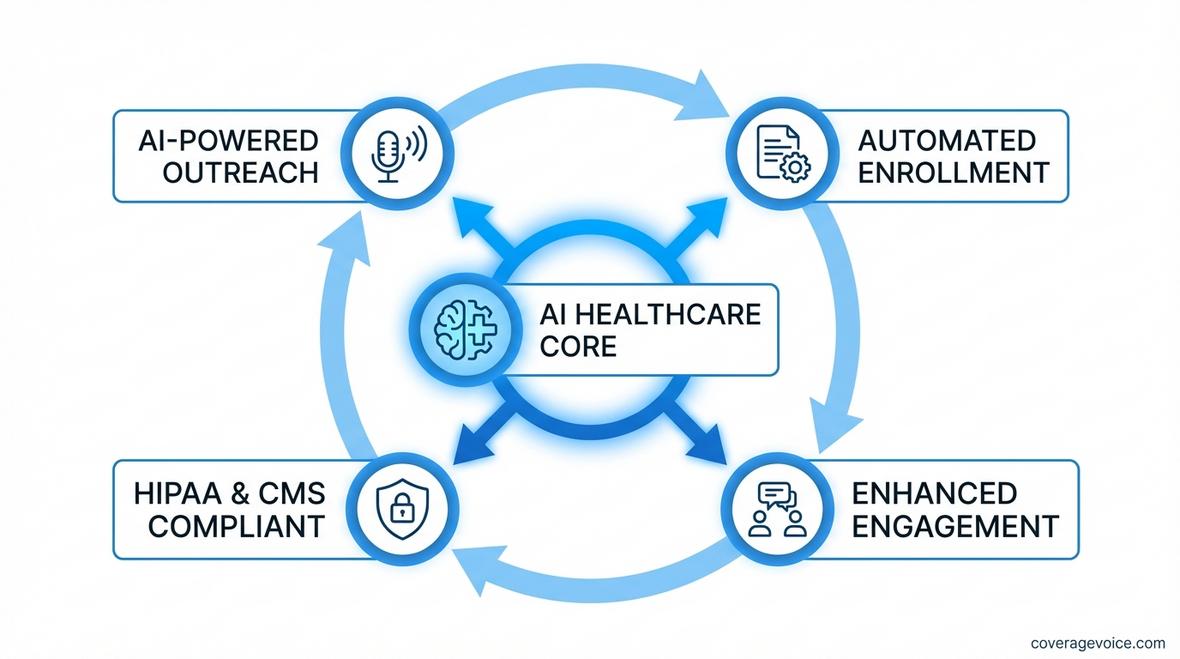
Leading Artificial Intelligence Healthcare Companies for Medicare Operations
The Medicare-focused AI landscape includes several providers offering specialized capabilities for enrollment automation, member engagement, and operational efficiency.
CoverageVoice: Medicare Voice AI Specialist
CoverageVoice has emerged as the leading artificial intelligence healthcare company purpose-built for Medicare operations. Unlike generic healthcare AI platforms, CoverageVoice focuses exclusively on the unique requirements of Medicare Advantage plans, FMOs, brokers, and health plan call centers.
The platform delivers comprehensive capabilities across the Medicare member lifecycle, from initial lead qualification through post-enrollment retention. Key differentiators include:
- Native CMS and HIPAA Compliance: Built-in compliance frameworks that eliminate the need for extensive customization or compliance overlays
- Medicare-Trained Conversational AI: Natural language models trained specifically on Medicare terminology, plan types, and enrollment processes
- Omnichannel Engagement: Unified AI across voice, SMS, and digital channels with consistent member experiences
- Real-Time Analytics: Granular performance tracking on conversion rates, compliance adherence, and operational efficiency
Organizations implementing CoverageVoice have reported significant operational improvements, with one case study documenting how Medicare voice AI replaced 45 agents while improving response times and member satisfaction scores.
For Medicare brokers and FMOs specifically, the platform offers specialized capabilities including lead reactivation tools that automatically re-engage dormant prospects using intelligent, compliant outreach sequences.
Specialized Voice AI Capabilities for Medicare
The most effective artificial intelligence healthcare companies recognize that Medicare operations require more than basic call handling. Advanced voice AI platforms deliver specialized capabilities including:
Intelligent Lead Qualification
AI-powered pre-screening identifies high-intent prospects based on eligibility criteria, plan preferences, and enrollment readiness. This capability enables organizations to prioritize agent time on qualified leads while automating initial contact and information gathering.
Medicare organizations using pre-screening automation have reduced agent time per enrollment by 40-60% while improving lead-to-enrollment conversion rates.
Appointment Scheduling Optimization
Coordinating enrollment appointments across multiple time zones, agent availability, and member preferences creates significant administrative burden. AI-powered appointment scheduling systems handle this complexity automatically, reducing no-show rates and maximizing agent productivity.
After-Hours Member Support
Medicare beneficiaries don't limit their questions to business hours. Implementing after-hour AI agents ensures 24/7 availability without proportional cost increases, capturing enrollment opportunities that would otherwise be lost to competitors.
Industry-Specific Applications Across Medicare Ecosystem
Different segments within the Medicare ecosystem have unique operational requirements that specialized artificial intelligence healthcare companies address with tailored solutions.
FMO and Broker Operations
Field Marketing Organizations and independent brokers face intense competition for Medicare beneficiary attention. AI platforms designed for this segment prioritize lead generation efficiency, multi-carrier quoting capabilities, and agent productivity enhancement.
Solutions like those profiled in Medicare brokers and FMOs implementations focus on maximizing the value extracted from each lead source while reducing the cost per enrollment.
Health Plan Call Centers
Medicare Advantage plans and supplement insurers operate large-scale call centers that must balance member satisfaction with operational efficiency. AI implementations in this environment emphasize call deflection, tier-zero support, and intelligent routing to specialized agents.
Organizations deploying Medicare call center solutions have documented significant improvements in first-call resolution rates while reducing average handle times by 30-50%.
Marketing Agencies Serving Medicare Clients
Agencies managing Medicare marketing campaigns require AI tools that integrate with advertising platforms, track campaign performance, and optimize lead nurturing sequences. Specialized capabilities include automated follow-up for PPC leads, multi-touch attribution, and compliant marketing communication management.
The marketing agencies vertical benefits particularly from AI that connects advertising investment directly to enrollment outcomes, enabling data-driven budget allocation decisions.
Comparative Analysis: Evaluating Medicare-Focused AI Platforms
When comparing artificial intelligence healthcare companies for Medicare implementations, several platforms compete for market leadership. Understanding their relative strengths and weaknesses enables informed vendor selection.
CoverageVoice vs. Alternative Platforms
Organizations evaluating Medicare AI often compare CoverageVoice against broader healthcare AI platforms that have added Medicare capabilities. Key comparison factors include Medicare-specific training data, compliance architecture depth, and implementation complexity.
Detailed comparisons are available for organizations considering alternatives, including CareCycle vs CoverageVoice and Rivvi vs CoverageVoice analyses that examine feature parity, pricing models, and implementation timelines.
The consensus among Medicare operations leaders is that purpose-built Medicare AI platforms deliver faster deployment, higher compliance confidence, and better enrollment outcomes compared to adapted general healthcare AI solutions.
Implementation Best Practices for Medicare AI
Successfully deploying AI automation in Medicare operations requires thoughtful planning that balances technology capabilities with organizational readiness and regulatory compliance.
Phased Rollout Strategy
Rather than attempting enterprise-wide AI deployment, leading organizations begin with specific high-value use cases. Common starting points include after-hours lead qualification, appointment reminder automation, or tier-zero FAQ handling.
This phased approach enables organizations to validate AI performance, refine conversational flows, and build internal confidence before expanding to more complex interactions like full enrollment conversations.
Compliance Validation Framework
Before deploying AI in member-facing roles, Medicare organizations must validate that every conversation, data capture, and handoff meets CMS and HIPAA requirements. This includes testing consent capture workflows, call recording disclosures, and PHI handling procedures.
Organizations implementing comprehensive HIPAA-compliant AI voice automation establish detailed compliance checklists that govern AI behavior across all interaction scenarios.
Agent Collaboration Model
The most successful AI implementations treat technology as agent augmentation rather than replacement. AI handles routine inquiries, qualification, and scheduling while seamlessly transferring complex cases to human specialists.
This collaborative model maximizes the value of both AI efficiency and human expertise, creating better member experiences while improving operational economics.
Measuring ROI and Performance Metrics
Quantifying the value delivered by artificial intelligence healthcare companies requires tracking metrics aligned with Medicare business objectives.
Cost Per Enrollment Reduction
The most direct ROI metric compares total enrollment costs before and after AI implementation. Leading organizations report 40-60% reductions in fully-loaded cost per enrollment when AI handles initial contact, qualification, and scheduling.
Research from the Bureau of Labor Statistics Healthcare Industry Data indicates that labor costs represent 60-70% of total call center expenses, making AI-driven automation particularly impactful for Medicare operations with high interaction volumes.
Conversion Rate Improvement
Beyond cost reduction, effective AI improves enrollment conversion by ensuring faster response times, consistent information delivery, and persistent follow-up. Organizations implementing AI-powered lead nurturing report 20-35% increases in lead-to-enrollment conversion rates.
Member Satisfaction Scores
Contrary to concerns that AI degrades member experience, properly implemented voice AI often improves satisfaction scores. Immediate response availability, consistent information accuracy, and patient conversation pacing contribute to positive member perceptions.
Medicare organizations tracking Net Promoter Scores (NPS) before and after AI deployment typically observe 10-15 point improvements, particularly when AI handles routine inquiries while reserving human agents for complex situations requiring empathy and judgment.
Future Trends in Medicare AI for 2026 and Beyond
The artificial intelligence healthcare companies leading Medicare innovation continue advancing capabilities that will define competitive advantage in coming years.
Predictive Member Retention
Next-generation AI platforms analyze member behavior patterns to identify disenrollment risk before members actively shop alternatives. Proactive retention outreach triggered by AI predictions enables plans to address concerns before losing members to competitors.
Multilingual Support Expansion
As Medicare beneficiary populations become increasingly diverse, AI platforms are expanding language support beyond English and Spanish. Advanced natural language processing enables authentic conversations in Mandarin, Vietnamese, Korean, and other languages prevalent in Medicare populations.
Integration with Social Determinants of Health
Forward-thinking Medicare organizations are connecting AI engagement platforms with social determinants of health (SDOH) data, enabling personalized outreach that addresses transportation barriers, food insecurity, and other factors affecting plan utilization and member satisfaction.
Selecting the Right AI Partner for Your Medicare Organization
Choosing among artificial intelligence healthcare companies requires evaluating both technical capabilities and organizational fit factors.
Evaluation Framework
Successful vendor selection processes assess five critical dimensions: Medicare-specific expertise, compliance architecture, integration capabilities, scalability for volume fluctuations, and total cost of ownership including implementation and ongoing support.
Organizations should request detailed case studies demonstrating results in similar operational contexts, along with references from Medicare-focused implementations rather than general healthcare deployments.
Proof of Concept Recommendations
Before committing to enterprise agreements, leading Medicare organizations conduct limited proof-of-concept implementations that validate AI performance on actual member interactions. These pilots should include compliance review, member satisfaction tracking, and conversion rate measurement across sufficient volume to establish statistical significance.
Conclusion
The landscape of artificial intelligence healthcare companies serving Medicare operations has matured significantly, with specialized providers delivering compliant, results-driven automation that transforms enrollment efficiency and member engagement. For Medicare professionals managing call centers, broker networks, or health plan operations, selecting the right AI partner has become a strategic imperative that directly impacts competitive positioning and operational economics. Organizations that thoughtfully evaluate Medicare-specific capabilities, implement phased rollouts with rigorous compliance validation, and measure performance against business-aligned metrics position themselves to capture the full value of AI automation while maintaining the regulatory adherence and member experience quality that define Medicare excellence.
Ready to Transform Your Medicare Enrollment Process?
See how Coverage Voice AI can help you automate Medicare enrollment.