Top Conversational AI Companies In 2026: Leaders Transforming Enterprise Communication

Understanding the Conversational AI Landscape in 2026
The conversational AI industry has evolved dramatically, with businesses across healthcare, insurance, and financial services leveraging intelligent automation to enhance customer experiences. As organizations seek to reduce operational costs while improving service quality, identifying the top conversational AI companies becomes critical for strategic technology investments. These platforms now handle everything from complex Medicare enrollment workflows to real-time patient engagement, demonstrating measurable ROI through reduced average handle time (AHT) and improved customer satisfaction scores.
According to Forrester Wave Leaders in Conversational AI, leading platforms achieve mean CSAT scores of 4.5 out of 5 in AI interactions, with 70% first-contact resolution rates and documented ROI from reduced AHT in high-volume contact centers. This performance benchmark sets the standard for evaluating enterprise-grade conversational AI solutions.
The market now features specialized providers focusing on vertical-specific use cases, particularly in heavily regulated industries like healthcare and insurance. Companies evaluating conversational AI solutions must assess not only technical capabilities but also compliance frameworks, integration flexibility, and domain expertise.
What Defines Top Conversational AI Companies
The top conversational AI companies distinguish themselves through four interconnected pillars that drive enterprise value and sustainable competitive advantage in increasingly complex operational environments.
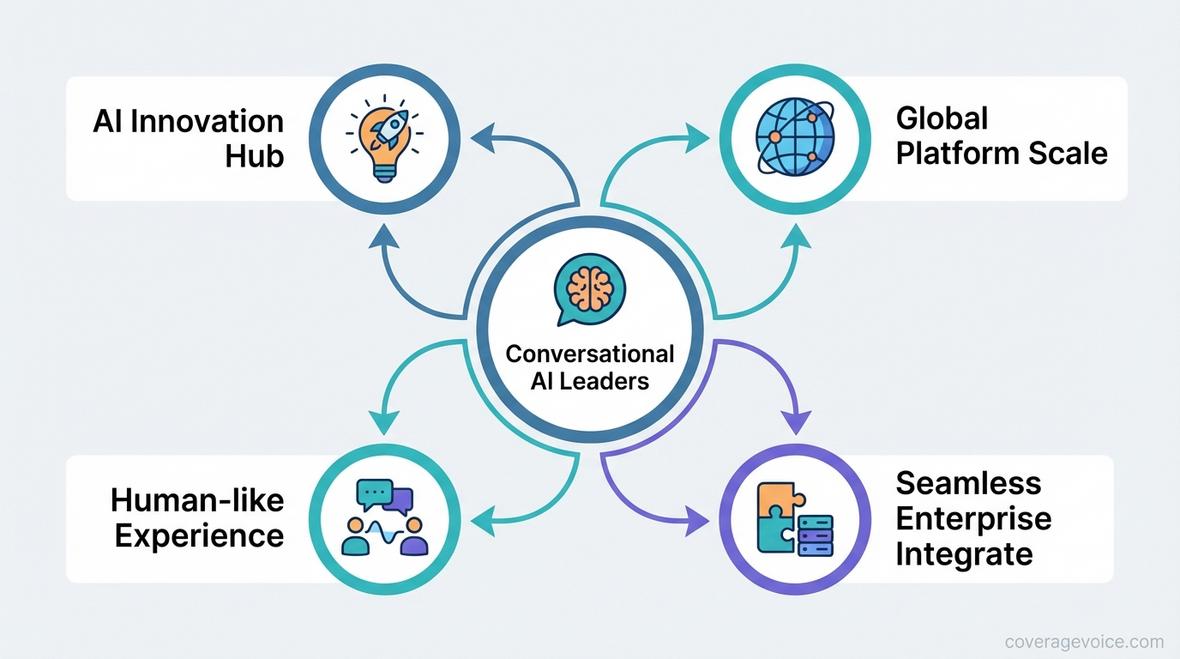
AI Innovation Hub Capabilities
Leading conversational AI platforms invest heavily in proprietary natural language processing (NLP) models, emotion detection algorithms, and contextual understanding systems. These innovations enable virtual receptionist capabilities that understand nuanced healthcare terminology, insurance jargon, and regulatory requirements specific to Medicare and Medicaid programs.
Advanced sentiment analysis allows AI agents to detect caller frustration, confusion, or satisfaction in real-time, triggering appropriate escalation protocols or empathy-based responses. The most sophisticated systems incorporate continuous learning mechanisms that improve performance with each interaction, adapting to seasonal variations like Annual Enrollment Period (AEP) call volume spikes.
Global Platform Scale and Infrastructure
Enterprise conversational AI requires robust infrastructure capable of handling millions of concurrent conversations across voice, chat, SMS, and email channels. The top providers offer 99.9% uptime guarantees with geographically distributed data centers ensuring low-latency responses regardless of caller location.
Scalability becomes particularly critical during high-volume periods. For Medicare organizations, the ability to handle AEP and OEP automation without degraded performance separates enterprise-grade solutions from limited platforms. Leading companies demonstrate capacity to scale from baseline operations to 10x volume within hours, maintaining consistent response quality.
Human-Like Conversational Experience
The most successful conversational AI platforms create experiences indistinguishable from human agents for routine interactions. This involves sophisticated voice synthesis with natural prosody, appropriate pause patterns, and contextual tone adjustments based on conversation flow.
Beyond voice quality, top platforms master conversation design principles including turn-taking, clarification requests, and graceful error recovery. When handling Medicare enrollment processes, these systems guide callers through complex multi-step workflows while maintaining conversational naturalness and regulatory compliance.
Seamless Enterprise Integration
Leading conversational AI companies provide pre-built connectors for CRM systems, enrollment platforms, claims management software, and compliance monitoring tools. This integration capability enables insurance automation workflows that span multiple backend systems while presenting a unified conversational interface.
API-first architectures allow IT teams to embed conversational capabilities into existing applications without wholesale system replacements. For healthcare organizations managing complex technology ecosystems, this integration flexibility dramatically reduces implementation timelines and total cost of ownership.
Key Evaluation Criteria for Conversational AI Platforms
Organizations selecting from the top conversational AI companies should apply a structured evaluation framework addressing both technical capabilities and business alignment factors.
Industry-Specific Expertise and Compliance
Generic conversational AI platforms struggle with industry-specific terminology, regulatory requirements, and workflow complexity. Medicare organizations require solutions understanding HIPAA compliance, CMS regulations, TCPA consent requirements, and state-specific insurance rules.
Platforms with healthcare specialization offer pre-configured TCPA compliance features, automated consent management, and built-in safeguards preventing prohibited marketing practices. This domain expertise accelerates deployment while reducing compliance risks that could result in substantial penalties.
Implementation Speed and Time-to-Value
Traditional conversational AI implementations often require 6-12 months for production deployment. Leading platforms reduce this timeline to 4-8 weeks through pre-built industry templates, automated training processes, and streamlined integration methodologies.
For Medicare organizations facing tight AEP deadlines, implementation speed directly impacts revenue capture. Solutions offering rapid deployment without sacrificing customization capabilities provide competitive advantages during critical enrollment windows. Organizations should evaluate vendor track records on implementation timelines and request case studies demonstrating accelerated deployments.
Performance Metrics and ROI Documentation
Top conversational AI companies provide transparent performance benchmarks including intent recognition accuracy, conversation completion rates, average handling time, customer satisfaction scores, and containment rates. These metrics enable data-driven comparisons across competing platforms.
Organizations should request vendor-provided ROI calculators incorporating industry-specific variables. For Medicare call centers, relevant factors include cost per enrollment, agent productivity improvements, and seasonal volume management. Solutions with documented Medicare voice AI ROI case studies demonstrate proven value in similar operational contexts.
Customization and Control
While pre-built templates accelerate deployment, organizations require customization capabilities matching their unique brand voice, operational workflows, and business rules. Leading platforms balance ease-of-use with sophisticated customization through visual conversation designers, no-code rule engines, and flexible scripting options.
Healthcare organizations with complex eligibility rules, multi-plan offerings, and specialized member populations need platforms accommodating these requirements without extensive custom development. Evaluation should include hands-on testing of customization interfaces and assessment of required technical expertise.
Top Conversational AI Companies by Vertical Specialization
The conversational AI market has matured beyond general-purpose chatbots toward vertical-specific solutions delivering measurable business outcomes in targeted industries.
Healthcare and Medicare-Focused Platforms
Medicare-specialized conversational AI platforms address unique challenges including complex eligibility verification, multi-step enrollment workflows, and strict regulatory compliance requirements. These solutions integrate with Medicare-specific systems including CMS enrollment platforms, plan comparison tools, and benefits verification databases.
Organizations serving Medicare populations benefit from platforms offering dual-eligible LIS outreach capabilities, automated benefit explanations, and compliant marketing communication management. The most effective solutions combine voice AI with omnichannel engagement, reaching members through their preferred communication channels while maintaining conversation continuity.
Coverage Voice exemplifies this specialized approach, offering purpose-built solutions for Medicare brokers, FMOs, and health plans. The platform handles everything from Medicare call center operations to member retention workflows, demonstrating documented results including replacing 45 agents while improving service quality metrics.
Financial Services and Insurance Carriers
Insurance carriers beyond Medicare also leverage conversational AI for policy servicing, claims status inquiries, and payment processing. These platforms must navigate complex policy documents, calculate premiums based on multiple variables, and process transactions securely.
Leading insurance-focused platforms offer sophisticated AI lead qualification capabilities, automatically identifying high-intent prospects and routing them appropriately. This capability dramatically improves sales team efficiency by ensuring agents focus on qualified opportunities rather than unqualified inquiries.
Retail and E-Commerce Solutions
Retail-focused conversational AI platforms emphasize product recommendations, order tracking, and return processing. These solutions integrate with e-commerce platforms, inventory management systems, and logistics providers to deliver comprehensive customer service automation.
While retail platforms excel at transactional interactions, they typically lack the regulatory compliance features and complex workflow management required for healthcare applications. Organizations should carefully assess whether general-purpose platforms can accommodate industry-specific requirements or if specialized solutions provide better fit.
Build vs. Buy Decision Framework
Organizations evaluating the top conversational AI companies must simultaneously consider whether building proprietary solutions offers strategic advantages over commercial platforms.
Total Cost of Ownership Analysis
Building conversational AI in-house requires substantial investments in AI/ML talent, infrastructure, ongoing model training, and continuous platform maintenance. Organizations must staff data science teams, DevOps engineers, conversation designers, and quality assurance specialists.
Commercial platforms convert these capital expenses into operational expenses with predictable monthly costs based on usage volume. For most Medicare organizations, build vs. buy cost analysis favors commercial solutions unless conversation volumes exceed millions of monthly interactions or unique requirements prevent commercial platform adoption.
Time-to-Market Considerations
Building conversational AI from scratch typically requires 12-24 months before production deployment, assuming availability of specialized talent. This timeline includes model development, conversation design, integration work, testing, and iterative refinement based on real-world performance.
Commercial platforms reduce this timeline to weeks, enabling organizations to capture immediate value rather than waiting years for internal development completion. For time-sensitive opportunities like AEP enrollment windows, commercial solutions provide decisive advantages.
Competitive Differentiation Assessment
Organizations should build proprietary conversational AI only when the technology itself provides competitive differentiation. For most Medicare organizations, conversational AI represents operational enablement rather than core competitive advantage.
Investing development resources in proprietary enrollment algorithms, member engagement strategies, or network optimization typically yields greater competitive returns than building conversational AI infrastructure. Commercial platforms allow organizations to focus internal innovation capacity on differentiating capabilities while leveraging best-in-class conversation technology.
Implementation Best Practices for Enterprise Conversational AI
Successfully deploying solutions from the top conversational AI companies requires structured implementation methodologies addressing technical integration, change management, and continuous optimization.
Phased Pilot Approach
Organizations should begin with limited-scope pilots addressing specific high-volume, low-complexity use cases. For Medicare organizations, ideal pilot scenarios include appointment scheduling, benefits verification inquiries, or after-hours call handling.
Successful pilots demonstrate measurable value while building organizational confidence in the technology. They also surface integration challenges, training requirements, and operational adjustments needed before enterprise-wide deployment. Pilot durations typically span 60-90 days, providing sufficient data for performance assessment without excessive delay.
Agent and Stakeholder Change Management
Conversational AI implementations affect multiple stakeholder groups including contact center agents, IT teams, compliance officers, and business leaders. Effective change management addresses concerns about job displacement, explains how AI augments rather than replaces human agents, and provides clear transition plans.
Leading organizations position conversational AI as agent assistance technology, handling routine inquiries while escalating complex situations to human experts. This framing reduces resistance while accurately reflecting optimal human-AI collaboration models. Training programs should help agents develop skills for handling escalated conversations and supervising AI performance.
Continuous Performance Optimization
Initial conversational AI deployment represents the beginning rather than completion of the implementation journey. Top-performing organizations establish continuous optimization processes including regular conversation analysis, intent model refinement, and workflow adjustments based on performance data.
Weekly performance reviews examining key metrics like containment rate, escalation reasons, conversation abandonment, and customer satisfaction enable rapid identification of improvement opportunities. Organizations should allocate ongoing resources for conversation design refinement, ensuring the AI evolves with changing business requirements and customer expectations.
Measuring Conversational AI Success
Organizations deploying solutions from the top conversational AI companies require comprehensive measurement frameworks tracking both operational efficiency and customer experience outcomes.
Operational Efficiency Metrics
Key operational metrics include cost per conversation, containment rate (percentage of conversations resolved without human escalation), average handling time, concurrent conversation capacity, and system availability. These metrics directly translate to operational cost savings and capacity improvements.
For Medicare organizations, enrollment-specific metrics like cost per enrollment, enrollment completion rate, and time-to-enrollment provide critical business outcome measurements. Platforms demonstrating 30x resolution improvements deliver transformative operational advantages during high-volume periods.
Customer Experience Metrics
Customer satisfaction (CSAT), Net Promoter Score (NPS), and customer effort score measure experience quality from the member perspective. Leading conversational AI platforms maintain CSAT scores comparable to or exceeding human agent benchmarks, demonstrating that well-designed AI delivers excellent experiences.
Conversation-level metrics including intent recognition accuracy, successful task completion, and conversation duration provide granular insight into experience quality. Organizations should track these metrics by conversation type, enabling targeted improvements for specific workflows.
Business Outcome Metrics
Ultimate success measurement focuses on business outcomes including revenue impact, member retention rates, and compliance adherence. For Medicare organizations, conversational AI should demonstrably improve star ratings through enhanced member engagement and service accessibility.
ROI calculations should incorporate both direct cost savings from reduced agent requirements and indirect benefits including expanded service hours, improved scalability during peak periods, and enhanced member satisfaction driving retention and referrals.
Future Trends Shaping Conversational AI
The conversational AI landscape continues evolving rapidly, with emerging capabilities expanding potential applications and improving performance across existing use cases.
Multimodal AI Interactions
Next-generation conversational AI platforms integrate voice, visual, and text modalities within single conversations. Members might begin interactions via SMS, transition to voice for complex questions, and receive visual confirmations via email all within a unified conversation thread maintaining full context.
This multimodal approach particularly benefits complex workflows like Medicare enrollment, where visual plan comparisons complement verbal explanations. Organizations should evaluate whether prospective platforms support multimodal interactions and assess their omnichannel conversation management capabilities.
Predictive Engagement and Proactive Outreach
Advanced conversational AI platforms increasingly incorporate predictive analytics identifying members likely to disenroll, miss important deadlines, or experience health challenges. These insights trigger proactive retention outreach before problems escalate.
Proactive engagement dramatically improves member outcomes while reducing crisis intervention costs. For Medicare Advantage plans, predictive outreach addressing medication adherence, preventive care appointments, and benefit utilization optimization directly impacts quality measures and financial performance.
Emotion AI and Empathy Enhancement
Emerging emotion AI capabilities analyze vocal characteristics, word choice, and conversation patterns to detect emotional states including frustration, confusion, anxiety, or satisfaction. This emotional intelligence enables AI agents to adjust communication style, offer additional support, or escalate to human agents when appropriate.
For healthcare applications, empathetic AI interactions significantly improve member experience, particularly for vulnerable populations managing complex health conditions or navigating confusing insurance processes. Organizations should assess vendor capabilities in emotion detection and empathetic response generation.
Frequently Asked Questions
What ROI can organizations expect from conversational AI?
Organizations typically achieve 200-400% ROI within the first year through reduced agent costs, increased operational capacity, and improved conversion rates. Medicare-specific implementations demonstrate cost per enrollment reductions of 60-80% while simultaneously improving member satisfaction scores. Actual ROI varies based on conversation volumes, complexity, and implementation quality.
How long does conversational AI implementation take?
Implementation timelines range from 4-8 weeks for specialized healthcare platforms with pre-built templates to 6-12 months for custom implementations or general-purpose platforms requiring extensive configuration. Organizations should prioritize vendors with proven rapid deployment capabilities and industry-specific accelerators.
How do conversational AI platforms ensure HIPAA and TCPA compliance?
Leading healthcare-focused platforms include built-in compliance features such as encrypted data storage, access controls, audit logging, automated consent management, and prohibited content filtering. Organizations should request detailed compliance documentation, review security certifications, and validate that platforms meet industry-specific regulatory requirements.
What integration capabilities should organizations prioritize?
Priority integrations include CRM systems, enrollment platforms, claims management software, telephony infrastructure, and compliance monitoring tools. Organizations should evaluate both pre-built connectors and API flexibility for custom integrations. Platforms offering comprehensive integration capabilities dramatically reduce implementation complexity and ongoing maintenance requirements.
How do specialized Medicare AI platforms compare to general conversational AI?
Medicare-specialized platforms offer pre-configured compliance features, industry-specific workflows, and terminology understanding that general platforms lack. While general platforms provide broader capabilities, specialized solutions deliver faster implementation, superior out-of-box performance for Medicare use cases, and ongoing product development aligned with healthcare industry needs. Organizations should compare specialized alternatives to understand trade-offs.
Conclusion
Selecting from the top conversational AI companies requires careful evaluation of technical capabilities, industry expertise, implementation speed, and long-term platform viability. Organizations should prioritize vendors demonstrating proven performance in similar operational contexts, with documented ROI and compliance frameworks addressing industry-specific requirements.
For Medicare organizations, specialized platforms like Coverage Voice offer purpose-built solutions addressing the unique complexity of healthcare enrollment, member engagement, and regulatory compliance. These focused platforms typically deliver faster implementations, superior out-of-box performance, and ongoing product development aligned with healthcare industry evolution.
As conversational AI technology continues advancing, early adopters gain sustainable competitive advantages through operational efficiency, enhanced member experiences, and scalable growth capacity. Organizations beginning their conversational AI journey today position themselves for long-term success in increasingly AI-enabled healthcare markets.
Ready to Transform Your Medicare Enrollment Process?
See how Coverage Voice AI can help you automate Medicare enrollment.