Voice AI For Healthcare: Complete Guide To Transforming Patient Engagement And Operational Efficiency In 2026

Introduction
The healthcare industry is undergoing a profound transformation as voice AI for healthcare emerges as a critical technology for improving patient engagement, streamlining operations, and ensuring regulatory compliance. In 2026, healthcare organizations face mounting pressure to deliver personalized care while managing escalating costs and complex compliance requirements. Rapid Adoption of Generative AI in Healthcare for 2026 marks a pivotal moment, with healthcare providers, Medicare organizations, and call centers embracing intelligent automation to meet these challenges head-on.
Voice AI technology offers 24/7 availability, instant response times, and the ability to handle thousands of simultaneous conversations while maintaining HIPAA compliance. For Medicare organizations, FMOs, and health plan call centers, this technology represents a strategic advantage during high-volume periods like the Annual Enrollment Period (AEP). This comprehensive guide explores how voice AI for healthcare is revolutionizing patient engagement, enrollment automation, and operational efficiency across the healthcare ecosystem.
What Is Voice AI for Healthcare?
Voice AI for healthcare refers to conversational artificial intelligence systems specifically designed to interact with patients, members, and healthcare consumers through natural voice conversations. Unlike traditional interactive voice response (IVR) systems that rely on rigid menu trees, modern voice AI leverages natural language processing (NLP), machine learning, and generative AI to understand context, intent, and sentiment in real-time.
These intelligent systems can handle diverse healthcare tasks including appointment scheduling, medication reminders, benefit verification, enrollment assistance, and post-discharge follow-ups. For Medicare organizations, voice AI transforms call center operations by automating routine inquiries while escalating complex cases to human agents when necessary.
Key Components of Healthcare Voice AI
- Natural Language Understanding (NLU): Interprets patient questions and requests across multiple dialects and communication styles
- Speech Recognition: Converts spoken language into text with medical terminology accuracy
- Intent Recognition: Identifies the underlying purpose of patient interactions to route calls appropriately
- Integration Capabilities: Connects seamlessly with EHR systems, CRM platforms, and enrollment databases
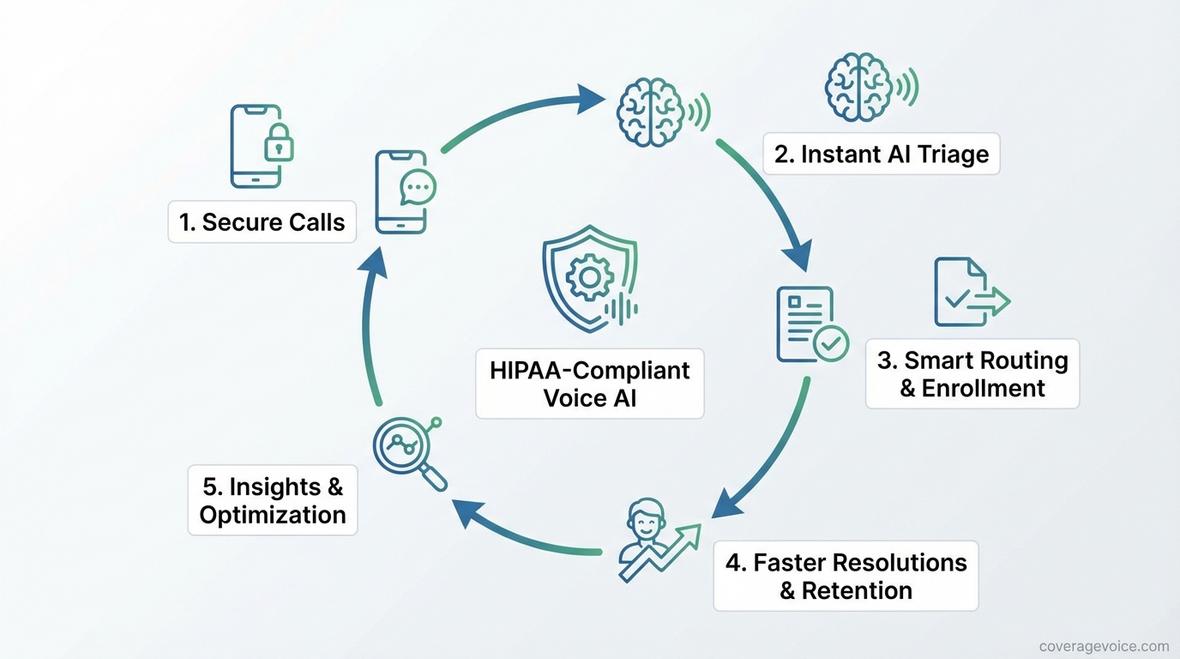
- HIPAA Compliance: Ensures all conversations and data storage meet strict healthcare privacy regulations
Market Growth and Industry Adoption
The healthcare AI market is experiencing exponential growth, with voice AI representing one of the fastest-growing segments. According to research from Grand View Research, the Patient Engagement with Voice AI Growing at Fastest CAGR, with this segment anticipated to grow fastest, driven by 24/7 support for reminders, follow-ups, and wellness check-ins, especially for aging populations.
Healthcare providers are rapidly embracing AI technologies across operational functions. Research indicates that 71% of Hospitals Using Predictive AI in EHR in 2024, with 71% of hospitals reporting predictive AI integration with electronic health records (up from 66% in 2023), and 66% of physicians actively using AI tools in their clinical workflows.
Transformational Workforce Impact
The operational benefits of voice AI for healthcare extend beyond cost savings to tangible productivity gains. According to Speechmatics research, Voice AI Adds 30 Million Minutes Back to Healthcare Workforce by 2025, with voice AI adding 30 million minutes back to the healthcare workforce by December 2025. Case studies show organizations achieving 21x ROI, 5%+ patient retention increases, and 2.4+ hours saved per physician daily through voice AI implementation.
Primary Use Cases for Voice AI in Healthcare
Voice AI technology serves multiple critical functions across the healthcare continuum, with particularly strong applications in Medicare enrollment, patient engagement, and operational automation.
Automated Appointment Scheduling and Reminders
One of the most impactful applications of voice AI for healthcare involves automating appointment management. Traditional manual scheduling consumes significant staff time and contributes to high no-show rates that impact revenue and care continuity. Voice AI systems can handle inbound scheduling requests 24/7 while proactively reaching out with intelligent appointment reminders.
Research demonstrates that Voice AI Reduces No-Show Rates by Up to 30%, with outbound reminder calls reducing no-shows by up to 30% while saving staff 4+ hours daily on inbound scheduling tasks and improving revenue protection. These systems can offer rescheduling options, send confirmation messages across multiple channels, and update calendar systems automatically.
Medicare Enrollment and Benefit Verification
For Medicare organizations, FMOs, and health plans, the Annual Enrollment Period (AEP) represents both an opportunity and an operational challenge. Voice AI for AEP automation enables organizations to handle massive call volumes without proportionally increasing staff.
Voice AI agents can conduct benefit verification, answer plan comparison questions, collect enrollment information, and even complete enrollment applications through conversational interactions. These systems integrate with Medicare CRM platforms to ensure all interactions are documented and compliant with CMS regulations. Organizations implementing Medicare voice AI enrollment automation report dramatic reductions in cost-per-enrollment while maintaining high conversion rates.
Patient Engagement and Chronic Care Management
Voice AI excels at maintaining ongoing relationships with patients and members between clinical encounters. Automated check-in calls, medication adherence reminders, and wellness program outreach become scalable through intelligent voice agents that can personalize conversations based on individual health profiles and preferences.
For Medicare Advantage plans focused on improving Star Ratings, voice AI provides consistent member touchpoints that drive HEDIS measure compliance and demonstrate care quality. Member engagement solutions powered by voice AI can identify at-risk members, facilitate preventive care scheduling, and provide health education at scale.
Call Center Triage and Virtual Reception
Healthcare call centers face enormous volume fluctuations, particularly during open enrollment periods and seasonal health events. Voice AI serves as an intelligent virtual receptionist that can handle routine inquiries, authenticate callers, gather preliminary information, and route calls to the appropriate department or specialist.
This intelligent triage reduces wait times for patients while allowing human agents to focus on complex cases requiring empathy, clinical judgment, or detailed plan counseling. Organizations report that voice AI handles 60-80% of routine inquiries autonomously, dramatically improving operational efficiency and caller satisfaction.
Medicare-Specific Applications of Voice AI
The Medicare ecosystem presents unique opportunities for voice AI implementation due to high call volumes, complex regulatory requirements, and the demographic characteristics of Medicare beneficiaries.
Dual-Eligible and LIS Outreach
Identifying and enrolling dual-eligible beneficiaries and those qualifying for Low Income Subsidy (LIS) programs requires extensive outreach efforts. Voice AI for dual-eligible outreach can conduct thousands of screening calls simultaneously, identifying potentially eligible individuals and scheduling appointments with enrollment specialists.
These systems can navigate language barriers through multilingual capabilities and adjust conversation complexity based on beneficiary comprehension, ensuring equitable access to benefits information.
Member Retention and Renewal Automation
Retention represents a critical metric for Medicare Advantage plans, with disenrollment directly impacting revenue and operational efficiency. Voice AI for member retention enables proactive outreach to at-risk members, addressing concerns before they result in disenrollment.
Automated renewal reminders, plan change notifications, and satisfaction surveys conducted through voice AI help organizations maintain high retention rates. These systems can identify dissatisfaction patterns and trigger human intervention when retention risk reaches critical thresholds.
After-Hours and Weekend Support
Medicare beneficiaries often need assistance outside traditional business hours, particularly when reviewing plan materials or experiencing urgent questions about coverage. After-hours AI agents provide 24/7 support without requiring organizations to staff call centers around the clock.
These systems can answer frequently asked questions, schedule callbacks with human agents, process enrollment applications, and provide emergency contact information when appropriate. This capability significantly enhances member satisfaction while controlling labor costs.
HIPAA Compliance and Data Security
Healthcare organizations rightfully prioritize data security and regulatory compliance when evaluating voice AI solutions. Modern voice AI for healthcare platforms are built with HIPAA compliance as a foundational requirement, not an afterthought.
Essential Compliance Requirements
HIPAA-compliant voice AI systems must implement multiple layers of protection including end-to-end encryption for voice data, secure storage with appropriate access controls, comprehensive audit logging of all interactions, Business Associate Agreements (BAAs) with all technology vendors, and regular security assessments and penetration testing.
Additionally, Medicare-specific regulations require compliance with CMS marketing and enrollment guidelines, TCPA requirements for outbound calling, and proper scope of appointment (SOA) documentation. Organizations implementing Medicare marketing compliance solutions must ensure their voice AI platforms support these regulatory requirements natively.
Authentication and Identity Verification
Voice AI systems employ sophisticated authentication methods to verify caller identity before discussing protected health information. These may include multi-factor authentication, knowledge-based verification questions, voice biometrics for returning callers, and integration with existing authentication systems.
Proper authentication ensures that voice AI conversations meet HIPAA standards while providing seamless member experiences.
Implementation Considerations and Best Practices
Successfully deploying voice AI for healthcare requires thoughtful planning, stakeholder alignment, and attention to both technical and human factors.
Integration with Existing Systems
Voice AI platforms must connect seamlessly with existing healthcare IT infrastructure including electronic health records (EHR), customer relationship management (CRM) systems, enrollment platforms, telephony infrastructure, and analytics dashboards. Organizations should evaluate voice AI vendors based on their integration capabilities and existing connector ecosystem.
Change Management and Staff Training
Introducing voice AI represents organizational change that affects call center agents, supervisors, IT teams, and compliance officers. Successful implementations include comprehensive training on when to escalate calls from AI to human agents, how to review AI conversation logs for quality assurance, understanding AI capabilities and limitations, and ongoing optimization based on performance data.
Organizations should position voice AI as augmenting human capabilities rather than replacing staff, emphasizing how automation allows agents to focus on higher-value interactions requiring empathy and complex problem-solving.
Continuous Monitoring and Optimization
Voice AI systems improve over time through machine learning, but this requires active monitoring and refinement. Key performance indicators to track include call containment rate, average handling time, first-call resolution rate, member satisfaction scores, enrollment conversion rates, and compliance adherence metrics.
Regular analysis of conversation transcripts helps identify areas where AI responses need refinement or where additional training data would improve performance.
ROI and Cost Analysis
Healthcare organizations evaluating voice AI for healthcare must understand both implementation costs and expected returns to justify investment.
Implementation and Operational Costs
Typical cost components include platform licensing fees (often per-conversation or per-minute pricing), integration and implementation services, ongoing maintenance and support, telephony and infrastructure costs, and staff training and change management.
For Medicare organizations, transparent pricing models that align costs with usage help control expenses during peak enrollment periods while maintaining efficiency during lower-volume months.
Quantifiable Benefits and Returns
Organizations implementing voice AI typically realize returns through reduced labor costs (30-50% reduction in routine call handling), increased enrollment conversion (15-25% improvement through immediate response), reduced no-show rates (20-30% decrease), improved member retention (5-10% improvement), and extended service hours without proportional cost increases.
Healthcare systems report that voice AI implementations often achieve positive ROI within 6-12 months, with returns accelerating as systems learn and improve over time.
Comparing Voice AI Platforms for Healthcare
The healthcare voice AI market includes multiple vendors with varying capabilities, specializations, and pricing models. Medicare organizations should evaluate platforms based on healthcare-specific features, HIPAA compliance certifications, integration capabilities, conversational quality and natural language understanding, scalability during peak periods, and vendor expertise in Medicare regulations.
Organizations considering alternatives should review detailed comparisons such as Rivvi vs CoverageVoice and CareCycle vs CoverageVoice to understand feature differences and specialization areas.
Future Trends in Healthcare Voice AI
As we progress through 2026, several emerging trends are shaping the evolution of voice AI for healthcare including multimodal AI that combines voice with visual and text-based interactions, enhanced emotional intelligence to better recognize and respond to patient sentiment, predictive capabilities that anticipate patient needs before explicit requests, and deeper clinical integration allowing voice AI to access and update clinical documentation.
These advances will further expand the role of voice AI from operational efficiency tool to comprehensive patient engagement platform that supports care delivery across the entire healthcare journey.
Frequently Asked Questions
How does voice AI for healthcare differ from traditional IVR systems?
Traditional IVR systems rely on rigid menu trees and limited keyword recognition, while modern voice AI uses natural language processing to understand conversational speech, context, and intent. Voice AI can handle complex, multi-turn conversations and learn from interactions, whereas IVR systems follow predetermined paths. For Medicare organizations, this means voice AI can conduct actual enrollment conversations rather than simply routing calls.
Is voice AI compliant with HIPAA and CMS regulations?
Reputable healthcare voice AI platforms are built with HIPAA compliance as a core requirement, implementing encryption, access controls, audit logging, and Business Associate Agreements. For Medicare-specific applications, platforms must also support CMS marketing guidelines, TCPA compliance, and proper SOA documentation. Organizations should verify compliance certifications and request detailed security documentation before implementation.
What happens when voice AI cannot handle a call?
Quality voice AI systems recognize their limitations and seamlessly escalate to human agents when conversations exceed their capabilities. This typically occurs with highly complex plan questions, emotionally distressed callers, requests for clinical advice, or technical issues requiring specialist knowledge. The AI transfers complete conversation context to the human agent, ensuring continuity and avoiding caller frustration from repeating information.
How long does it take to implement voice AI for a Medicare call center?
Implementation timelines vary based on complexity, but typical deployments range from 4-12 weeks. This includes system integration with existing CRM and telephony infrastructure, conversation flow development and testing, staff training and change management, and pilot testing before full deployment. Organizations with well-documented processes and modern IT infrastructure often complete implementations faster.
Can voice AI handle multiple languages for diverse Medicare populations?
Modern voice AI for healthcare platforms support multiple languages and can automatically detect the caller's preferred language. This capability is particularly important for Medicare organizations serving diverse beneficiary populations, including Spanish-speaking members and other language groups. Multilingual support ensures equitable access to enrollment assistance and member services regardless of language preference.
Conclusion
Voice AI for healthcare represents a transformative technology that addresses critical operational challenges while improving patient and member experiences. For Medicare organizations, FMOs, and health plan call centers, intelligent voice automation offers a path to scale operations, control costs, and maintain regulatory compliance during high-volume enrollment periods and beyond. As healthcare continues evolving toward value-based care models that emphasize engagement and outcomes, voice AI solutions provide the technological foundation for delivering personalized, accessible, and efficient member interactions at scale. Organizations that strategically implement voice AI position themselves for competitive advantage in an increasingly digital healthcare landscape.
Ready to Transform Your Medicare Enrollment Process?
See how Coverage Voice AI can help you automate Medicare enrollment.